CCSS.
The Standard
Demonstrate understanding of words by relating them to their opposites (antonyms) and to words with similar but not identical meanings (synonyms).
Common Core State Standards for English Language Arts
Teacher's field guide
What This Standard Means
What Students Need to Do
- Students connect a word to words with similar meanings and to words with opposite meanings. They also explain small differences among near synonyms and choose the best word for a context.
What Mastery Looks Like
- Students can give a fitting synonym and antonym for a familiar word. They can rank words such as irritated, angry, and furious by strength and explain their choices.
Common Misconceptions
- Students may think synonyms mean exactly the same thing and can always replace one another. They may choose an unrelated word as an antonym or change the part of speech.
How to Assess It
- Give this exit ticket: For “angry,” write one synonym and one antonym, then explain how the synonym differs from “angry.”
Lesson moves
Ways to Teach It
Give pairs index cards to sort into synonym pairs, antonym pairs, and groups of near synonyms ordered by strength.
Ask students to explain which word fits each setting: whisper, speak, or shout in a library, classroom, and playground.
Play a word-card relay where teams supply a synonym, an antonym, and a sentence showing the target word’s meaning.
Match weather words such as chilly, cold, warm, and hot to thermometer readings, then compare their shades of meaning.
Free download
Printable L.4.5c Worksheet
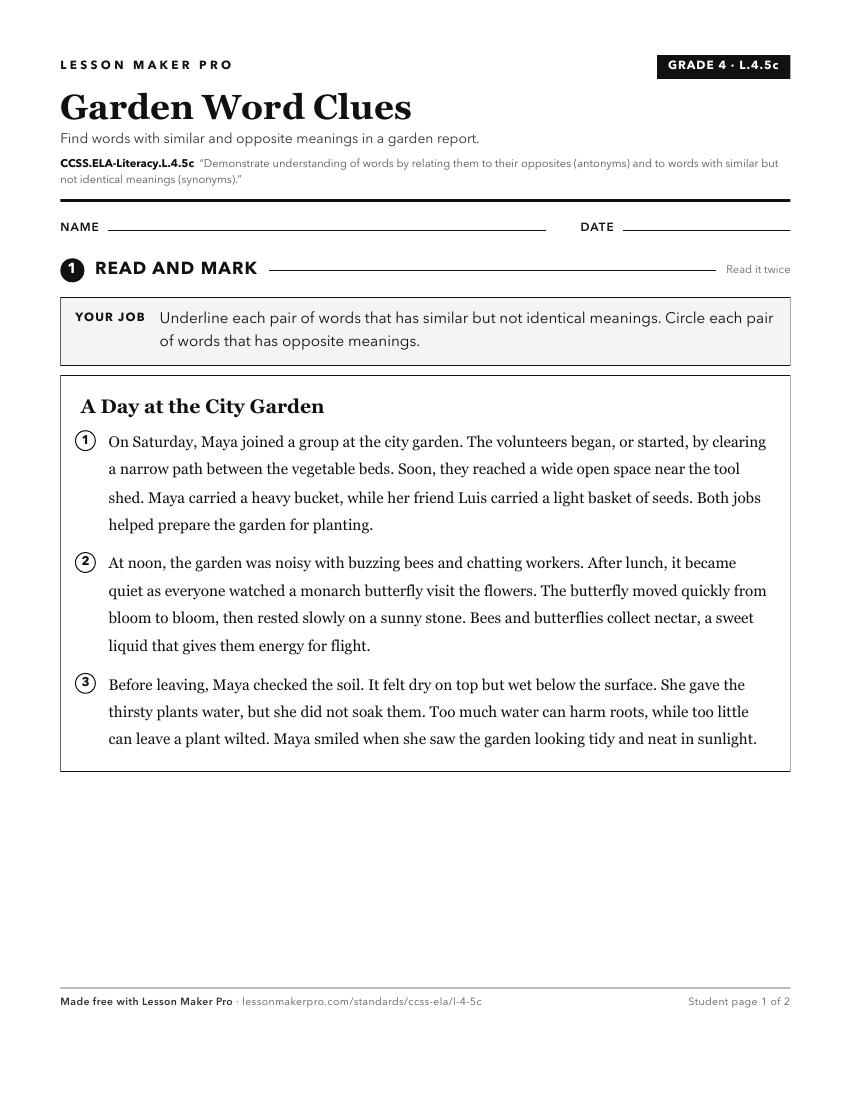
A ready-to-print activity worksheet aligned to CCSS.ELA-Literacy.L.4.5c, with an answer key for the teacher on its own page. No account needed.
PDF, US Letter, prints cleanly in black and white.
Download the worksheetLearning progression
Where This Standard Sits
Before This Standard
If students are struggling here, check these first.
What This Unlocks
Mastery here sets students up for these next.
Keep exploring
Related Standards
- CCSS.ELA-Literacy.L.2.5
Demonstrate understanding of word relationships and nuances in word meanings.
- CCSS.ELA-Literacy.L.K.5b
Demonstrate understanding of frequently occurring verbs and adjectives by relating them to their opposites (antonyms).
- CCSS.ELA-Literacy.L.7.5b
Use the relationship between particular words (e.g., synonym/antonym, analogy) to better understand each of the words.
Turn this exact standard into a lesson
Grade, subject, topic, and the complete standard are prefilled. Create one free, no account needed.
Also for this standard:Make a WorksheetMake a QuizMake a Sub Lesson