CCSS.
The Standard
Demonstrate understanding of frequently occurring verbs and adjectives by relating them to their opposites (antonyms).
Common Core State Standards for English Language Arts
Teacher's field guide
What This Standard Means
What Students Need to Do
- Students connect familiar action words and describing words with words that mean the opposite. They show the contrast through speech, movement, pictures, or objects.
What Mastery Looks Like
- Students can name a clear opposite for common words such as “sit,” “open,” “big,” and “happy.” They can use both words correctly in speech or pictures.
Common Misconceptions
- Students may give a different word instead of an opposite, such as pairing “run” with “walk.” They may also confuse action pairs with describing pairs.
How to Assess It
- Give students the words “hot,” “fast,” and “open.” Ask them to say each opposite and act out or explain one pair.
Lesson moves
Ways to Teach It
Give pairs picture cards showing actions or traits, then have students find and stand beside the classmate holding the opposite card.
Show two contrasting pictures and ask, “What opposite words describe what you see?”
Play Opposite Simon Says with commands such as stand, sit, move fast, move slowly, open hands, and close hands.
Take an opposite hunt around the room, finding examples such as lights on and off, full and empty, or open and closed.
Free download
Printable L.K.5b Worksheet
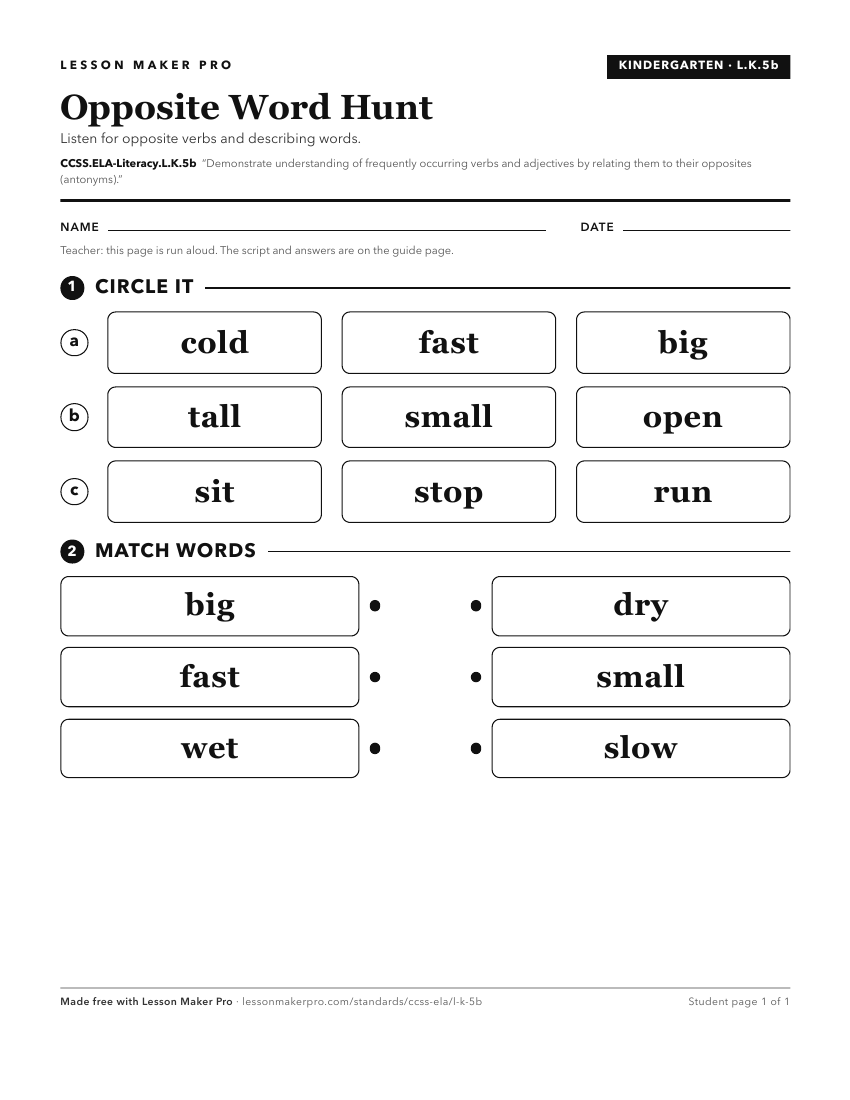
A ready-to-print activity worksheet aligned to CCSS.ELA-Literacy.L.K.5b, with an answer key for the teacher on its own page. No account needed.
PDF, US Letter, prints cleanly in black and white.
Download the worksheetLearning progression
Where This Standard Sits
What This Unlocks
Mastery here sets students up for these next.
Keep exploring
Related Standards
- CCSS.ELA-Literacy.L.2.5
Demonstrate understanding of word relationships and nuances in word meanings.
- CCSS.ELA-Literacy.L.5.5c
Use the relationship between particular words (e.g., synonyms, antonyms, homographs) to better understand each of the words.
- CCSS.ELA-Literacy.L.7.5b
Use the relationship between particular words (e.g., synonym/antonym, analogy) to better understand each of the words.
- CCSS.ELA-Literacy.L.4.5c
Demonstrate understanding of words by relating them to their opposites (antonyms) and to words with similar but not identical meanings (synonyms).
Turn this exact standard into a lesson
Grade, subject, topic, and the complete standard are prefilled. Create one free, no account needed.
Also for this standard:Make a WorksheetMake a QuizMake a Sub Lesson