CCSS.
The Standard
Use the relationship between particular words (e.g., synonym/antonym, analogy) to better understand each of the words.
Common Core State Standards for English Language Arts
Teacher's field guide
What This Standard Means
What Students Need to Do
- Students identify how words are connected through synonyms, antonyms, or analogies. They use that connection to work out meanings and explain differences between related words.
What Mastery Looks Like
- Students can infer an unfamiliar word’s meaning from a synonym, antonym, or analogy. They can name the relationship and explain how it supports their answer.
Common Misconceptions
- Students may treat synonyms as exact matches and ignore differences in tone or strength. They may match analogy words by topic instead of identifying the relationship between each pair.
How to Assess It
- Use this exit ticket: “Timid is to bold as reluctant is to eager.” Name the relationship, then explain what reluctant means.
Lesson moves
Ways to Teach It
Give pairs of word cards for students to sort under synonym, antonym, and analogy relationship labels, then require a reason for each placement.
Ask students to explain how slim, skinny, and slender are related, then write one sentence showing how their tones differ.
Play an analogy relay where teams complete word pairs, name each relationship, and earn a point only when their explanation is accurate.
Compare affordable and cheap in store advertisements, then discuss why a seller might choose one word over the other.
Free download
Printable L.7.5b Worksheet
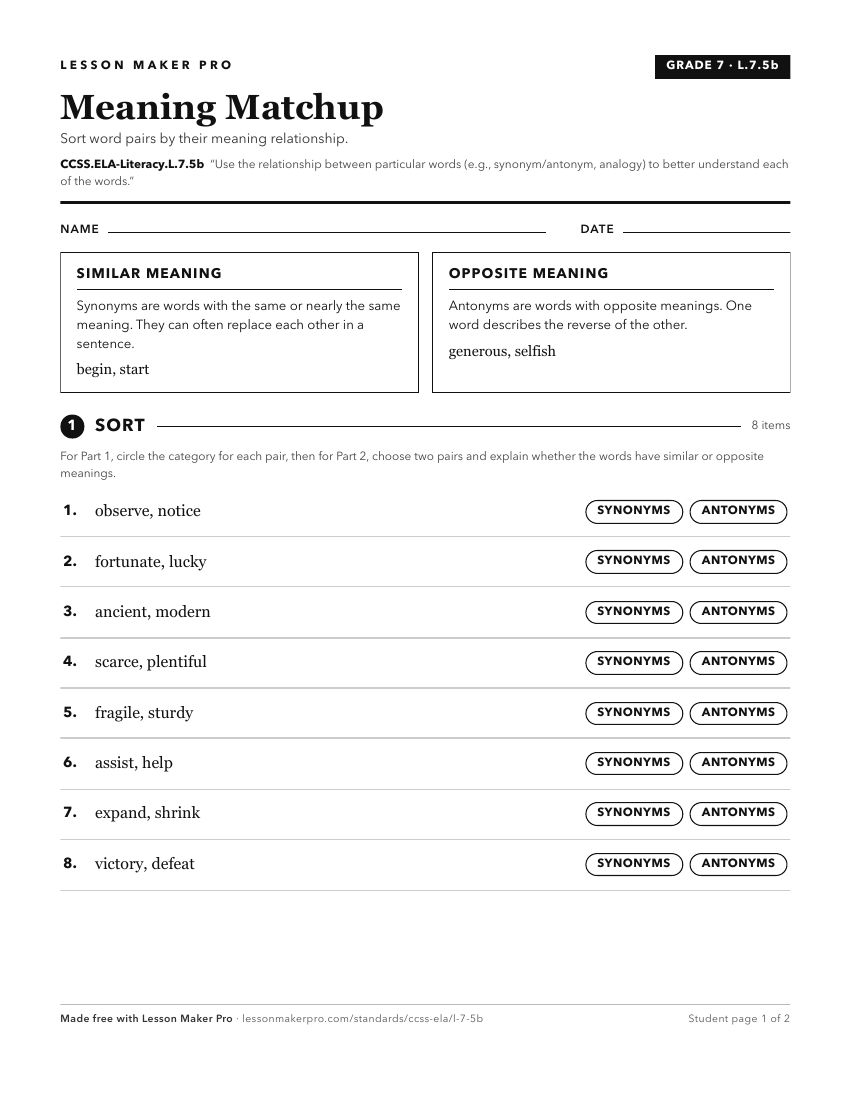
A ready-to-print activity worksheet aligned to CCSS.ELA-Literacy.L.7.5b, with an answer key for the teacher on its own page. No account needed.
PDF, US Letter, prints cleanly in black and white.
Download the worksheetLearning progression
Where This Standard Sits
Before This Standard
If students are struggling here, check these first.
What This Unlocks
Mastery here sets students up for these next.
Keep exploring
Related Standards
- CCSS.ELA-Literacy.L.5.5c
Use the relationship between particular words (e.g., synonyms, antonyms, homographs) to better understand each of the words.
- CCSS.ELA-Literacy.L.4.5c
Demonstrate understanding of words by relating them to their opposites (antonyms) and to words with similar but not identical meanings (synonyms).
Turn this exact standard into a lesson
Grade, subject, topic, and the complete standard are prefilled. Create one free, no account needed.
Also for this standard:Make a WorksheetMake a QuizMake a Sub Lesson