CCSS.
The Standard
Use the relationship between particular words (e.g., cause/effect, part/whole, item/category) to better understand each of the words.
Common Core State Standards for English Language Arts
Teacher's field guide
What This Standard Means
What Students Need to Do
- Students identify the specific connection between two words. They use that connection to figure out or clarify what one or both words mean.
What Mastery Looks Like
- Students correctly label connections such as cause and effect, part and whole, or item and category. They explain how the connection clarifies a word's meaning.
Common Misconceptions
- Students may treat any two words from the same sentence as related. They may also reverse cause and effect or confuse a part with an example of a category.
How to Assess It
- Give students drought/crop failure, wheel/bicycle, and robin/bird. Ask them to label each relationship and explain one word using its partner.
Lesson moves
Ways to Teach It
Give pairs word cards to match, then have students place each pair under cause and effect, part and whole, or item and category.
Ask students to write how knowing that a stamen is part of a flower helps explain the word stamen.
Run a team relay where students draw a word pair, name its relationship, and earn a point for a correct explanation.
Use a grocery flyer to sort named products into categories, then discuss how each category helps define unfamiliar product names.
Free download
Printable L.6.5b Worksheet
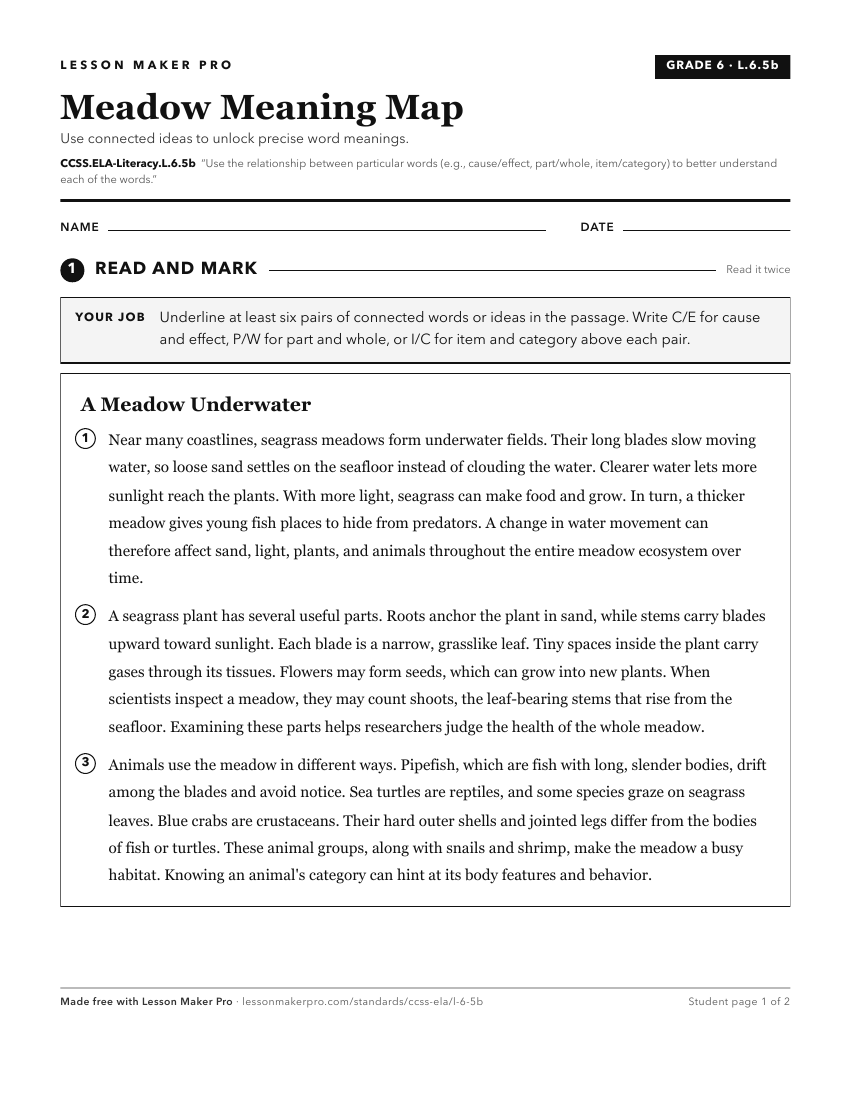
A ready-to-print activity worksheet aligned to CCSS.ELA-Literacy.L.6.5b, with an answer key for the teacher on its own page. No account needed.
PDF, US Letter, prints cleanly in black and white.
Download the worksheetLearning progression
Where This Standard Sits
What This Unlocks
Mastery here sets students up for these next.
Keep exploring
Related Standards
- CCSS.ELA-Literacy.L.5.5c
Use the relationship between particular words (e.g., synonyms, antonyms, homographs) to better understand each of the words.
- CCSS.ELA-Literacy.L.5.4a
Use context (e.g., cause/effect relationships and comparisons in text) as a clue to the meaning of a word or phrase.
- CCSS.ELA-Literacy.L.8.5b
Use the relationship between particular words to better understand each of the words.
Turn this exact standard into a lesson
Grade, subject, topic, and the complete standard are prefilled. Create one free, no account needed.
Also for this standard:Make a WorksheetMake a QuizMake a Sub Lesson