CCSS.
The Standard
- CCSS.ELA-Literacy.L.9-10.5
- Demonstrate understanding of figurative language, word relationships, and nuances in word meanings.
Analyze nuances in the meaning of words with similar denotations.
Common Core State Standards for English Language Arts
Teacher's field guide
What This Standard Means
What Students Need to Do
- Students compare near-synonyms and explain how their shades of meaning differ. They choose the word that best fits a sentence's tone, context, and purpose.
What Mastery Looks Like
- A student can distinguish words such as stubborn, persistent, and determined. They use context evidence to justify why one choice is more accurate or effective than another.
Common Misconceptions
- Students may treat synonyms as interchangeable because their dictionary definitions overlap. They may focus only on connotation and miss differences in intensity, formality, or implied attitude.
How to Assess It
- Exit ticket: In “Maya continued revising after three rejected drafts,” choose persistent, stubborn, or relentless, then explain what each option suggests.
Adopted as
This framework is adopted as written in Connecticut, Delaware, District of Columbia, Michigan, Nevada, New Hampshire, Vermont, Wyoming.
- California: L_9-10_5b
- Connecticut: CCSS.ELA-Literacy.L.9-10.5b
- Delaware: CC9-10L5b
- District of Columbia: CCSS.ELA-Literacy.L.9-10.5b
- Indiana: 9-10_RC_10
- Kentucky: L_9-10_5_b
- Maryland: L_9-10_5_b
- Michigan: CCSS.ELA-Literacy.L.9-10.5b
- Montana: CCSS.ELA-Literacy.L.9-10.5b
- Nevada: CCSS.ELA-Literacy.L.9-10.5b
- New Hampshire: CCSS.ELA-Literacy.L.9-10.5b
- New Mexico: CCSS.ELA-Literacy.L.9-10.5b
- New York: 9-10L5b
State teaching guidance: Use this component with the complete New York 9-10L5 requirement and its other components. A matching component does not establish equivalence of the entire national family. (NY component, p. 105.) New York State Next Generation English Language Arts Learning Standards (2017), page 105. Check shared national resources against this guidance before use.
- Vermont: CCSS.ELA-Literacy.L.9-10.5b
- Washington: CCSS.ELA-Literacy.L.9-10.5b
- Wyoming: CCSS.ELA-Literacy.L.9-10.5b
Lesson moves
Ways to Teach It
Have students sort word cards such as slim, skinny, and slender along scales for approval, intensity, and formality.
Ask students which verb, glanced, stared, or peered, best fits a suspicious character, then have them defend the choice in writing.
Play Synonym Swap: teams replace a highlighted word in a sentence, then earn a point for explaining the change in tone.
Compare three headlines about the same event and discuss how near-synonyms shape readers’ views of the people involved.
Free download
Printable L.9-10.5b Worksheet
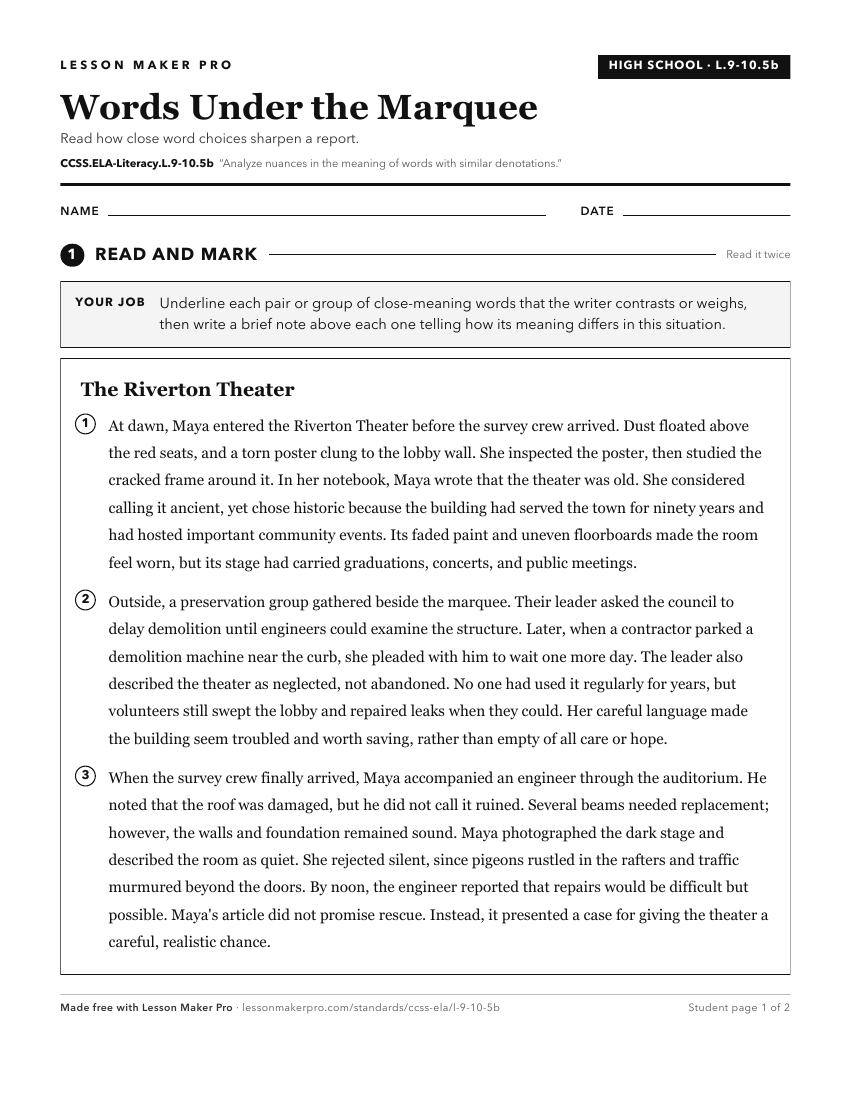
A ready-to-print activity worksheet aligned to CCSS.ELA-Literacy.L.9-10.5b, with an answer key for the teacher on its own page. No account needed.
PDF, US Letter, prints cleanly in black and white.
Download the worksheetLearning progression
Where This Standard Sits
Before This Standard
If students are struggling here, check these first.
What This Unlocks
Mastery here sets students up for these next.
Keep exploring
Related Standards
- CCSS.ELA-Literacy.L.2.5
Demonstrate understanding of word relationships and nuances in word meanings.
- CCSS.ELA-Literacy.L.7.5c
Distinguish among the connotations (associations) of words with similar denotations (definitions) (e.g., refined, respectful, polite, diplomatic, condescending)...
- CCSS.ELA-Literacy.RI.8.4
Determine the meaning of words and phrases as they are used in a text, including figurative, connotative, and technical meanings; analyze the impact of specific...
Turn this exact standard into a lesson
Grade, subject, topic, and the complete standard are prefilled. Create one free, no account needed.
Also for this standard:Make a WorksheetMake a QuizMake a Sub Lesson