CCSS.
The Standard
Distinguish shades of meaning among verbs differing in manner (e.g., look, peek, glance, stare, glare, scowl) and adjectives differing in intensity (e.g., large, gigantic) by defining or choosing them or by acting out the meanings.
Common Core State Standards for English Language Arts
Teacher's field guide
What This Standard Means
What Students Need to Do
- Students compare similar action words and explain how the actions differ. They order describing words by intensity and choose the best word for a situation.
What Mastery Looks Like
- Students can act out or explain related verbs so others can identify each one. They can arrange adjectives by intensity and explain why one is stronger.
Common Misconceptions
- Students may treat similar words, such as glance and stare, as interchangeable. They may assume the longest adjective is always the strongest.
How to Assess It
- Give an exit ticket: “Mia looked through a keyhole for one second. Circle peeked, glanced, or stared, then explain your choice.”
Lesson moves
Ways to Teach It
Give pairs cards labeled peek, glance, stare, and glare, then have one student act while the other names the verb.
Ask, “How are stomp and tiptoe different?” and have students write or draw a situation for each word.
Play an intensity ladder game by sorting adjective cards such as warm, hot, and scorching from weakest to strongest.
Observe classmates moving at recess, then choose exact verbs such as stroll, race, march, or dash to describe their actions.
Free download
Printable L.1.5d Worksheet
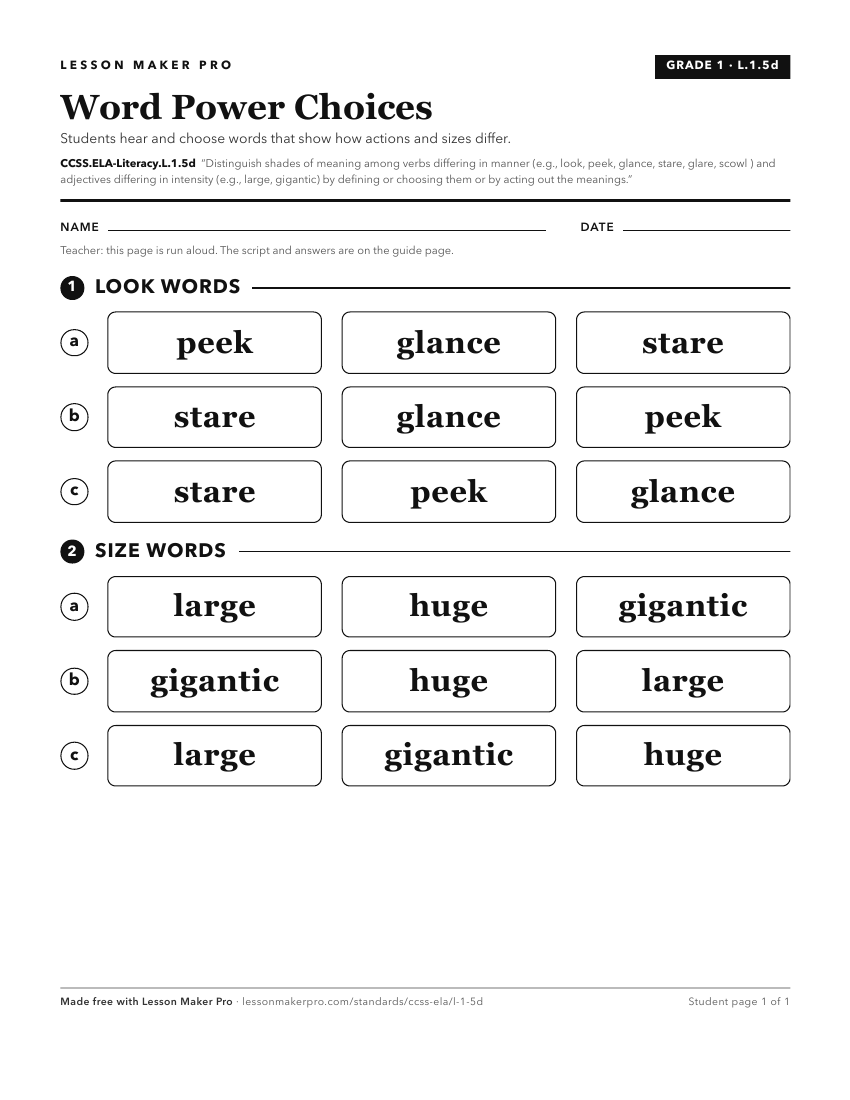
A ready-to-print activity worksheet aligned to CCSS.ELA-Literacy.L.1.5d, with an answer key for the teacher on its own page. No account needed.
PDF, US Letter, prints cleanly in black and white.
Download the worksheetLearning progression
Where This Standard Sits
Before This Standard
If students are struggling here, check these first.
Keep exploring
Related Standards
- CCSS.ELA-Literacy.L.2.5b
Distinguish shades of meaning among closely related verbs (e.g., toss, throw, hurl) and closely related adjectives (e.g., thin, slender, skinny, scrawny).
- CCSS.ELA-Literacy.L.3.5c
Distinguish shades of meaning among related words that describe states of mind or degrees of certainty (e.g., knew, believed, suspected, heard, wondered).
- CCSS.ELA-Literacy.L.K.5b
Demonstrate understanding of frequently occurring verbs and adjectives by relating them to their opposites (antonyms).
Turn this exact standard into a lesson
Grade, subject, topic, and the complete standard are prefilled. Create one free, no account needed.
Also for this standard:Make a WorksheetMake a QuizMake a Sub Lesson