CCSS.
The Standard
Distinguish shades of meaning among verbs describing the same general action (e.g., walk, march, strut, prance) by acting out the meanings.
Common Core State Standards for English Language Arts
Teacher's field guide
What This Standard Means
What Students Need to Do
- Students compare action words that name similar movements. They act out each word and describe how the movements differ in speed, force, manner, or feeling.
What Mastery Looks Like
- Given three related action words, students act out each one with clear differences. They can explain a difference using words such as quietly, heavily, quickly, or proudly.
Common Misconceptions
- Students may think similar action words mean exactly the same thing. They may change only their speed instead of also changing body position, force, or attitude.
How to Assess It
- Say, “Show me how you tiptoe, stomp, and march.” Ask each student to name one movement detail that makes each action different.
Lesson moves
Ways to Teach It
Set out action word cards, then have students pick one and use their whole body to show its exact meaning.
Ask, “How are nibble and gobble different?” Have partners act, discuss, and complete the sentence, “Gobble means to eat...”
Play action word charades with sets such as peek, stare, and glance, then let classmates identify the exact word.
Observe movement during recess or physical education, then name precise verbs such as dash, wander, crawl, or leap.
Free download
Printable L.K.5d Worksheet
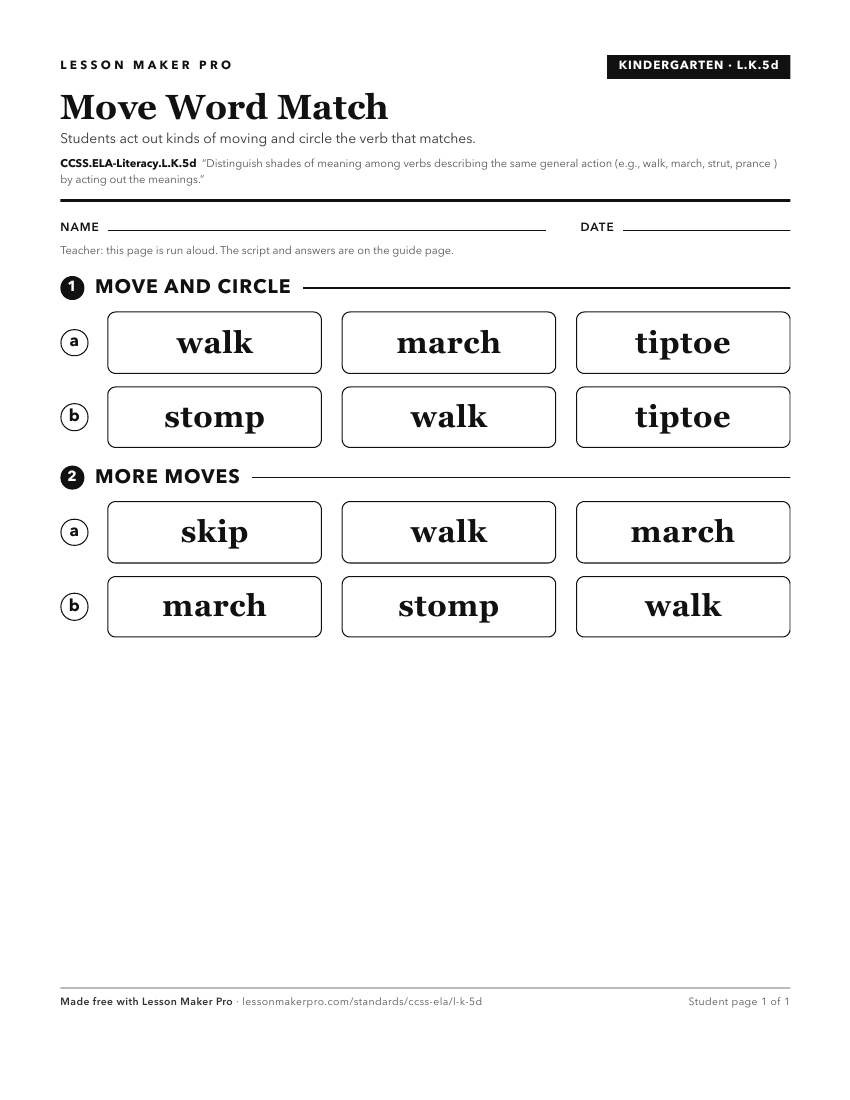
A ready-to-print activity worksheet aligned to CCSS.ELA-Literacy.L.K.5d, with an answer key for the teacher on its own page. No account needed.
PDF, US Letter, prints cleanly in black and white.
Download the worksheetLearning progression
Where This Standard Sits
What This Unlocks
Mastery here sets students up for these next.
Keep exploring
Related Standards
- CCSS.ELA-Literacy.L.3.5a
Distinguish the literal and nonliteral meanings of words and phrases in context (e.g., take steps).
- CCSS.ELA-Literacy.L.1.1e
Use verbs to convey a sense of past, present, and future (e.g., Yesterday I walked home; Today I walk home; Tomorrow I will walk home).
- CCSS.ELA-Literacy.L.2.5b
Distinguish shades of meaning among closely related verbs (e.g., toss, throw, hurl) and closely related adjectives (e.g., thin, slender, skinny, scrawny).
Turn this exact standard into a lesson
Grade, subject, topic, and the complete standard are prefilled. Create one free, no account needed.
Also for this standard:Make a WorksheetMake a QuizMake a Sub Lesson