CCSS.
The Standard
Distinguish the literal and nonliteral meanings of words and phrases in context (e.g., take steps).
Common Core State Standards for English Language Arts
Teacher's field guide
What This Standard Means
What Students Need to Do
- Students decide whether a word or phrase means exactly what it says or communicates a different idea. They use nearby words and events to explain the intended meaning.
What Mastery Looks Like
- Given “The test was a piece of cake,” a student identifies the phrase as nonliteral and explains that the test was easy. The student uses context to support the explanation.
Common Misconceptions
- Students may assume every unusual phrase is nonliteral. They may use the most familiar meaning of a word instead of checking the surrounding sentence.
How to Assess It
- Exit ticket: “After Ben spilled the beans about the surprise, Ana frowned.” Students label the phrase, explain its intended meaning, and underline a context clue.
Lesson moves
Ways to Teach It
Give pairs phrase cards and picture cards, then have them match literal and intended meanings and justify each match with sentence clues.
Read “My backpack weighs a ton,” then ask students to write what the speaker means and what the words say exactly.
Play Literal or Not: teams hold up L or N cards for context sentences and earn a point by explaining each phrase.
Examine a rainy weather report and the phrase “raining cats and dogs,” then compare the phrase with the actual weather shown.
Free download
Printable L.3.5a Worksheet
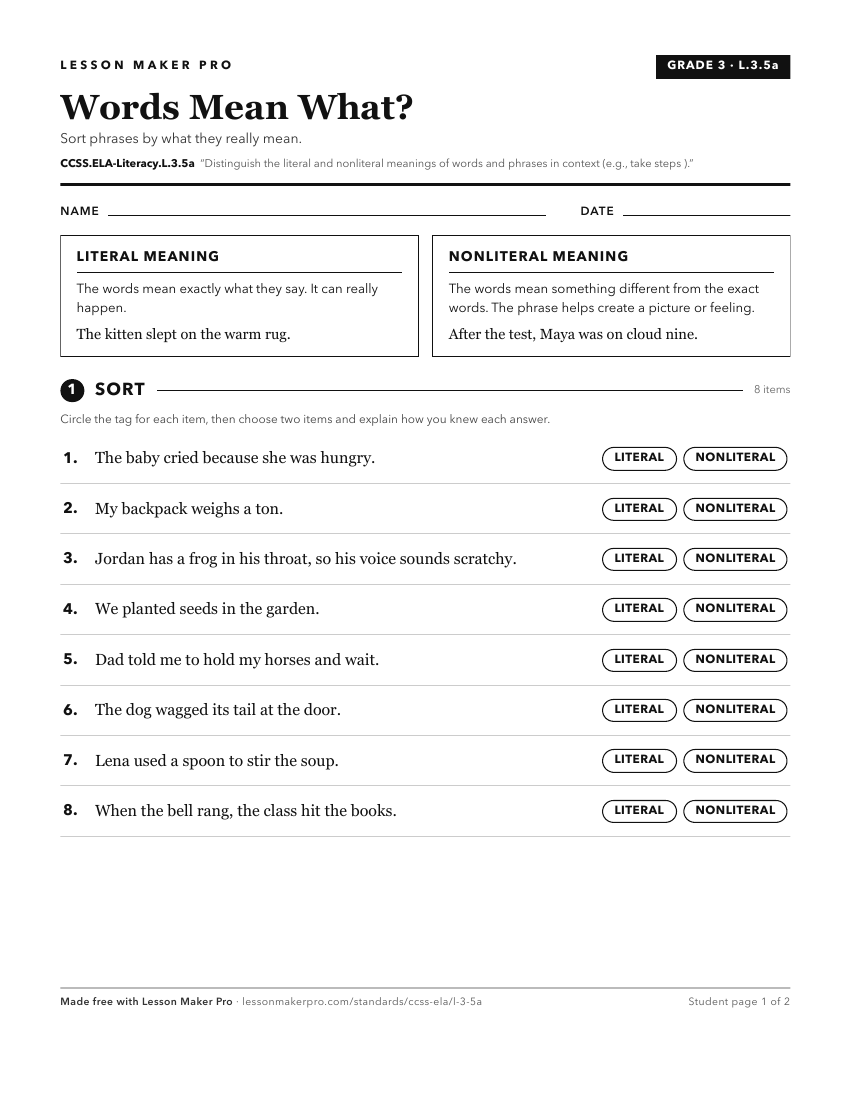
A ready-to-print activity worksheet aligned to CCSS.ELA-Literacy.L.3.5a, with an answer key for the teacher on its own page. No account needed.
PDF, US Letter, prints cleanly in black and white.
Download the worksheetLearning progression
Where This Standard Sits
Before This Standard
If students are struggling here, check these first.
What This Unlocks
Mastery here sets students up for these next.
Keep exploring
Related Standards
- CCSS.ELA-Literacy.L.6.5
Demonstrate understanding of figurative language, word relationships, and nuances in word meanings.
- CCSS.ELA-Literacy.L.4.5
Demonstrate understanding of figurative language, word relationships, and nuances in word meanings.
- CCSS.ELA-Literacy.RL.3.4
Determine the meaning of words and phrases as they are used in a text, distinguishing literal from nonliteral language.
- CCSS.ELA-Literacy.L.5.5
Demonstrate understanding of figurative language, word relationships, and nuances in word meanings.
Turn this exact standard into a lesson
Grade, subject, topic, and the complete standard are prefilled. Create one free, no account needed.
Also for this standard:Make a WorksheetMake a QuizMake a Sub Lesson