CCSS.
The Standard
Identify real-life connections between words and their use (e.g., describe foods that are spicy or juicy).
Common Core State Standards for English Language Arts
Teacher's field guide
What This Standard Means
What Students Need to Do
- Students connect new words to familiar objects, people, places, feelings, and events. They name an example and explain why the word fits that example.
What Mastery Looks Like
- Students give a clear real-life example for a word and explain how the example matches its meaning. They can also tell why a nonexample does not fit.
Common Misconceptions
- Students may repeat a definition without naming a real object, event, or experience. They may choose an example that is loosely related but does not show the word's exact meaning.
How to Assess It
- Give an exit ticket with the words enormous, slippery, and noisy. Students choose one word, name or draw an example, and explain why it fits.
Lesson moves
Ways to Teach It
Have students touch classroom objects and sort them under cards labeled rough, smooth, hard, and soft, then explain one choice.
Ask students to write about a time they felt nervous, proud, or relieved, then explain why that word fits.
Play adjective charades using words such as exhausted, cautious, and cheerful, with classmates naming a matching real-life situation.
Take a school photo walk and label pictured places, objects, or actions with words such as crowded, quiet, shiny, or narrow.
Free download
Printable L.2.5a Worksheet
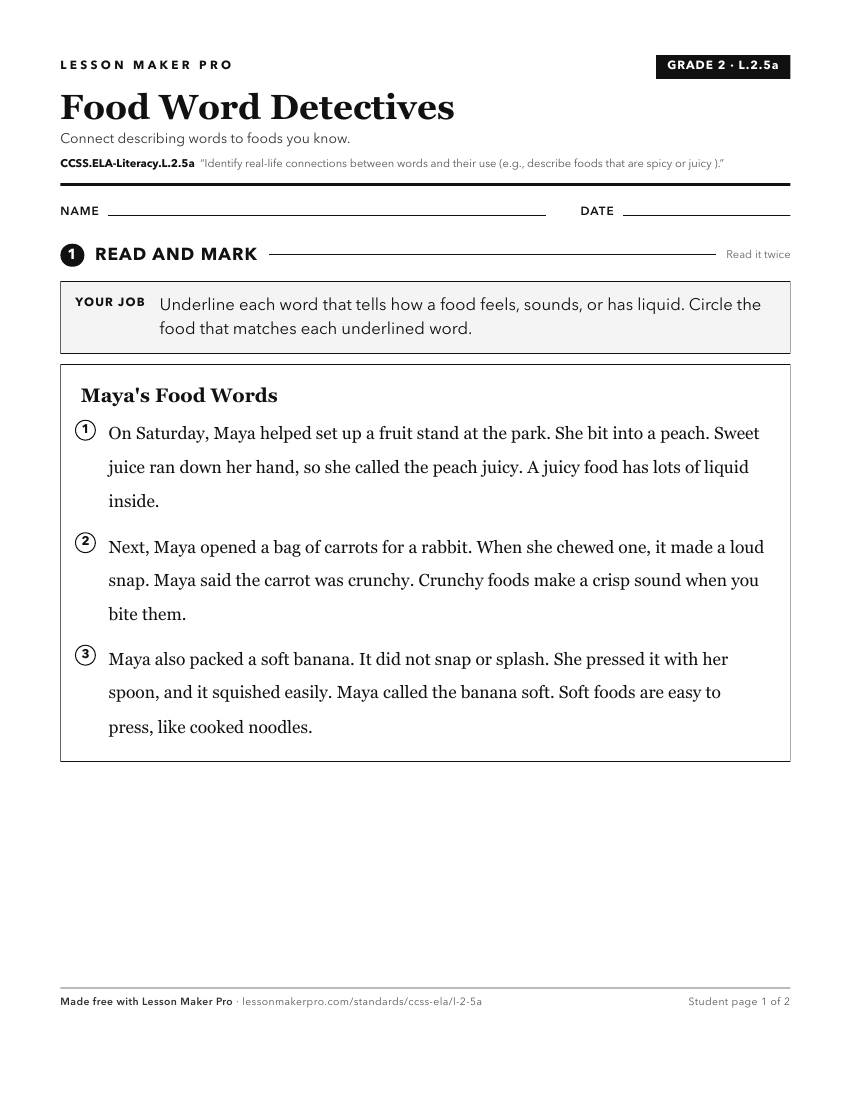
A ready-to-print activity worksheet aligned to CCSS.ELA-Literacy.L.2.5a, with an answer key for the teacher on its own page. No account needed.
PDF, US Letter, prints cleanly in black and white.
Download the worksheetLearning progression
Where This Standard Sits
Before This Standard
If students are struggling here, check these first.
What This Unlocks
Mastery here sets students up for these next.
Keep exploring
Related Standards
- CCSS.ELA-Literacy.L.3.5b
Identify real-life connections between words and their use (e.g., describe people who are friendly or helpful).
- CCSS.ELA-Literacy.L.K.5c
Identify real-life connections between words and their use (e.g., note places at school that are colorful).
- CCSS.ELA-Literacy.L.1.5c
Identify real-life connections between words and their use (e.g., note places at home that are cozy).
- CCSS.ELA-Literacy.L.8.5b
Use the relationship between particular words to better understand each of the words.
Turn this exact standard into a lesson
Grade, subject, topic, and the complete standard are prefilled. Create one free, no account needed.
Also for this standard:Make a WorksheetMake a QuizMake a Sub Lesson