CCSS.
The Standard
Ensure subject-verb and pronoun-antecedent agreement.
Common Core State Standards for English Language Arts
Teacher's field guide
What This Standard Means
What Students Need to Do
- Students make subjects and verbs agree in number. They also choose pronouns that match the nouns they replace.
What Mastery Looks Like
- Students correctly pair singular subjects with singular verbs and plural subjects with plural verbs. They choose pronouns that match the noun in number and revise agreement errors.
Common Misconceptions
- Students may match the verb to the nearest noun instead of the sentence subject. They may add s to plural verbs or pair a plural noun with a singular pronoun.
How to Assess It
- Exit ticket: Correct “The basket of apples sit nearby” and “The girls packed her lunches.” Explain each change.
Lesson moves
Ways to Teach It
Give pairs noun, verb, and pronoun cards, then have them build and read sentences with matching forms.
Ask students to explain what sounds wrong in “The puppies chases its tails,” then rewrite it in two correct ways.
Play Agreement Relay, where teams choose the correct verb or pronoun to complete sentence strips.
Have students edit a mock class newsletter for agreement errors before reading the corrected version aloud.
Free download
Printable L.3.1f Worksheet
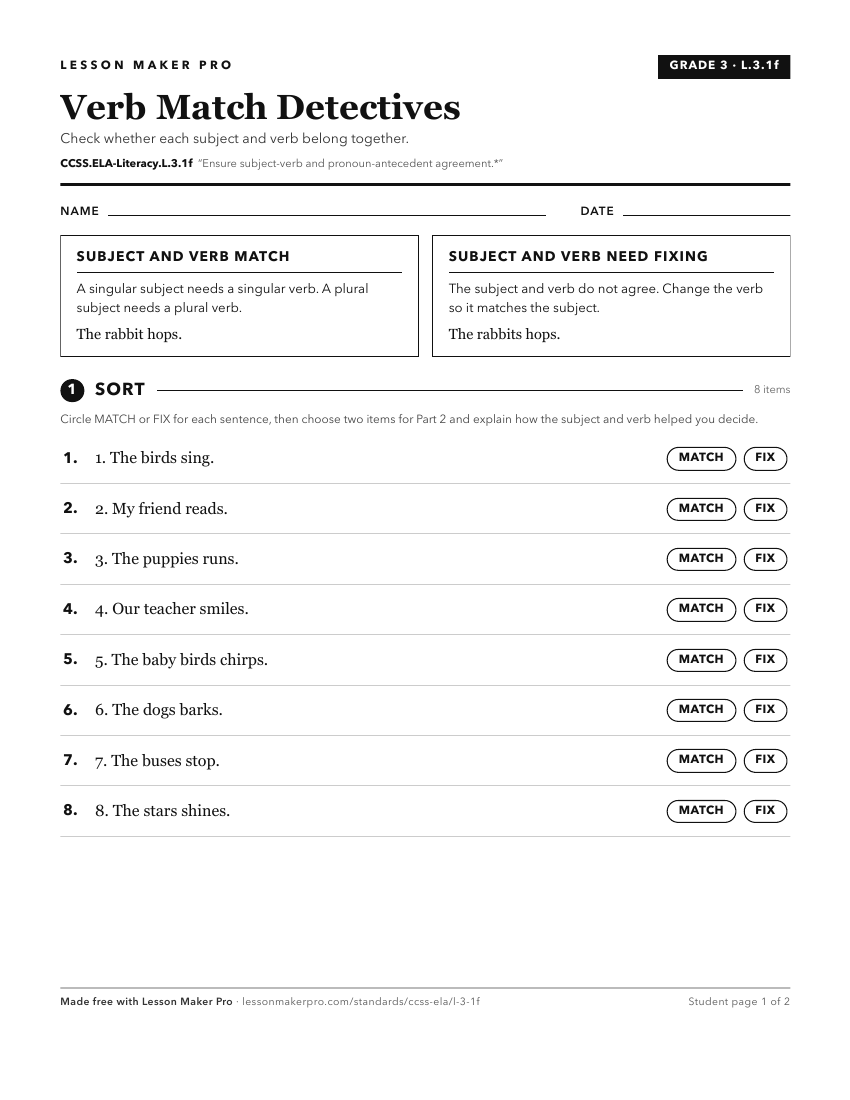
A ready-to-print activity worksheet aligned to CCSS.ELA-Literacy.L.3.1f, with an answer key for the teacher on its own page. No account needed.
PDF, US Letter, prints cleanly in black and white.
Download the worksheetLearning progression
Where This Standard Sits
Before This Standard
If students are struggling here, check these first.
Keep exploring
Related Standards
- CCSS.ELA-Literacy.L.6.1c
Recognize and correct inappropriate shifts in pronoun number and person.
- CCSS.ELA-Literacy.L.6.1a
Ensure that pronouns are in the proper case (subjective, objective, possessive).
- CCSS.ELA-Literacy.L.6.1d
Recognize and correct vague pronouns (i.e., ones with unclear or ambiguous antecedents).
- CCSS.ELA-Literacy.L.5.1d
Recognize and correct inappropriate shifts in verb tense.
Turn this exact standard into a lesson
Grade, subject, topic, and the complete standard are prefilled. Create one free, no account needed.
Also for this standard:Make a WorksheetMake a QuizMake a Sub Lesson