CCSS.
The Standard
Ensure that pronouns are in the proper case (subjective, objective, possessive).
Common Core State Standards for English Language Arts
Teacher's field guide
What This Standard Means
What Students Need to Do
- Students choose pronouns based on whether they act as the subject, receive the action, or show ownership. They apply the same choices in compound phrases and after prepositions.
What Mastery Looks Like
- Students select the correct pronoun based on its job in a sentence. They also use correct forms in compound phrases, such as “Maya and I” or “between Maya and me.”
Common Misconceptions
- Students often write “me and Jordan” as a subject or use “Jordan and I” after a preposition. They may add apostrophes to possessive pronouns, such as “her’s” or “their’s.”
How to Assess It
- Exit ticket: Correct and label the pronoun in each sentence: “Me and Ava finished,” “She spoke to Ava and I,” and “The folder is her’s.”
Lesson moves
Ways to Teach It
Give pairs pronoun cards to sort into subject, object, and possessive columns, then use each card in a sentence frame.
Ask students to explain why “Sam and I went” changes to “The teacher called Sam and me.”
Run a pronoun relay where teams replace underlined nouns with correct pronouns and earn a point for naming each pronoun’s job.
Have students edit a short email containing five pronoun errors, then rewrite it for a teacher or coach.
Free download
Printable L.6.1a Worksheet
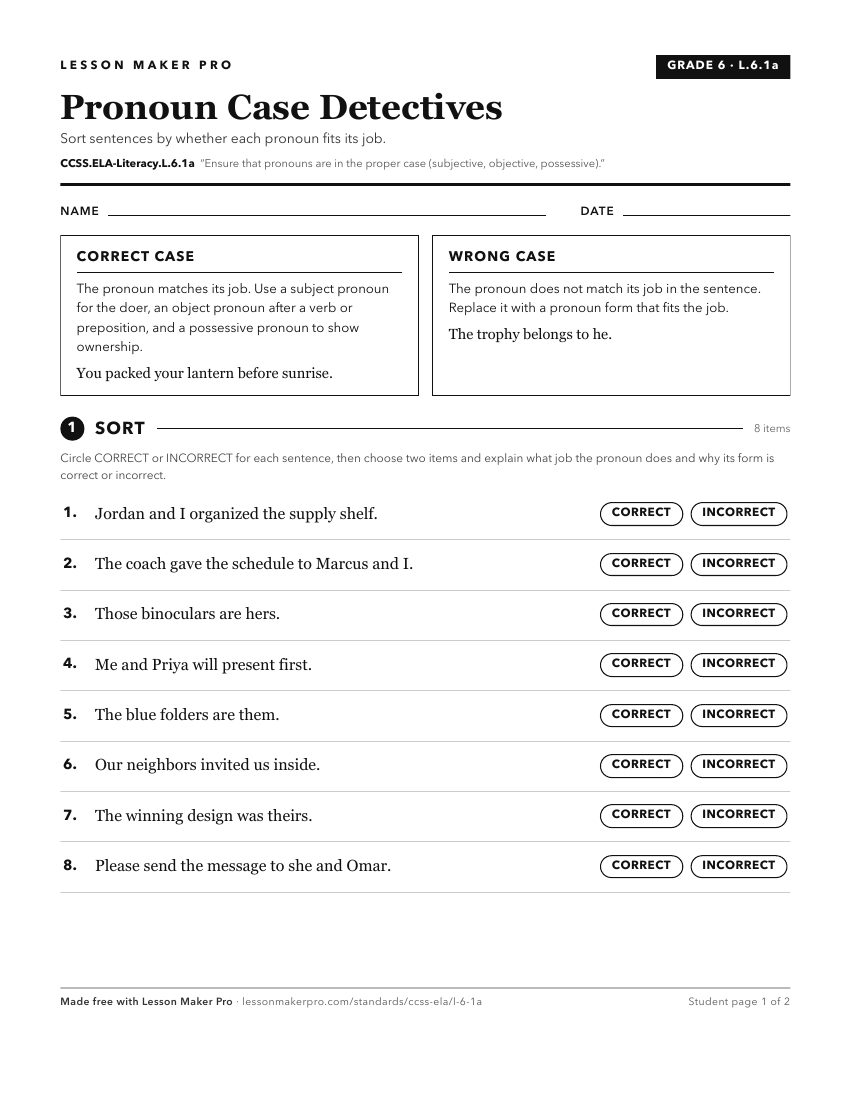
A ready-to-print activity worksheet aligned to CCSS.ELA-Literacy.L.6.1a, with an answer key for the teacher on its own page. No account needed.
PDF, US Letter, prints cleanly in black and white.
Download the worksheetLearning progression
Where This Standard Sits
Before This Standard
If students are struggling here, check these first.
Keep exploring
Related Standards
- CCSS.ELA-Literacy.L.6.1c
Recognize and correct inappropriate shifts in pronoun number and person.
- CCSS.ELA-Literacy.L.1.1d
Use personal, possessive, and indefinite pronouns (e.g., I, me, my; they, them, their; anyone, everything).
- CCSS.ELA-Literacy.L.6.1d
Recognize and correct vague pronouns (i.e., ones with unclear or ambiguous antecedents).
- CCSS.ELA-Literacy.L.3.1f
Ensure subject-verb and pronoun-antecedent agreement.
Turn this exact standard into a lesson
Grade, subject, topic, and the complete standard are prefilled. Create one free, no account needed.
Also for this standard:Make a WorksheetMake a QuizMake a Sub Lesson