CCSS.
The Standard
Recognize and correct inappropriate shifts in pronoun number and person.
Common Core State Standards for English Language Arts
Teacher's field guide
What This Standard Means
What Students Need to Do
- Students track who or what each pronoun refers to across sentences. They keep singular and plural forms consistent and avoid unplanned switches among first, second, and third person.
What Mastery Looks Like
- Students can identify the antecedent for each pronoun in a sentence or paragraph. They can correct inconsistent pronouns while keeping the original meaning and point of view.
Common Misconceptions
- Students may match a pronoun to the nearest noun instead of its actual antecedent. They may switch from “I” or “we” to “you” midparagraph. Some also treat every pronoun change as wrong, even when the antecedent changes.
How to Assess It
- Give students a four-sentence paragraph with one number shift and one person shift. Ask them to circle both errors and rewrite each sentence.
Lesson moves
Ways to Teach It
Give pairs sentence strips, colored pronoun cards, and antecedent cards, then have them replace mismatched pronouns and explain each repair.
Compare “When runners train, they build stamina” with “When runners train, you build stamina,” then discuss and rewrite for consistent point of view.
Run a pronoun repair relay where teams edit cards containing number or person shifts and earn points for accurate explanations.
Have students edit a school announcement that shifts among “we,” “you,” and “they,” then revise it for one clear audience.
Free download
Printable L.6.1c Worksheet
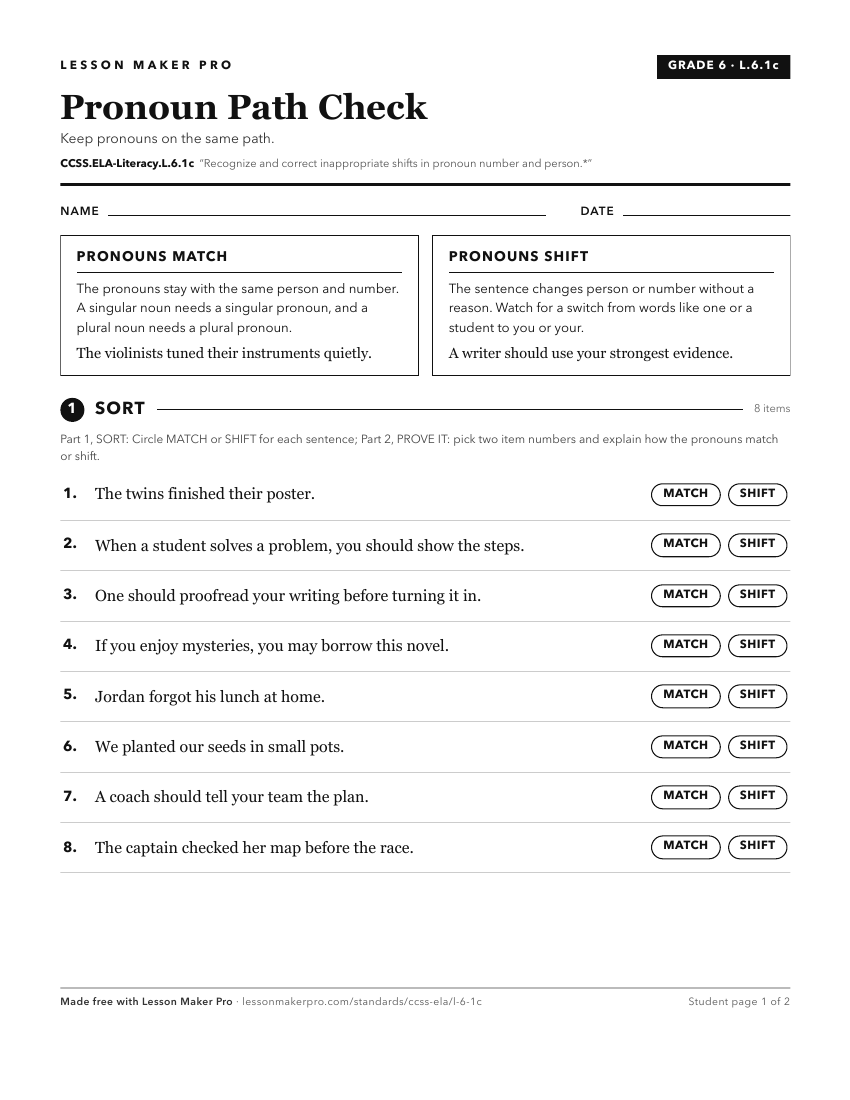
A ready-to-print activity worksheet aligned to CCSS.ELA-Literacy.L.6.1c, with an answer key for the teacher on its own page. No account needed.
PDF, US Letter, prints cleanly in black and white.
Download the worksheetKeep exploring
Related Standards
- CCSS.ELA-Literacy.L.6.1a
Ensure that pronouns are in the proper case (subjective, objective, possessive).
- CCSS.ELA-Literacy.L.6.1d
Recognize and correct vague pronouns (i.e., ones with unclear or ambiguous antecedents).
- CCSS.ELA-Literacy.L.8.1d
Recognize and correct inappropriate shifts in verb voice and mood.
- CCSS.ELA-Literacy.L.5.1d
Recognize and correct inappropriate shifts in verb tense.
Turn this exact standard into a lesson
Grade, subject, topic, and the complete standard are prefilled. Create one free, no account needed.
Also for this standard:Make a WorksheetMake a QuizMake a Sub Lesson