CCSS.
The Standard
Recognize and correct inappropriate shifts in verb tense.
Common Core State Standards for English Language Arts
Teacher's field guide
What This Standard Means
What Students Need to Do
- Students identify places where writing shifts between past, present, or future tense without a reason. They correct the verbs so the timeline stays clear and consistent.
What Mastery Looks Like
- Students keep verbs in a consistent tense when the time stays the same. They change tense only when the timing of events changes, and they can explain why.
Common Misconceptions
- Students may switch from past to present when retelling events, especially when the action becomes exciting. They may also change tense because a nearby verb looks different, even when the time has not changed.
How to Assess It
- Give students this exit ticket: “Yesterday, Maya walks to the park and found a lost dog.” Ask them to rewrite it and explain each verb change.
Lesson moves
Ways to Teach It
Give pairs verb cards and sentence strips, then have them replace any verb that causes an incorrect tense shift.
Ask students to revise a short paragraph that shifts tense, then explain why each corrected verb fits the timeline.
Play Tense Detective by hiding five incorrect tense shifts in a passage and awarding points for accurate corrections and explanations.
Use a short news report, recipe story, or sports recap and identify how consistent verb tense keeps the event sequence clear.
Free download
Printable L.5.1d Worksheet
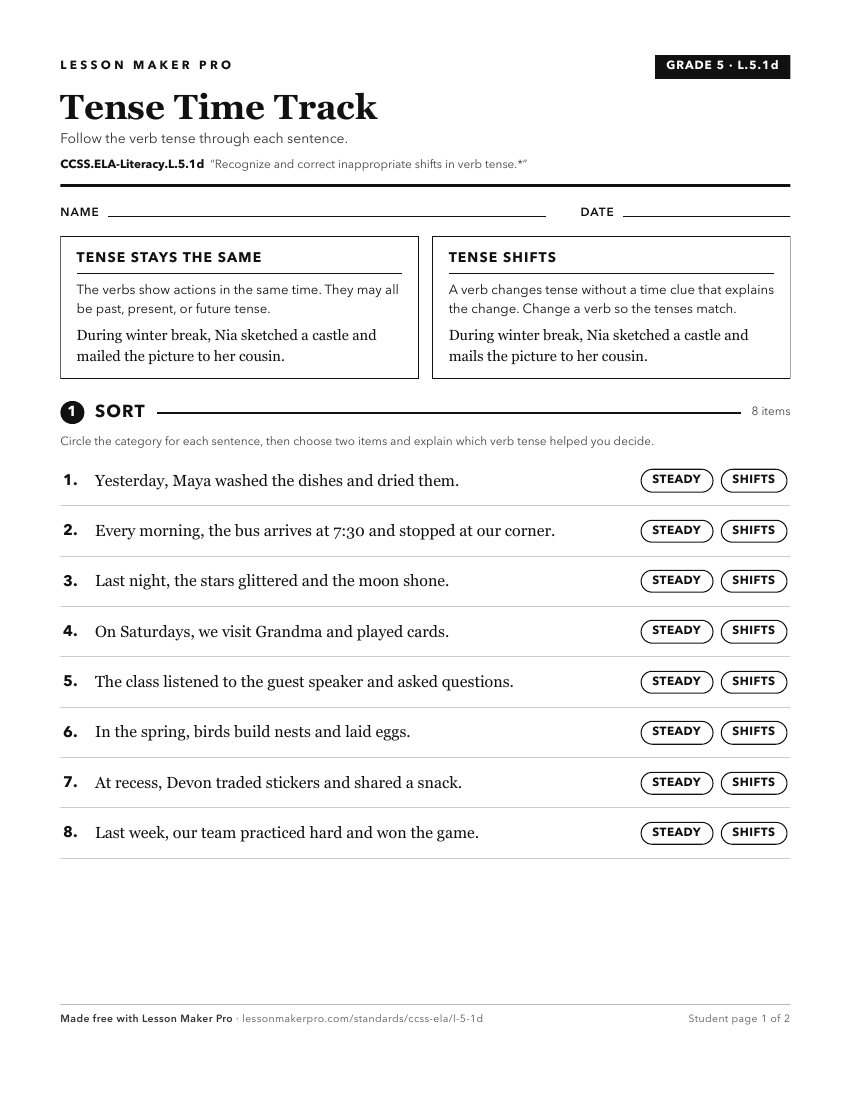
A ready-to-print activity worksheet aligned to CCSS.ELA-Literacy.L.5.1d, with an answer key for the teacher on its own page. No account needed.
PDF, US Letter, prints cleanly in black and white.
Download the worksheetKeep exploring
Related Standards
- CCSS.ELA-Literacy.L.6.1c
Recognize and correct inappropriate shifts in pronoun number and person.
- CCSS.ELA-Literacy.L.5.1c
Use verb tense to convey various times, sequences, states, and conditions.
- CCSS.ELA-Literacy.L.6.1d
Recognize and correct vague pronouns (i.e., ones with unclear or ambiguous antecedents).
- CCSS.ELA-Literacy.L.8.1d
Recognize and correct inappropriate shifts in verb voice and mood.
Turn this exact standard into a lesson
Grade, subject, topic, and the complete standard are prefilled. Create one free, no account needed.
Also for this standard:Make a WorksheetMake a QuizMake a Sub Lesson