Alabama Social Studies SS24.WH.4
Standard Cluster
Explain how changes associated with the Industrial Revolution affected the economies, societies, and politics of Europe. 4a Describe the technological inventions and labor conditions that characterized the Industrial Revolution in Europe. 4b Compare the theories of capitalism, utilitarianism, socialism, and Marxism, including the philosophies of John Stuart Mill, Karl Marx, and Robert Owen. 4c Describe the effects of urbanization on Europe during the nineteenth century, including the evolution of the middle and working classes.
2024 Alabama Course of Study: Social Studies
Cluster contents
Standards in This Cluster
SS24.WH.4 is a cluster heading. These are the individual standards under it.
- SS24.WH.4a
Describe the technological inventions and labor conditions that characterized the Industrial Revolution in Europe.
- SS24.WH.4b
Compare the theories of capitalism, utilitarianism, socialism, and Marxism, including the philosophies of John Stuart Mill, Karl Marx, and Robert Owen.
- SS24.WH.4c
Describe the effects of urbanization on Europe during the nineteenth century, including the evolution of the middle and working classes.
Teacher's field guide
What This Cluster Means
What Students Need to Do
- Students explain how steam power and textile machines changed production, factory jobs, and city life. They connect long shifts and crowded housing to the growth of the middle and working classes and calls for reform. They compare capitalism, Mill's utilitarianism, Owen's socialism, and Marx's ideas about class conflict.
What Mastery Looks Like
- Given a factory scene, a student can explain how a machine raised output and name a working condition. They can explain how city growth affected workers and the middle class differently. They can match private ownership, the greatest good, cooperative communities, and class struggle to the right ideas and thinkers.
Common Misconceptions
- Students may think machines ended factory jobs rather than changing the work people did. They may treat Owen's cooperative communities, Mill's greatest-good principle, and Marx's class struggle as the same idea. They may assume city growth helped every family equally, missing crowded worker housing and middle-class gains.
How to Assess It
- Exit ticket: A steam-powered textile mill opens in a city. Explain one change to work or housing, then match private ownership, the greatest good, cooperative communities, and class struggle to capitalism, Mill, Owen, and Marx.
Lesson moves
Ways to Teach It
Run a paper-shirt assembly line: one group draws, cuts, and labels whole shirts; another splits the jobs, then compare output and pace.
Ask: Who should set factory hours, owners, lawmakers, or workers? Have students defend an answer using Mill, Owen, or Marx.
Set four corners as capitalism, utilitarianism, Owen's socialism, and Marxism; read short claims, then have students move and explain their choice.
Compare a photo of crowded nineteenth-century housing with a local apartment listing; ask how jobs, rent, and space shape where families live.
Free download
Printable SS24.WH.4 Worksheet
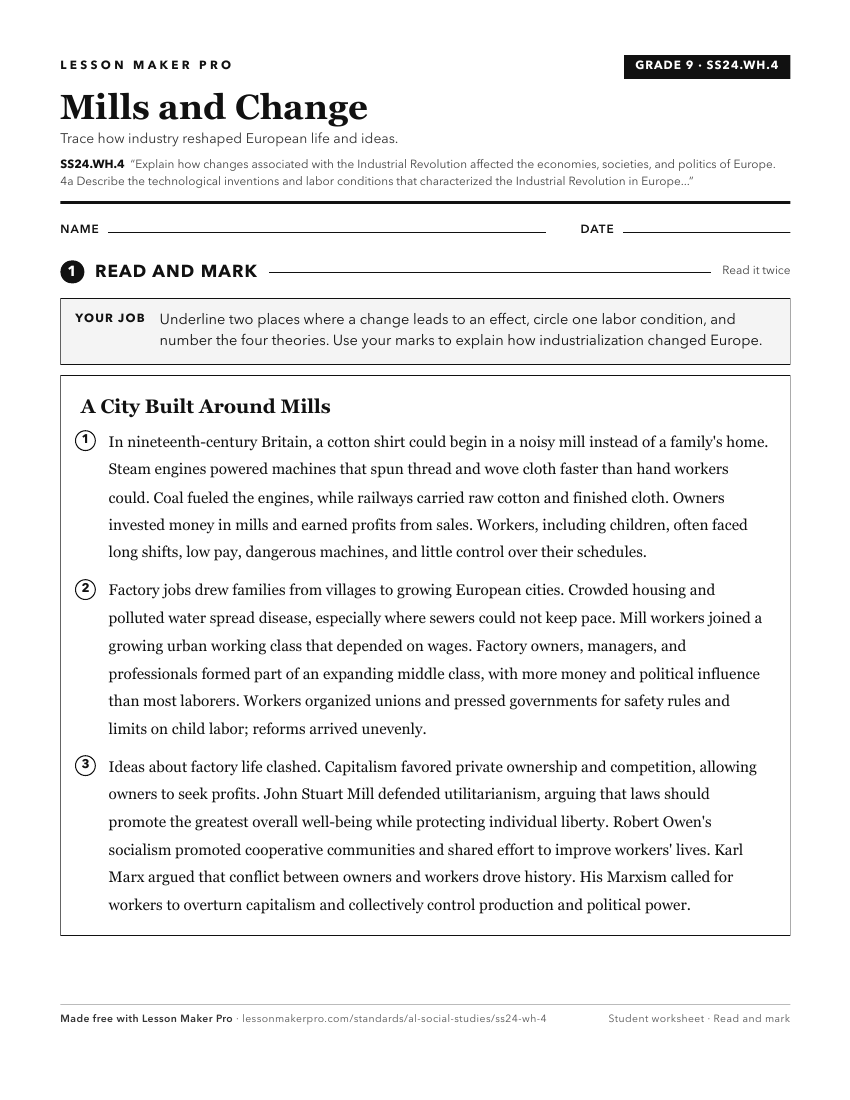
A ready-to-print activity worksheet aligned to SS24.WH.4, with an answer key for the teacher on its own page. No account needed.
PDF, US Letter, prints cleanly in black and white.
Download the worksheetKeep exploring
Related Standards
Turn this cluster into a lesson
Grade, subject, topic, and the complete cluster are prefilled. Create one free, no account needed.
Also for this cluster:Make a WorksheetMake a QuizMake a Sub Lesson