Alabama Social Studies SS24.WH.13a
The Standard
- SS24.WH.13
- Explain the origins of the Cold War as they relate to the economic, global, political, and social consequences of World War II.
Identify major international organizations and the spheres of influence that developed as the result of World War II and the emergence of Cold War hostilities, including North Atlantic Treaty Organization (NATO), United Nations (UN), and Warsaw Pact.
2024 Alabama Course of Study: Social Studies
Teacher's field guide
What This Standard Means
What Students Need to Do
- Students identify the UN, NATO, and the Warsaw Pact and describe what each group did. They use a map to locate areas of U.S. and Soviet influence after World War II.
What Mastery Looks Like
- Given a 1960 map, a student identifies Britain and France as NATO members and Poland and the Soviet Union as Warsaw Pact members. They explain that the UN included countries from both sides and was not a military alliance.
Common Misconceptions
- Students may mistake the UN for a Western military alliance. They may put Poland in NATO or assume every European country joined one of the two alliances.
How to Assess It
- Exit ticket: Sort Britain, France, Poland, and the Soviet Union under NATO or Warsaw Pact. Then explain why the UN does not belong under either heading.
Lesson moves
Ways to Teach It
Hand out a 1960 Europe map; students color Britain and France for NATO, and Poland and the Soviet Union for the Warsaw Pact.
Ask, "How could the United States and Soviet Union both join the UN but lead opposing military alliances?" Have students write two sentences.
Run a card sort with country and purpose cards; students place duplicate country cards under both the UN and an alliance when needed.
Show today's UN and NATO membership lists; students find one country in both and explain why the Warsaw Pact is missing.
Free download
Printable SS24.WH.13a Worksheet
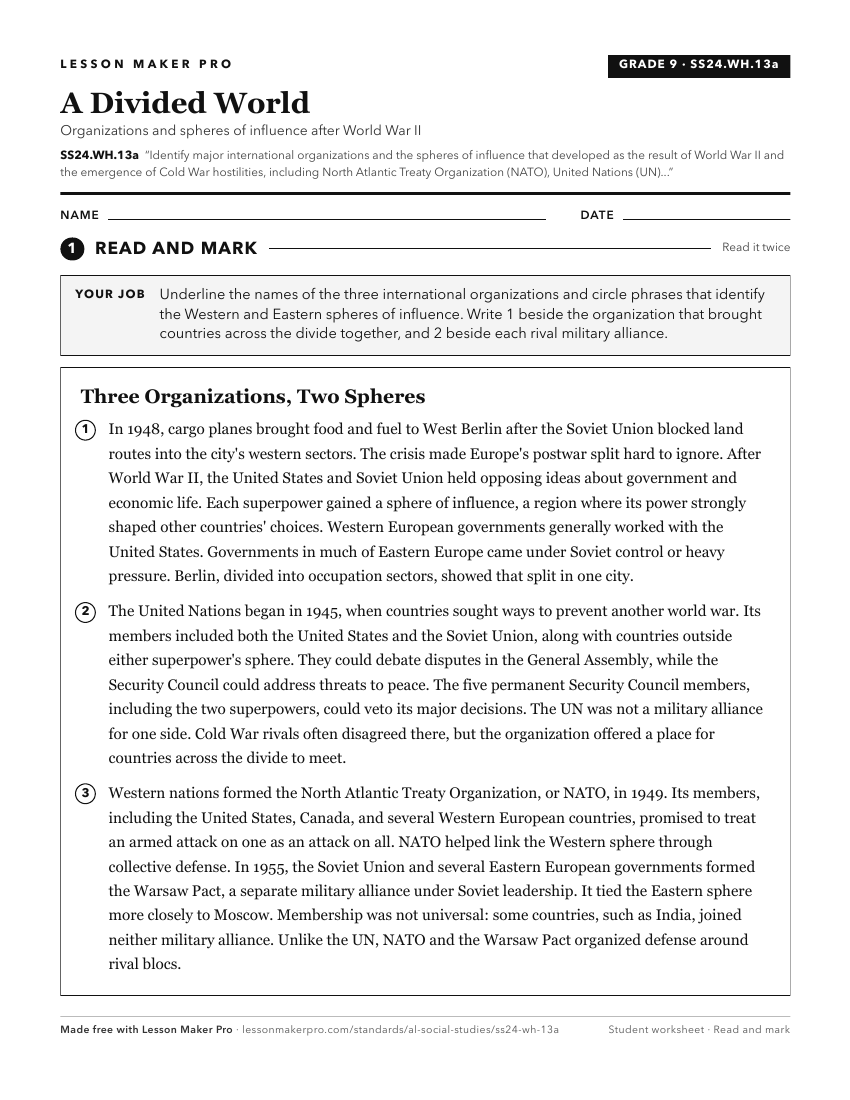
A ready-to-print activity worksheet aligned to SS24.WH.13a, with an answer key for the teacher on its own page. No account needed.
PDF, US Letter, prints cleanly in black and white.
Download the worksheetKeep exploring
Related Standards
- SS24.WH.10
Evaluate the economic, global, political, and social consequences of World War II.
- SS24.WH.14b
Analyze how economic aid expanded spheres of influence, including the Marshall Plan and Council for Mutual Economic Assistance (COMECON).
- SS24.US2.7e
Explain how key consequences of World War II shaped United States foreign policy after the war.
- SS24.WH.13
Explain the origins of the Cold War as they relate to the economic, global, political, and social consequences of World War II.
Turn this exact standard into a lesson
Grade, subject, topic, and the complete standard are prefilled. Create one free, no account needed.
Also for this standard:Make a WorksheetMake a QuizMake a Sub Lesson