Alabama Social Studies SS24.USG.5
Standard Cluster
Analyze how the functions and authority of the executive branch evolve through changes in the scope of presidential powers, executive orders, executive agreements, and the role of the president in foreign and domestic policy. 5a Describe how the president of the United States utilizes formal powers to achieve policy goals, including veto power, addressing the nation in the State of the Union Address, and the authority to pardon. 5b Describe how the president of the United States uses informal powers to shape public opinion, including interaction with media and the public, head of party, and symbolic powers of the Oval Office. 5c Explain the role of the Cabinet and White House staff in the process of presidential decision-making. 5d Compare and contrast the structures of the federal bureaucracy, including cabinet departments, independent regulatory commissions, government corporations, and independent executive agencies.
2024 Alabama Course of Study: Social Studies
Cluster contents
Standards in This Cluster
SS24.USG.5 is a cluster heading. These are the individual standards under it.
- SS24.USG.5a
Describe how the president of the United States utilizes formal powers to achieve policy goals, including veto power, addressing the nation in the State of the ...
- SS24.USG.5b
Describe how the president of the United States uses informal powers to shape public opinion, including interaction with media and the public, head of party, an...
- SS24.USG.5c
Explain the role of the Cabinet and White House staff in the process of presidential decision-making.
- SS24.USG.5d
Compare and contrast the structures of the federal bureaucracy, including cabinet departments, independent regulatory commissions, government corporations, and ...
Teacher's field guide
What This Cluster Means
What Students Need to Do
- Students explain how presidents use vetoes, pardons, speeches, executive orders, and executive agreements to pursue policy goals. They track how presidents have used these powers over time and where Congress or courts can limit them. They explain how Cabinet advisers, White House staff, and federal agencies help make and carry out decisions.
What Mastery Looks Like
- Given a policy problem, students can choose a presidential action and explain what it can and cannot do. They can distinguish Cabinet advice from White House staff work and sort the State Department, FCC, TVA, and NASA by agency type. They can compare two presidents' actions and describe how the use of presidential power changed.
Common Misconceptions
- Students may think an executive order creates a law that Congress cannot change. They often confuse executive agreements with treaties and assume Cabinet secretaries and White House staff do the same work. Some think a presidential pardon can erase a state conviction or that every federal agency is a Cabinet department.
How to Assess It
- Exit ticket: A president wants federal agencies to change hiring rules without a new law. Explain what an executive order can direct, name one limit on it, and identify who helps carry it out.
Lesson moves
Ways to Teach It
Hand pairs agency and job cards for the State Department, FCC, TVA, and NASA; have them match jobs and sort agency types.
Ask: After Congress passes a bill the president opposes, what can a veto do that an Oval Office speech cannot?
Role-play a wildfire executive agreement with Canada: the secretary of state negotiates terms, and the chief of staff coordinates advice.
Show Executive Orders 9066 and 9981 from the National Archives; students mark each directive and compare their effects on civil rights.
Free download
Printable SS24.USG.5 Worksheet
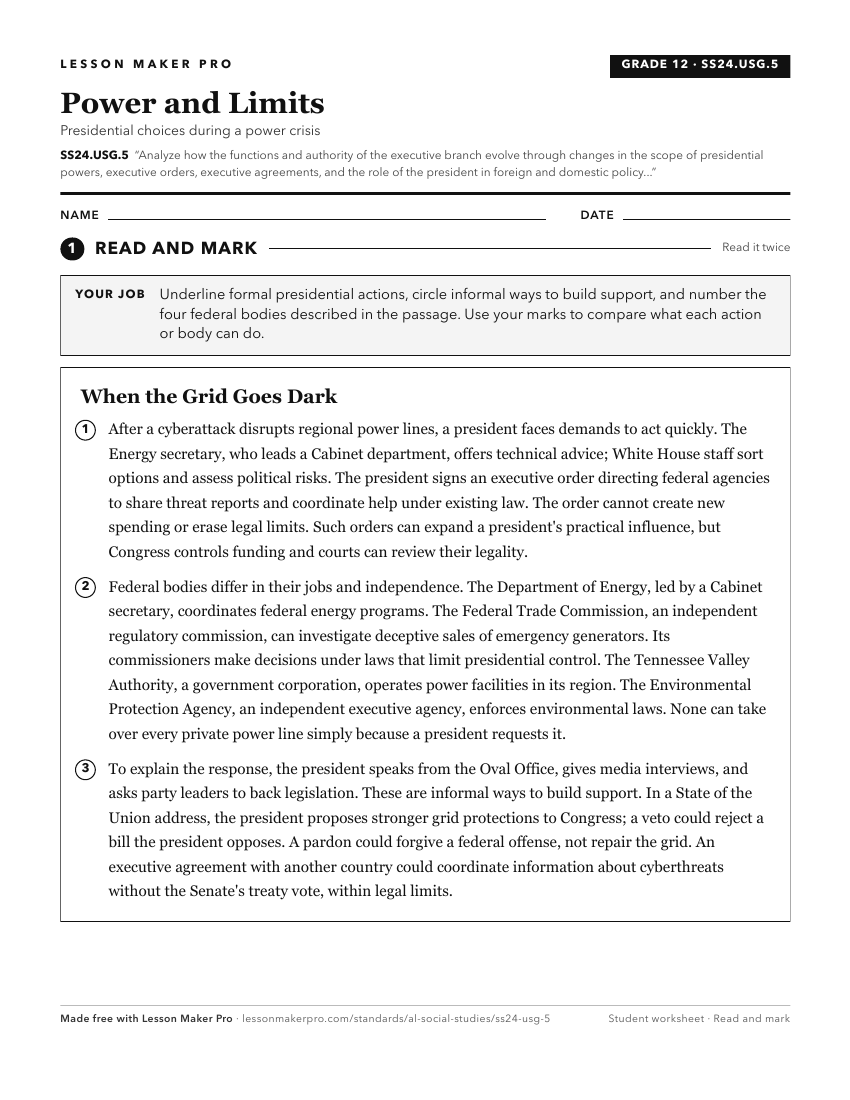
A ready-to-print activity worksheet aligned to SS24.USG.5, with an answer key for the teacher on its own page. No account needed.
PDF, US Letter, prints cleanly in black and white.
Download the worksheetKeep exploring
Related Standards
- SS24.US2.18
Analyze the shifts in United States foreign policy and challenges to it after the Cold War and into the twenty-first century.
- SS24.CWI.4
Compare and contrast the functions and powers of United States government entities which shape official responses to international issues and events.
- SS24.6.16
Compare duties and functions of the legislative, executive, and judicial branches at various levels of government.
Turn this cluster into a lesson
Grade, subject, topic, and the complete cluster are prefilled. Create one free, no account needed.
Also for this cluster:Make a WorksheetMake a QuizMake a Sub Lesson