Alabama Social Studies SS24.USG.3
Standard Cluster
Analyze the major features and structural organization of the Constitution of the United States and the Bill of Rights. 3a Summarize and explain the underlying principles of the Constitution, including checks and balances, federalism, limited government, popular sovereignty, republicanism, and separation of powers. 3b Summarize the formal process of amending the Constitution of the United States. 3c Explain how the Fourteenth Amendment extended rights to minority groups through the Due Process and Equal Protection Clauses.
2024 Alabama Course of Study: Social Studies
Cluster contents
Standards in This Cluster
SS24.USG.3 is a cluster heading. These are the individual standards under it.
- SS24.USG.3a
Summarize and explain the underlying principles of the Constitution, including checks and balances, federalism, limited government, popular sovereignty, republi...
- SS24.USG.3b
Summarize the formal process of amending the Constitution of the United States.
- SS24.USG.3c
Explain how the Fourteenth Amendment extended rights to minority groups through the Due Process and Equal Protection Clauses.
Teacher's field guide
What This Cluster Means
What Students Need to Do
- Students map the Preamble, articles, and amendments, including the Bill of Rights. They explain separation of powers, checks and balances, federalism, limited government, popular sovereignty, and republicanism using government decisions. They outline how amendments pass and how the Fourteenth Amendment limits unfair state actions.
What Mastery Looks Like
- A student can identify which branch acts, which branch can check it, and whether a power belongs to states or the federal government. They can give both amendment proposal routes and both ratification routes, with the required fractions. They can explain how due process applied many rights against states and how equal protection challenges racial discrimination by state governments.
Common Misconceptions
- Students mix up checks and balances with separation of powers, or think states always outrank Congress. They may think the president signs constitutional amendments or that a simple majority of states can ratify one. Some think the Bill of Rights applied directly to states from the start, or treat due process and equal protection as the same protection.
How to Assess It
- Exit ticket: Congress approves a proposed amendment with a simple majority in each house, then 30 states ratify it. Explain why it fails and give the correct thresholds.
Lesson moves
Ways to Teach It
Give pairs printed copies of the Constitution; have them mark the Preamble, branch articles, and Bill of Rights with three colors.
Ask: If Congress passes a law and the president vetoes it, how do separation of powers and checks and balances differ?
Run an amendment relay: teams sort cards showing proposal routes, ratification routes, and required fractions, then correct one planted mistake.
Read a paragraph from Brown v. Board of Education; ask how equal protection limits a state-run school district.
Free download
Printable SS24.USG.3 Worksheet
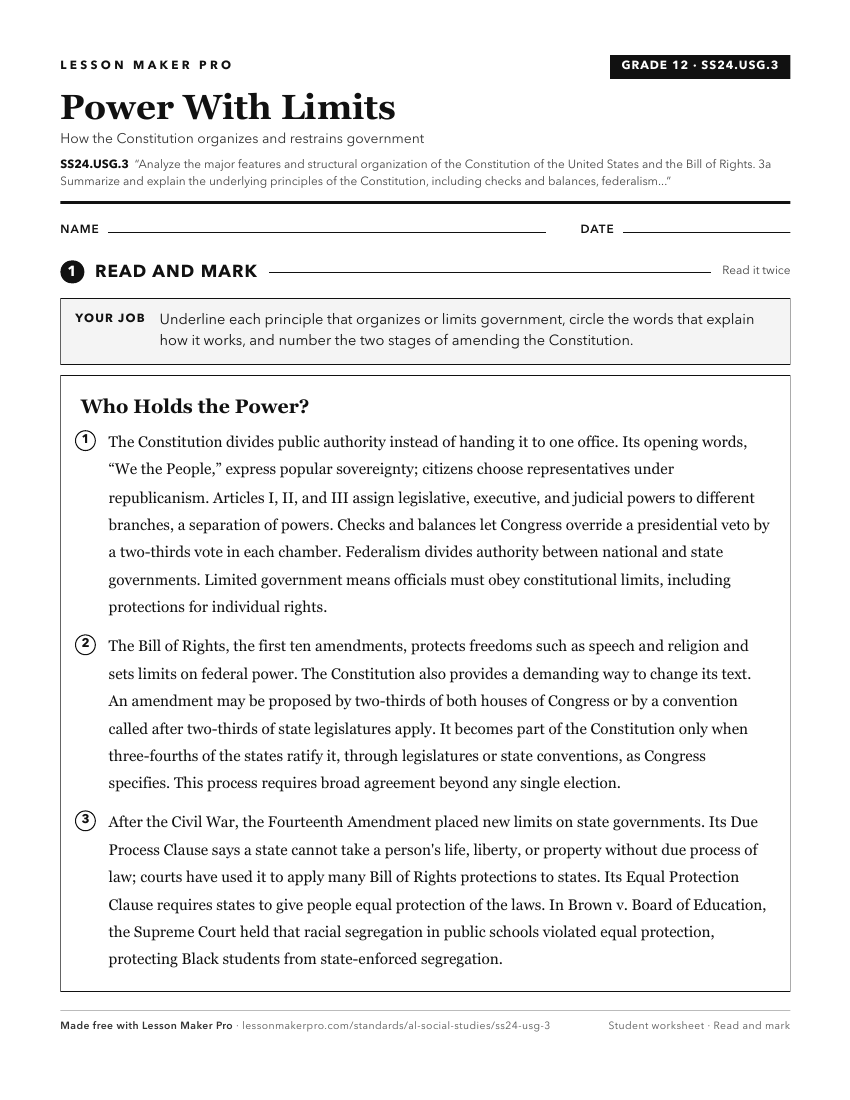
A ready-to-print activity worksheet aligned to SS24.USG.3, with an answer key for the teacher on its own page. No account needed.
PDF, US Letter, prints cleanly in black and white.
Download the worksheetKeep exploring
Related Standards
- SS24.6.13c
Analyze key elements of the Constitution that deal with citizenship and civic participation, including the path to citizenship and the process for amending the ...
- SS24.US1.2c
Compare the arguments of Federalists and Anti-Federalists regarding ratification of the United States Constitution, and explain how the Bill of Rights represent...
- SS24.6.13
Describe major ideas, concepts, and limitations of the Constitution of the United States.
Turn this cluster into a lesson
Grade, subject, topic, and the complete cluster are prefilled. Create one free, no account needed.
Also for this cluster:Make a WorksheetMake a QuizMake a Sub Lesson