Alabama Social Studies SS24.US2.17
Standard Cluster
Analyze the conservative revolution in American politics and how this shaped Ronald Reagan’s domestic and foreign policies. 17a Describe the growth and composition of movement conservatism beginning in the 1960s, and explain how this culminated in the formation of the Reagan Coalition and led to his election in 1980. 17b Analyze how Reaganomics and deregulation affected the American economy and society. 17c Trace the series of events during Reagan’s presidency leading to the emergence of the United States as the sole superpower, the fall of the Berlin Wall, and the collapse of the Soviet Union.
2024 Alabama Course of Study: Social Studies
Cluster contents
Standards in This Cluster
SS24.US2.17 is a cluster heading. These are the individual standards under it.
- SS24.US2.17a
Describe the growth and composition of movement conservatism beginning in the 1960s, and explain how this culminated in the formation of the Reagan Coalition an...
- SS24.US2.17b
Analyze how Reaganomics and deregulation affected the American economy and society.
- SS24.US2.17c
Trace the series of events during Reagan’s presidency leading to the emergence of the United States as the sole superpower, the fall of the Berlin Wall, and the...
Teacher's field guide
What This Cluster Means
What Students Need to Do
- Students show how conservative groups and some former Democrats helped elect Reagan in 1980. They use data to weigh the effects of tax cuts and deregulation on growth, deficits, and inequality. They trace U.S. and Soviet actions through the fall of the Berlin Wall and the later Soviet collapse.
What Mastery Looks Like
- A student can connect conservative organizing in the 1960s to Reagan's 1980 victory. They can use tax and deficit figures to explain both gains and tradeoffs. They can place Soviet reforms, arms talks, the 1989 Berlin Wall opening, and the 1991 Soviet breakup in order without crediting Reagan alone.
Common Misconceptions
- Students may think Reagan's voters were all longtime Republicans, leaving out former Democrats. They may credit tax cuts alone for lower inflation, ignoring Federal Reserve policy. They may place the Soviet collapse in 1989 or credit Reagan alone for the Berlin Wall's fall.
How to Assess It
- Exit ticket: Name two groups in Reagan's 1980 coalition and explain one tradeoff of his economic policies. Then give one U.S. action and one Soviet action before the Berlin Wall opened in 1989, and state when the Soviet Union broke up.
Lesson moves
Ways to Teach It
Pair voter-group cards with issue cards labeled abortion, taxes, and anticommunism, then build a paper map of Reagan's 1980 coalition.
Put a 1981 Reagan tax-cut speech beside a federal deficit graph; ask students to write one claimed benefit and one cost.
Run a timeline relay with 1983 missile defense, 1985 Soviet reforms, the 1987 arms treaty, the 1989 Berlin Wall opening, and the 1991 Soviet breakup.
Give students current, 1980, and 1988 federal tax bracket charts; have them calculate how top rates changed for high earners.
Free download
Printable SS24.US2.17 Worksheet
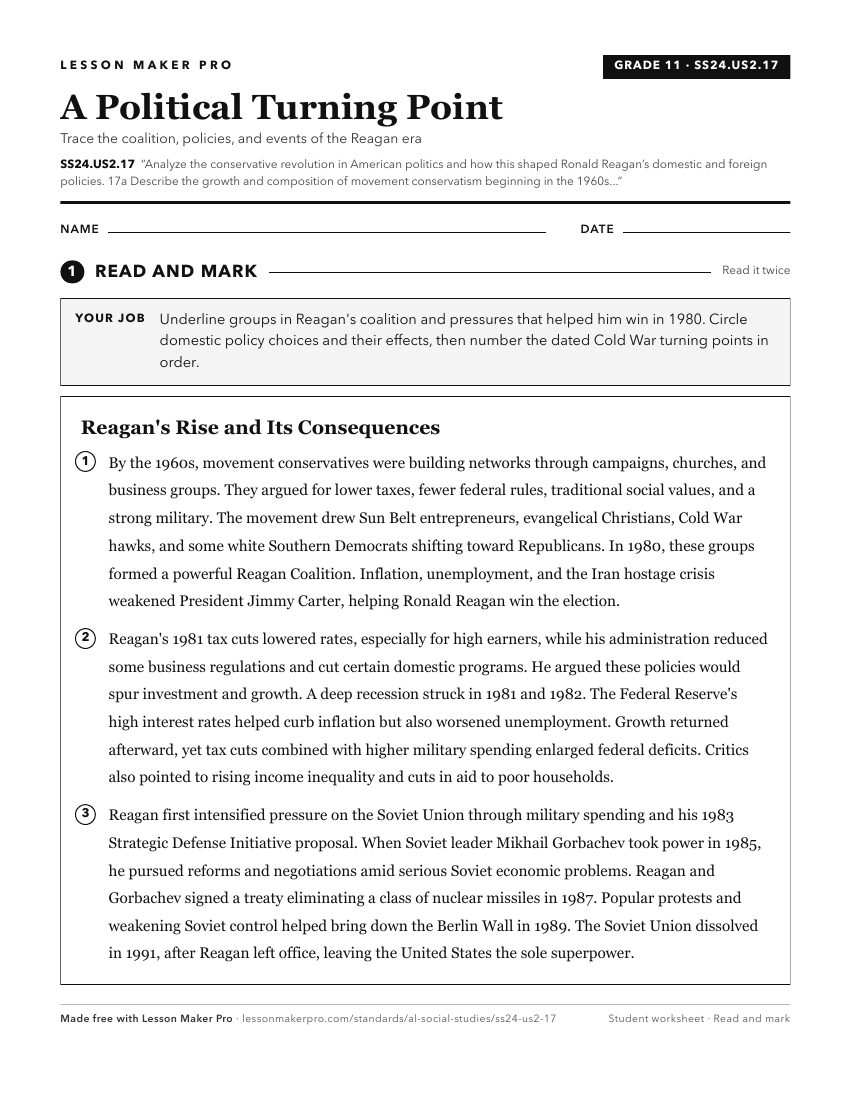
A ready-to-print activity worksheet aligned to SS24.US2.17, with an answer key for the teacher on its own page. No account needed.
PDF, US Letter, prints cleanly in black and white.
Download the worksheetKeep exploring
Related Standards
Turn this cluster into a lesson
Grade, subject, topic, and the complete cluster are prefilled. Create one free, no account needed.
Also for this cluster:Make a WorksheetMake a QuizMake a Sub Lesson