Alabama Social Studies SS24.US2.16
Standard Cluster
Describe significant foreign policy events during the presidencies of Richard Nixon, Gerald Ford, and Jimmy Carter that decreased hostility in the Cold War. 16a Analyze how America’s foreign policy decisions in the Vietnam War shaped Cold War actions in the 1970s, including détente and increased concern for human rights. 16b Evaluate how the United States’ increasing involvement in the Middle East during the 1970s affected both the region and the United States itself.
2024 Alabama Course of Study: Social Studies
Cluster contents
Standards in This Cluster
SS24.US2.16 is a cluster heading. These are the individual standards under it.
- SS24.US2.16a
Analyze how America’s foreign policy decisions in the Vietnam War shaped Cold War actions in the 1970s, including détente and increased concern for human rights...
- SS24.US2.16b
Evaluate how the United States’ increasing involvement in the Middle East during the 1970s affected both the region and the United States itself.
Teacher's field guide
What This Cluster Means
What Students Need to Do
- Students explain how the Vietnam War and public distrust shaped support for détente and greater attention to human rights. They trace how U.S. actions in the Middle East affected peace talks, oil prices, and relations with Iran.
What Mastery Looks Like
- Students can explain how Nixon’s China visit and SALT I, Ford’s Helsinki agreement, and Carter’s human rights policy changed Cold War diplomacy. They can use Camp David, the oil embargo, and the Iran hostage crisis to show gains and costs of U.S. involvement.
Common Misconceptions
- Some students think détente ended the Cold War or that the Helsinki agreement immediately ended Soviet repression. Others confuse the 1973 oil embargo with the Iran hostage crisis, or think Camp David settled every Arab-Israeli dispute.
How to Assess It
- Exit ticket: Connect Vietnam to détente in one sentence. Then name one diplomatic move each by Nixon, Ford, and Carter, and explain one effect of U.S. involvement in the Middle East at home and abroad.
Lesson moves
Ways to Teach It
Give pairs a blank map and cards for the China visit, SALT I, Helsinki, Camp David, and the Iran hostage crisis; mark locations and dates.
Ask: How did Vietnam change U.S. choices about negotiation and human rights? Write a claim supported by two named events.
Read six event slips aloud; have teams sort them under Nixon, Ford, or Carter and defend one choice.
Show a 1974 gas-line photo and a pump-price graph; ask students to connect U.S. support for Israel, the oil embargo, and household costs.
Free download
Printable SS24.US2.16 Worksheet
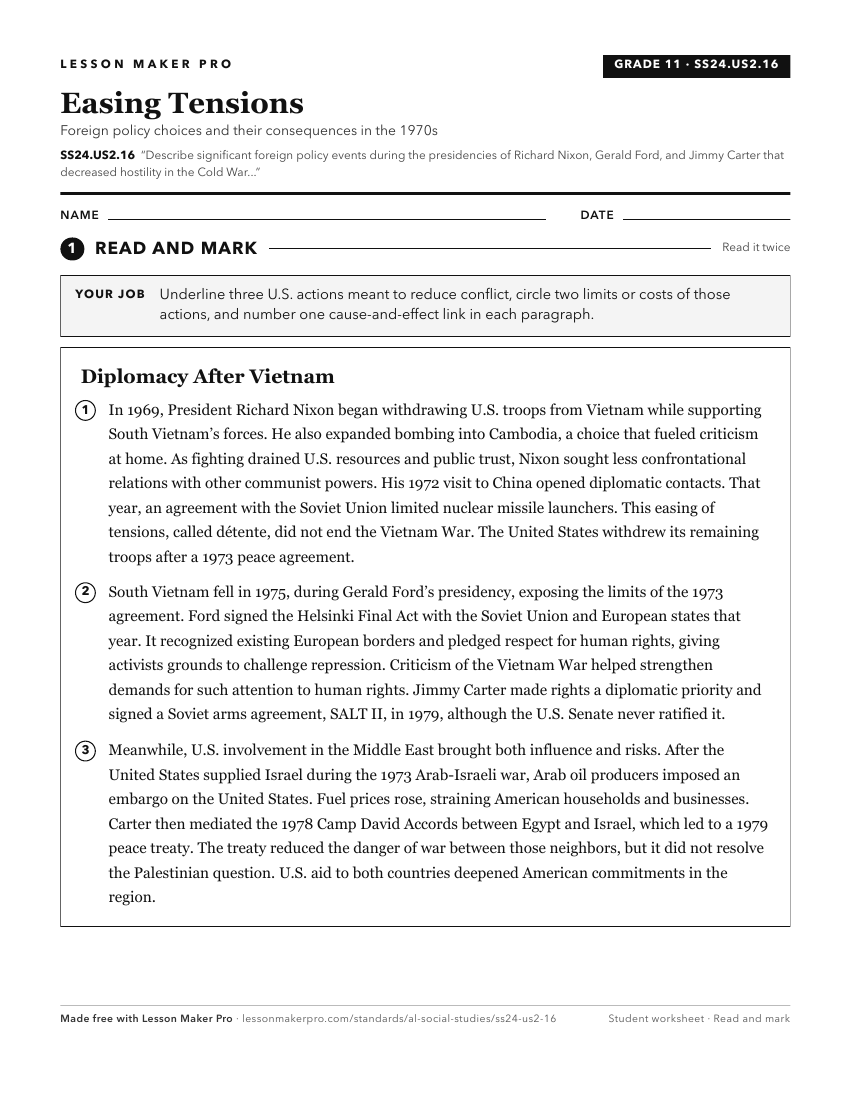
A ready-to-print activity worksheet aligned to SS24.US2.16, with an answer key for the teacher on its own page. No account needed.
PDF, US Letter, prints cleanly in black and white.
Download the worksheetKeep exploring
Related Standards
- SS24.US2.15
Describe how significant domestic events during the presidencies of Richard Nixon and Jimmy Carter shaped United States economics, politics, and society.
- SS24.US2.13
Explain the evolution of America’s Cold War policy to defend democracy and contain communism around the world and how this led to an escalation in armed conflic...
- SS24.US2.15b
Outline the events that led to the Watergate scandal and brought about the resignation of President Richard Nixon and the presidency of Gerald Ford.
Turn this cluster into a lesson
Grade, subject, topic, and the complete cluster are prefilled. Create one free, no account needed.
Also for this cluster:Make a WorksheetMake a QuizMake a Sub Lesson