Alabama Social Studies SS24.US2.16a
The Standard
- SS24.US2.16
- Describe significant foreign policy events during the presidencies of Richard Nixon, Gerald Ford, and Jimmy Carter that decreased hostility in the Cold War.
Analyze how America’s foreign policy decisions in the Vietnam War shaped Cold War actions in the 1970s, including détente and increased concern for human rights.
2024 Alabama Course of Study: Social Studies
Teacher's field guide
What This Standard Means
What Students Need to Do
- Students explain how U.S. choices in Vietnam affected later Cold War policy. They connect the war to talks with communist powers and growing attention to human rights. They also identify other reasons those policies changed.
What Mastery Looks Like
- A student can use dated sources to explain a link between Vietnam and a later policy choice. They can also explain why nuclear risks helped drive détente, apart from Vietnam.
Common Misconceptions
- Students may think détente meant the United States stopped opposing communism. They may place Nixon’s China visit after the war ended. Some assume Carter’s human rights policy came only from Vietnam.
How to Assess It
- Exit ticket: Explain one way Vietnam affected U.S. talks with communist powers and one way it shaped later human rights debates. Name one other reason for détente.
Lesson moves
Ways to Teach It
Build a desk timeline with cards for Nixon’s China visit, the Paris Peace Accords, the Helsinki agreement, and Carter’s UN speech; label two links.
Read excerpts from Nixon’s 1972 China remarks and Carter’s 1977 UN address; write which goal each emphasizes and where Vietnam might fit.
Play evidence match: pair claims about détente and human rights with excerpt cards from the Paris accords, Helsinki agreement, and Carter’s speech.
Print an excerpt from a recent State Department human rights report on Vietnam; underline two concerns and connect one to Carter’s policy.
Free download
Printable SS24.US2.16a Worksheet
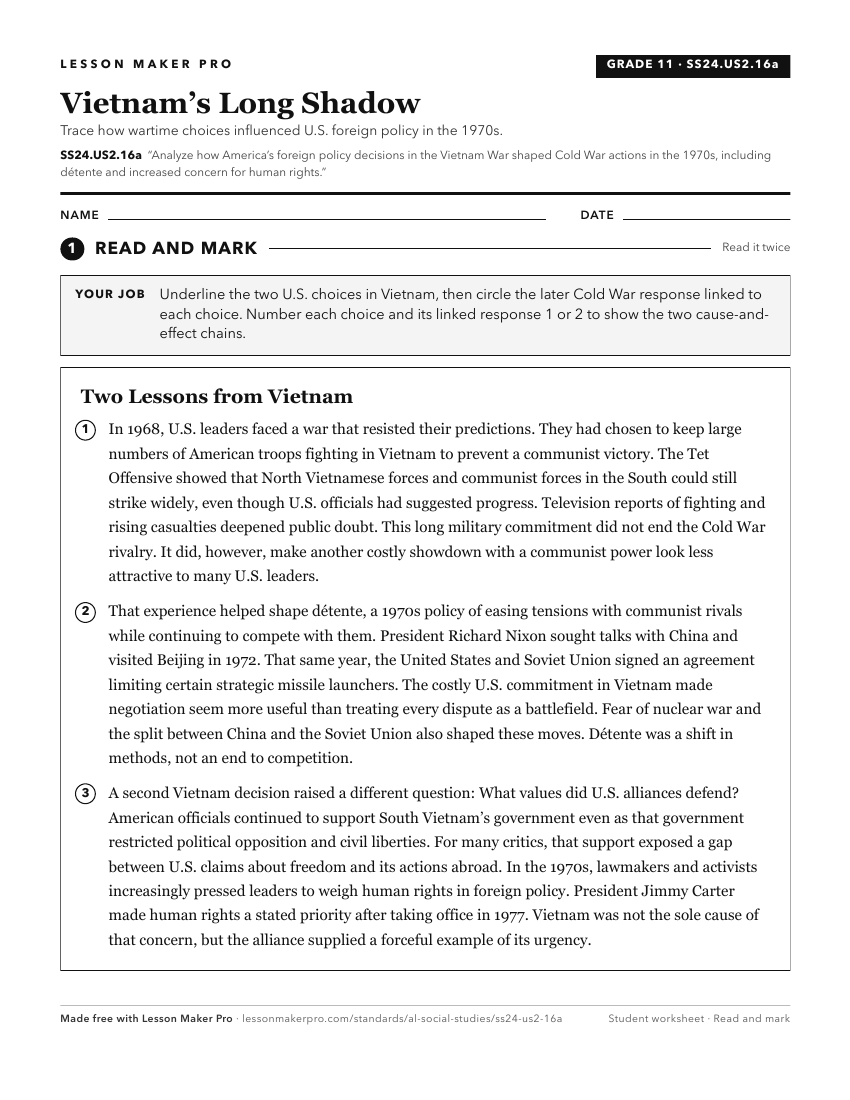
A ready-to-print activity worksheet aligned to SS24.US2.16a, with an answer key for the teacher on its own page. No account needed.
PDF, US Letter, prints cleanly in black and white.
Download the worksheetKeep exploring
Related Standards
- SS24.US2.9d
Analyze the domestic responses to the Cold War, including the impact of McCarthyism.
- SS24.US2.13d
Evaluate the relationship between domestic social movements, including the New Left and counterculture movements, and America’s war in Vietnam and explain how t...
- SS24.US2.13
Explain the evolution of America’s Cold War policy to defend democracy and contain communism around the world and how this led to an escalation in armed conflic...
- SS24.US2.16b
Evaluate how the United States’ increasing involvement in the Middle East during the 1970s affected both the region and the United States itself.
Turn this exact standard into a lesson
Grade, subject, topic, and the complete standard are prefilled. Create one free, no account needed.
Also for this standard:Make a WorksheetMake a QuizMake a Sub Lesson