Alabama Social Studies SS24.US1.5
Standard Cluster
Explain causes, courses, and consequences of United States’ expansionism and the rise of Manifest Destiny ideology prior to 1848. 5a Describe how the Treaty of Paris of 1783, Northwest Ordinance of 1785, Northwest Ordinance of 1787, and the Louisiana Purchase affected American territorial expansion. 5b Summarize the effects of the Indian Removal Act and the Trail of Tears on Native Americans, and describe the efforts by different nations to oppose removal. 5c Describe how scientific and technological advances helped facilitate expansion prior to 1848. 5d Analyze reasons for migration via the western trails and the consequences of the rapid settlement of California, Oregon, Texas, and Utah on those migrating, those residing in these regions, and on the United States as a whole. 5e Compare major events in Alabama from 1781 to 1823, including statehood as part of the expanding nation, acquisition of land, settlement, and the Creek War, to events occurring elsewhere in the developing nation.
2024 Alabama Course of Study: Social Studies
Cluster contents
Standards in This Cluster
SS24.US1.5 is a cluster heading. These are the individual standards under it.
- SS24.US1.5a
Describe how the Treaty of Paris of 1783, Northwest Ordinance of 1785, Northwest Ordinance of 1787, and the Louisiana Purchase affected American territorial exp...
- SS24.US1.5b
Summarize the effects of the Indian Removal Act and the Trail of Tears on Native Americans, and describe the efforts by different nations to oppose removal.
- SS24.US1.5c
Describe how scientific and technological advances helped facilitate expansion prior to 1848.
- SS24.US1.5d
Analyze reasons for migration via the western trails and the consequences of the rapid settlement of California, Oregon, Texas, and Utah on those migrating, tho...
- SS24.US1.5e
Compare major events in Alabama from 1781 to 1823, including statehood as part of the expanding nation, acquisition of land, settlement, and the Creek War, to e...
Teacher's field guide
What This Cluster Means
What Students Need to Do
- Students explain how treaties, land policies, and the Louisiana Purchase expanded US claims. They trace how Manifest Destiny, trails, maps, and steamboats encouraged migration to California, Oregon, Texas, and Utah. They explain forced removal and Native resistance, then compare Alabama's Creek War and statehood with expansion elsewhere.
What Mastery Looks Like
- On a dated map, a student distinguishes the 1783 boundary, 1785 land surveys, 1787 statehood rules, and the Louisiana Purchase. They explain why people took western trails and describe effects on migrants, Native residents, and the United States. They use Cherokee court challenges and Seminole resistance to explain opposition to removal and the Trail of Tears.
Common Misconceptions
- Students may think Manifest Destiny was a law rather than a belief used to justify expansion. They may assume land purchases gave the US uncontested ownership of land where Native nations lived. Some confuse the 1785 survey rules with the 1787 statehood rules or describe removal as voluntary.
How to Assess It
- Exit ticket: On a blank map, mark Alabama and one western trail. Write one reason settlers moved, one way a Native nation opposed removal, and one effect on each group.
Lesson moves
Ways to Teach It
On a blank map, pairs mark the 1783 boundary and Louisiana Purchase, then pin 1785 survey and 1787 statehood notes to the Northwest Territory.
Write two sentences: How did Manifest Destiny justify settlement, and how might a Cherokee petitioner challenge the claim that western land was empty?
Have pairs match cards for steamboats and river travel, surveyed maps and land claims, removal orders and Cherokee petitions, trails and Oregon settlement.
Show a current Alabama road map and locate the Tallapoosa River, then connect its Creek name to land taken after the Creek War.
Free download
Printable SS24.US1.5 Worksheet
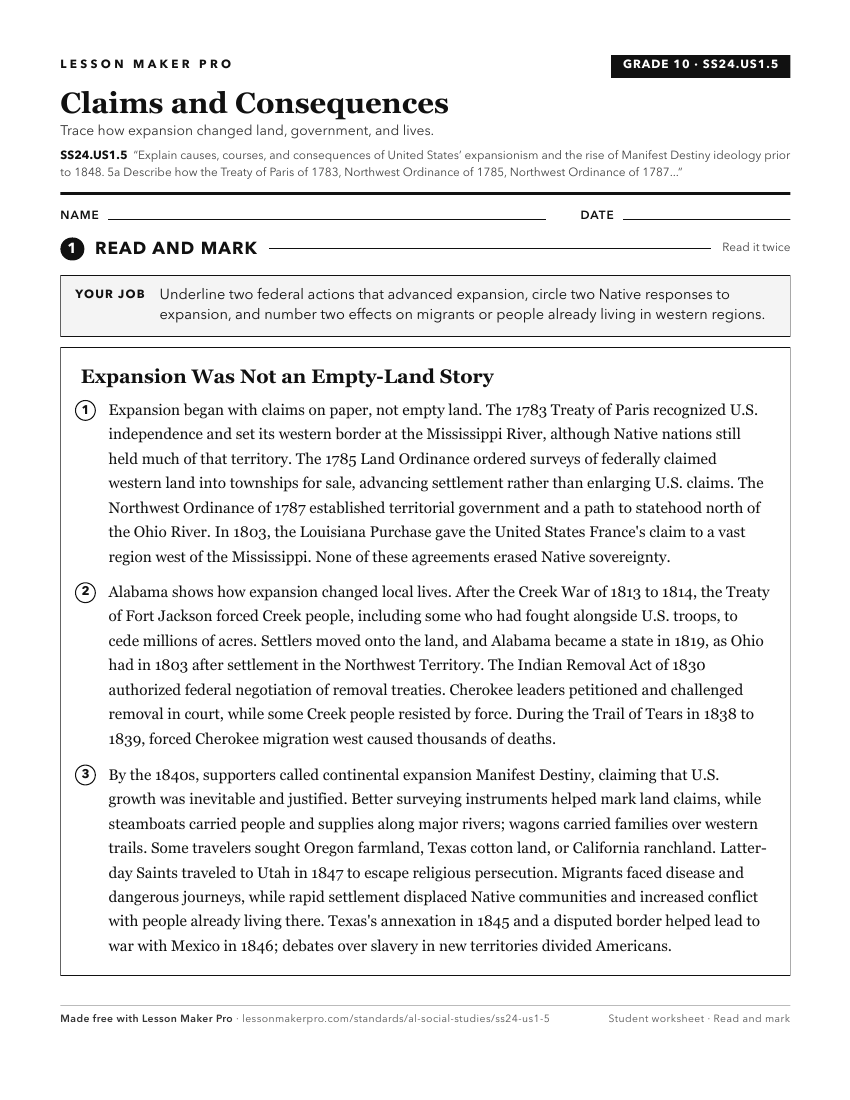
A ready-to-print activity worksheet aligned to SS24.US1.5, with an answer key for the teacher on its own page. No account needed.
PDF, US Letter, prints cleanly in black and white.
Download the worksheetKeep exploring
Related Standards
- SS24.US1.11b
Develop an argument to show how the causes and consequences of the Texas Revolution and Mexican-American War escalated sectional tension in the debate over slav...
- SS24.HG.9b
Explain the causes and consequences of migration within the United States, citing historical examples.
- SS24.WH.7
Explain causes and consequences of World War I, including imperialism, militarism, nationalism, and the alliance system.
- SS24.4.11
Describe events and factors that led to the United States' expansion prior to the Civil War, including conflicts, technological developments, trails, and the Go...
Turn this cluster into a lesson
Grade, subject, topic, and the complete cluster are prefilled. Create one free, no account needed.
Also for this cluster:Make a WorksheetMake a QuizMake a Sub Lesson