Alabama Social Studies SS24.US1.19
Standard Cluster
Describe the emergence of the New South economy and Jim Crow era, and explain the corresponding efforts to secure civil rights by Black Americans after Reconstruction. 19a Explain how Jim Crow laws, Plessy v. Ferguson (1896), and violence shaped the economic, political, and social structure of the New South after Reconstruction. 19b Summarize political and social motives that influenced the writing of the Constitution of Alabama of 1901, and explain its effect on politics and economics in Alabama. 19c Analyze the ideologies, efforts, and impacts of civil rights reformers, groups, and civic organizations that challenged Jim Crow laws and violence at the turn of the twentieth century. 19d Describe the efforts of reformers to create greater educational and economic opportunities for Black Americans through the establishment of new institutions and organizations.
2024 Alabama Course of Study: Social Studies
Cluster contents
Standards in This Cluster
SS24.US1.19 is a cluster heading. These are the individual standards under it.
- SS24.US1.19a
Explain how Jim Crow laws, Plessy v. Ferguson (1896), and violence shaped the economic, political, and social structure of the New South after Reconstruction.
- SS24.US1.19b
Summarize political and social motives that influenced the writing of the Constitution of Alabama of 1901, and explain its effect on politics and economics in A...
- SS24.US1.19c
Analyze the ideologies, efforts, and impacts of civil rights reformers, groups, and civic organizations that challenged Jim Crow laws and violence at the turn o...
- SS24.US1.19d
Describe the efforts of reformers to create greater educational and economic opportunities for Black Americans through the establishment of new institutions and...
Teacher's field guide
What This Cluster Means
What Students Need to Do
- Students explain how mills and railroads grew while sharecropping and segregated jobs kept many Black families poor. They show how segregation, violence, and Alabama's 1901 voting rules limited Black residents' rights. They compare the work of Black reformers who fought violence and built schools and civic groups.
What Mastery Looks Like
- Students can explain how Plessy upheld segregation and how Alabama's poll taxes and literacy tests reduced Black voting power. They connect lost voting power to decisions about schools and public spending. They can distinguish Ida B. Wells's anti-lynching work, Booker T. Washington's Tuskegee Institute, and W. E. B. Du Bois's work for political rights.
Common Misconceptions
- Students may think Plessy created segregation rather than upheld laws already in place. They may see literacy tests as fair requirements or miss that poll taxes also blocked poor white voters. They may assume Black reformers agreed on whether to focus first on job training or political rights.
How to Assess It
- Exit ticket: Plessy upheld segregated public spaces, and Alabama's 1901 constitution used poll taxes and literacy tests. Explain one effect of each, then name one Black reformer and a specific response.
Lesson moves
Ways to Teach It
Give pairs cotton, mill, and railroad cards, then have them build a flowchart showing who earned wages and who remained in debt.
Ask students to write: Why might Alabama lawmakers favor a poll tax, and how would it affect Black families and poor white families?
Play reformer match: students pair Wells, Washington, and Du Bois with anti-lynching pamphlets, Tuskegee, and NAACP organizing, then explain their matches.
Show your county's public school budget; ask who controls the money and how poll taxes changed whose votes counted in 1901.
Free download
Printable SS24.US1.19 Worksheet
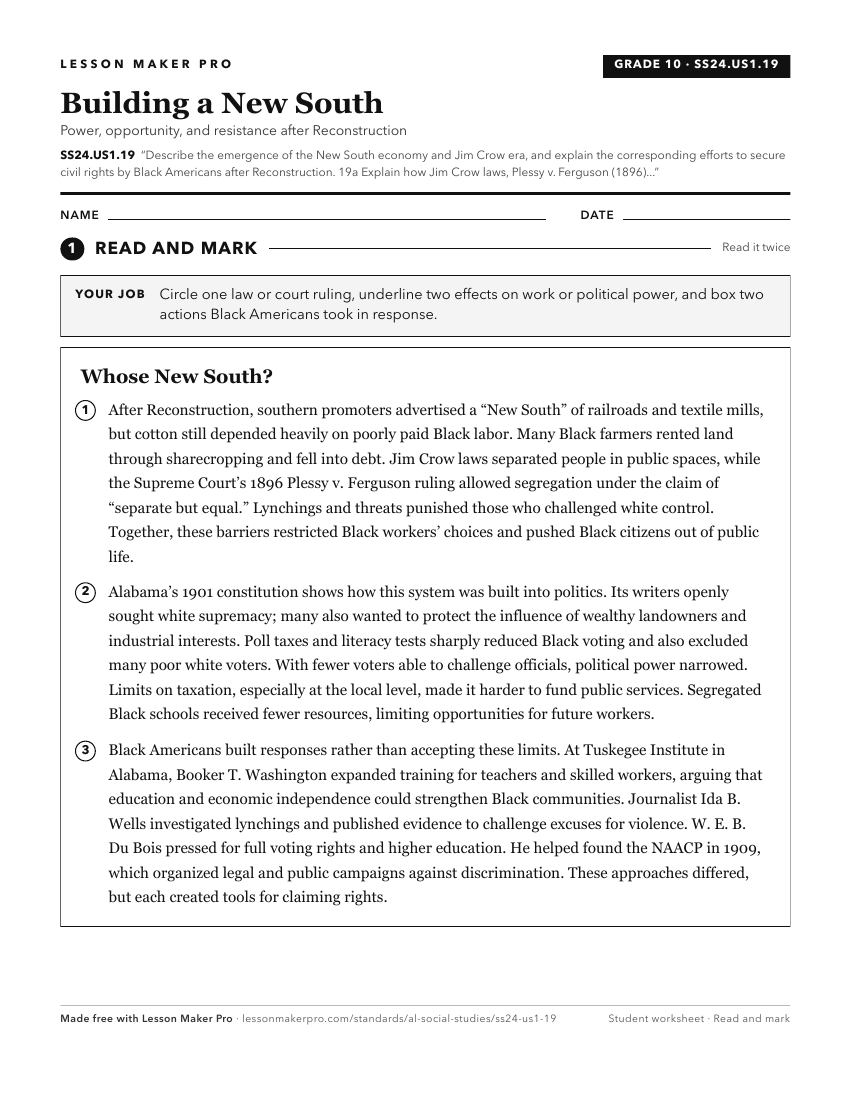
A ready-to-print activity worksheet aligned to SS24.US1.19, with an answer key for the teacher on its own page. No account needed.
PDF, US Letter, prints cleanly in black and white.
Download the worksheetKeep exploring
Related Standards
- SS24.AS.14b
Evaluate the role of new labor systems, Black Codes, and violence in stemming civil rights progress following Reconstruction in Alabama.
- SS24.4.15a
Explain political changes in Alabama during Reconstruction, including new state constitutions, Black Codes, changes in political parties, voting rights, and cit...
- SS24.US1.13
Evaluate how Reconstruction affected the economic, political, and social landscape of the South.
Turn this cluster into a lesson
Grade, subject, topic, and the complete cluster are prefilled. Create one free, no account needed.
Also for this cluster:Make a WorksheetMake a QuizMake a Sub Lesson