Alabama Social Studies SS24.P.6
The Standard
Explain how behavior genetics has contributed to the understanding of behavior and mental processes, including differentiating among deoxyribonucleic acid (DNA), chromosomes, and genes and identifying effects of chromosomal abnormalities.
2024 Alabama Course of Study: Social Studies
Teacher's field guide
What This Standard Means
What Students Need to Do
- Students tell DNA, genes, and chromosomes apart. They use twin-study comparisons to explain how genes and experience can both shape behavior. They describe a possible effect of an extra chromosome 21.
What Mastery Looks Like
- Given a study where identical twins are more alike than fraternal twins, students can explain why that suggests a genetic influence without saying genes determine behavior. They can explain that an extra chromosome 21 may affect learning and development.
Common Misconceptions
- Students may think a gene is a whole chromosome, or that DNA and genes are different materials. They may assume identical twins always act alike or that a genetic link makes a behavior inevitable. Some assume everyone with an extra chromosome 21 has the same abilities.
How to Assess It
- Exit ticket: Sketch a chromosome and label its DNA and one gene. Then explain what greater similarity between identical twins might suggest about behavior, and name one possible effect of an extra chromosome 21.
Lesson moves
Ways to Teach It
Give pairs a long paper strip labeled DNA, have them mark one gene, then coil the strip into a chromosome model.
Ask students to write why identical twins raised apart might share a habit but differ in how they handle stress.
Run a card sort matching DNA, gene, chromosome, and extra chromosome 21 to definitions and examples.
Show a headline claiming a 'gene for anxiety,' then have students rewrite it to include genetic risk and life experience.
Free download
Printable SS24.P.6 Worksheet
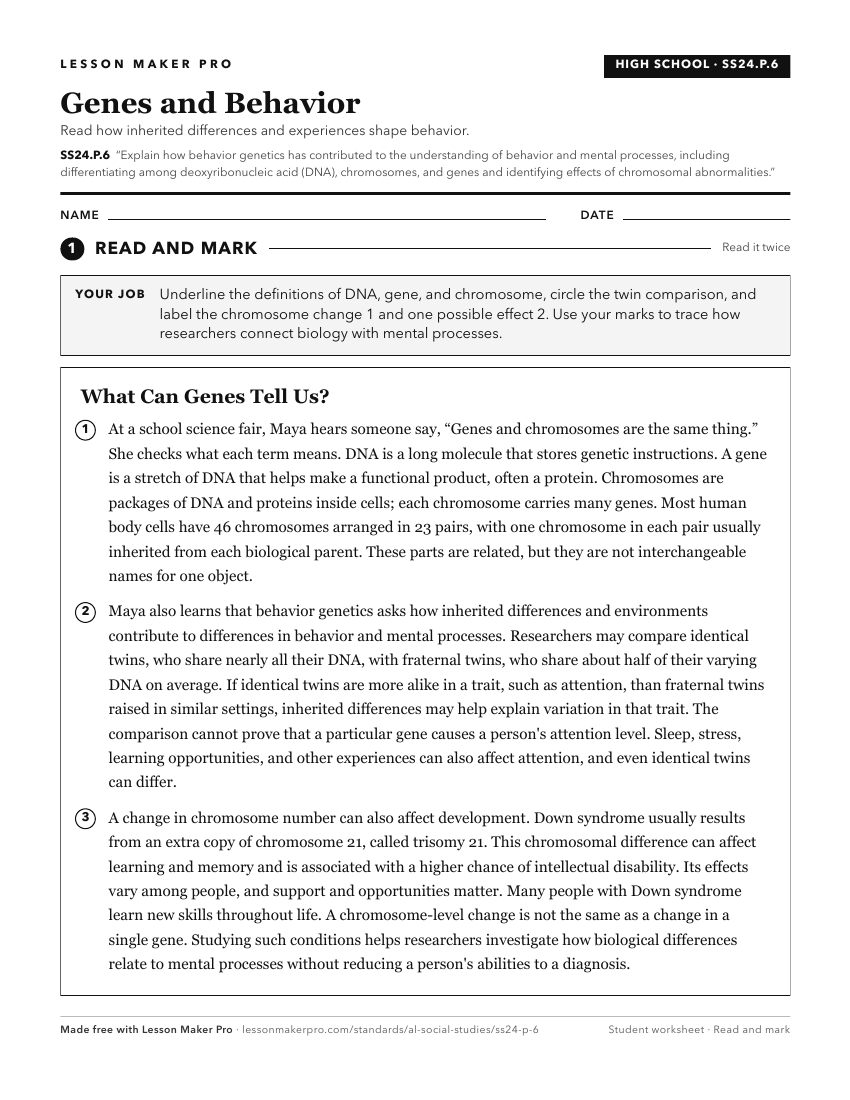
A ready-to-print activity worksheet aligned to SS24.P.6, with an answer key for the teacher on its own page. No account needed.
PDF, US Letter, prints cleanly in black and white.
Download the worksheetKeep exploring
Related Standards
- SS24.P.16
Describe major psychological disorders and their treatments and explain how examples of abnormal behavior differ from normal behavior.*
- SS24.P.4
Compare the effects of heredity and environment on development and behavior.*
- SS24.P.14
Explain the role of personality development in human behavior and differentiate among theories that seek to explain this development.
- SS24.P.1c
Describe how modern psychologists utilize multiple perspectives to understand behavior and mental processes, citing examples.*
Turn this exact standard into a lesson
Grade, subject, topic, and the complete standard are prefilled. Create one free, no account needed.
Also for this standard:Make a WorksheetMake a QuizMake a Sub Lesson