Alabama Social Studies SS24.P.15
Standard Cluster
Explain the role of motivation and emotion in human behavior.* 15a Describe theories that explain how biological, cognitive, and social factors influence motivation, including Abraham Maslow’s hierarchy of needs, arousal theory, and the theory drive for hunger (homeostasis). 15b Describe situational cues that cause emotions, including anger, curiosity, and anxiety.
2024 Alabama Course of Study: Social Studies
Cluster contents
Standards in This Cluster
SS24.P.15 is a cluster heading. These are the individual standards under it.
Teacher's field guide
What This Cluster Means
What Students Need to Do
- Students explain how body needs, thoughts, and other people affect what someone does. They compare Maslow's needs, arousal theory, and hunger as a drive to restore balance. They identify events that can spark anger, curiosity, or anxiety.
What Mastery Looks Like
- A student can explain hunger through homeostasis and the choice to seek a challenge through arousal theory. They can use Maslow's model to explain a need for belonging. They can name a situation that sparks an emotion and explain how someone's thoughts or peers might change the response.
Common Misconceptions
- Students may think hunger comes only from seeing food, rather than the body's need to restore balance. They may treat Maslow's needs as a fixed order everyone follows or assume arousal always means stress. They may mistake anger, curiosity, and anxiety for fixed traits rather than responses to situations.
How to Assess It
- Exit ticket: After skipping lunch, a student faces a surprise quiz, an unfair accusation, and a puzzling question. Explain the hunger through homeostasis, name three possible emotions, and use Maslow or arousal theory to explain one choice.
Lesson moves
Ways to Teach It
Give pairs cards showing skipped lunch, a roller coaster, a surprise quiz, and public praise; sort them by body need, arousal, or social cue.
Ask students to write: Would a surprise quiz make everyone anxious? Explain how past experience and classmates' reactions could change the feeling.
Read 'skipped lunch,' 'rode a roller coaster,' and 'joined a club'; students choose Maslow, arousal, or homeostasis corners and defend their picks.
Show a cafeteria menu and a sports tryout flyer; ask how hunger, belonging, or excitement might shape a student's choices.
Free download
Printable SS24.P.15 Worksheet
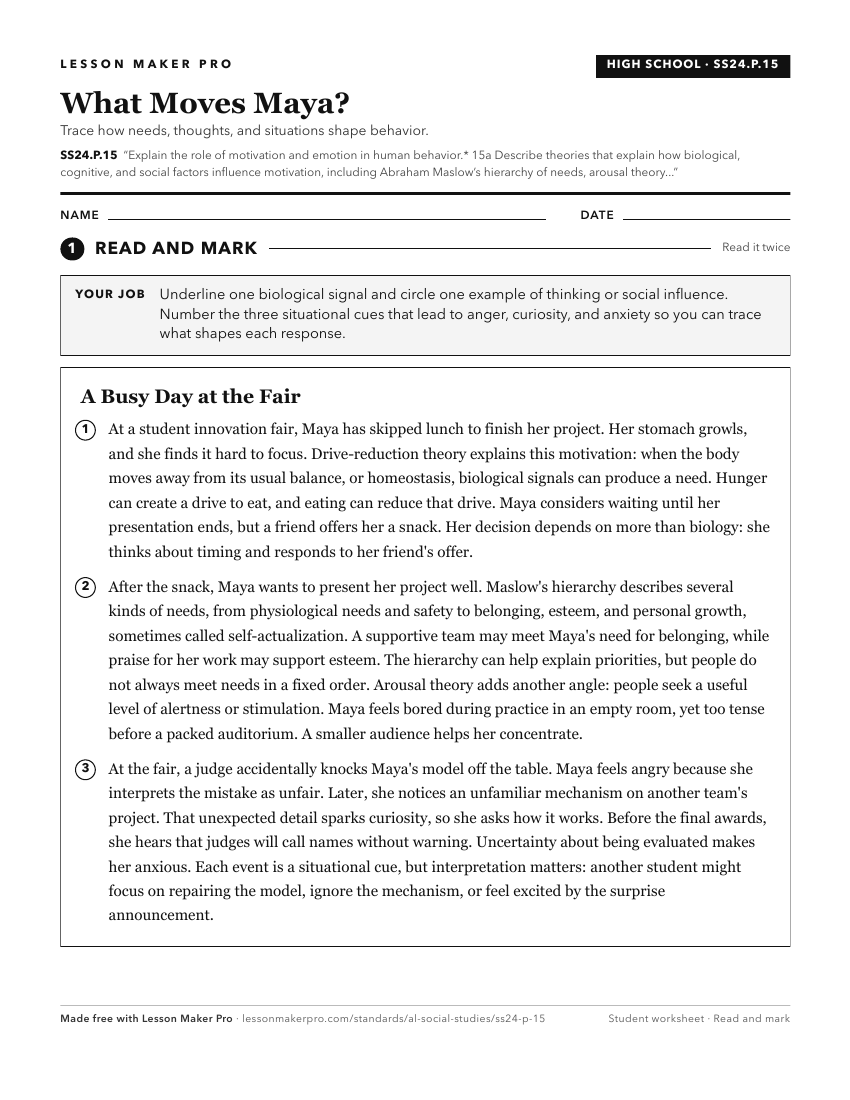
A ready-to-print activity worksheet aligned to SS24.P.15, with an answer key for the teacher on its own page. No account needed.
PDF, US Letter, prints cleanly in black and white.
Download the worksheetKeep exploring
Related Standards
- SS24.P.5
Describe the structure, biochemistry, and circuitry of the brain and nervous system, and explain their roles in human behavior and mental processes.*
- SS24.P.14
Explain the role of personality development in human behavior and differentiate among theories that seek to explain this development.
- SS24.P.7a
Explain the role of sensory systems in human behavior.
Turn this cluster into a lesson
Grade, subject, topic, and the complete cluster are prefilled. Create one free, no account needed.
Also for this cluster:Make a WorksheetMake a QuizMake a Sub Lesson