Alabama Social Studies SS24.P.13b
The Standard
- SS24.P.13
- Describe methods of assessing individual differences and theories of intelligence, including Charles E. Spearman's general (g) factor of intelligence, Howard Gardner's multiple intelligences, and Robert J. Sternberg's triarchic theory of intelligence.
Summarize concerns regarding the reliability and validity of intelligence test scores and describe the historical use and misuse of intelligence tests.
2024 Alabama Course of Study: Social Studies · Cognitive Psychology
Teacher's field guide
What This Standard Means
What Students Need to Do
- Students explain whether a test gives consistent scores and whether it measures what it claims to measure. They describe how intelligence tests were used to identify students needing help, then misused to support discrimination and eugenics.
What Mastery Looks Like
- A student can explain why a test might give consistent scores but still depend too much on English vocabulary or cultural knowledge. They can name a historical misuse without treating group score differences as proof of inborn ability.
Common Misconceptions
- Students may think a score is valid just because it stays the same on a retest. They may also assume a test score measures every kind of intelligence, or that differences between groups prove inborn differences.
How to Assess It
- Give this exit ticket: A student scores 85 twice on an English-only reasoning test but solves nonverbal puzzles well. What does this suggest about reliability and validity? Name one historical misuse of test scores.
Lesson moves
Ways to Teach It
Give pairs eight sample test questions on cards; have them sort questions by whether success depends on vocabulary, prior knowledge, or pattern recognition.
Ask students to write three sentences comparing Binet's goal of finding students who needed help with the later use of scores to support eugenics.
Play a card-sort game: students match test scenarios to reliability concerns, validity concerns, or both, then defend one match.
Show a job posting and a sample aptitude question; ask whether answering that question predicts success at the listed job tasks.
Free download
Printable SS24.P.13b Worksheet
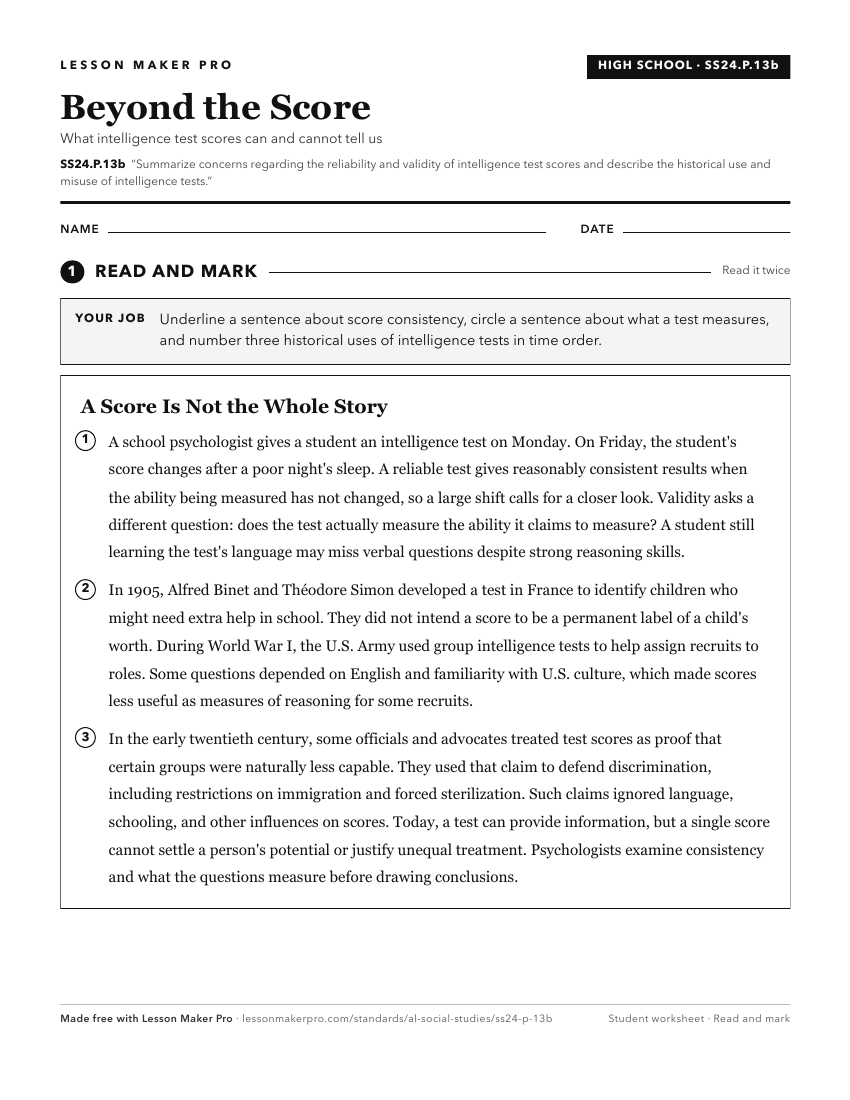
A ready-to-print activity worksheet aligned to SS24.P.13b, with an answer key for the teacher on its own page. No account needed.
PDF, US Letter, prints cleanly in black and white.
Download the worksheetKeep exploring
Related Standards
- SS24.S.2b
Explain the usefulness of discerning and sharing insights into human behavior of individuals and groups.*
- SS24.P.14a
Describe different measures of personality, including the Neuroticism-Extroversion-Openness Personality Inventory (NEO-PI), the Minnesota Multiphasic Personalit...
- SS24.P.13a
Describe different types of intelligence tests and explain the Flynn effect.
- SS24.P.13
Describe methods of assessing individual differences and theories of intelligence, including Charles E. Spearman's general (g) factor of intelligence, Howard Ga...
Turn this exact standard into a lesson
Grade, subject, topic, and the complete standard are prefilled. Create one free, no account needed.
Also for this standard:Make a WorksheetMake a QuizMake a Sub Lesson