Alabama Social Studies SS24.P.13
Standard Cluster
Describe methods of assessing individual differences and theories of intelligence, including Charles E. Spearman's general (g) factor of intelligence, Howard Gardner's multiple intelligences, and Robert J. Sternberg's triarchic theory of intelligence. 13a Describe different types of intelligence tests and explain the Flynn effect. 13b Summarize concerns regarding the reliability and validity of intelligence test scores and describe the historical use and misuse of intelligence tests.
2024 Alabama Course of Study: Social Studies
Cluster contents
Standards in This Cluster
SS24.P.13 is a cluster heading. These are the individual standards under it.
Teacher's field guide
What This Cluster Means
What Students Need to Do
- Students compare Spearman’s general ability, Gardner’s multiple intelligences, and Sternberg’s analytical, creative, and practical abilities. They distinguish individual intelligence tests from group tests and explain why average scores can rise across generations. They consider whether scores are consistent, measure what they claim, and have been misused.
What Mastery Looks Like
- Given a puzzle and a planning task, students explain how each theory would interpret different results. They explain why rising average scores can make old test norms misleading. They can tell the difference between a consistent score and a valid measure, and describe a past misuse of test scores.
Common Misconceptions
- Students may mistake Gardner’s intelligences for fixed learning styles. They may think the Flynn effect means every person gets smarter with age. Some assume that repeatable scores are accurate and fair for every group.
How to Assess It
- Exit ticket: A student gets nearly the same score twice on a test full of unfamiliar U.S. idioms. Explain whether the test is reliable and valid for that student, then name one historical misuse of test scores.
Lesson moves
Ways to Teach It
Give pairs a pattern puzzle, word analogy, and budget plan; ask them to mark what each task measures and what it misses.
Ask students how Spearman, Gardner, and Sternberg would interpret a classmate who solves puzzles well but struggles to plan a fundraiser.
Hand out cards describing a one-on-one intelligence test, group screening test, and math achievement test; teams sort them by purpose.
Show old and newly normed IQ score charts; ask why schools update test norms when average scores rise across generations.
Free download
Printable SS24.P.13 Worksheet
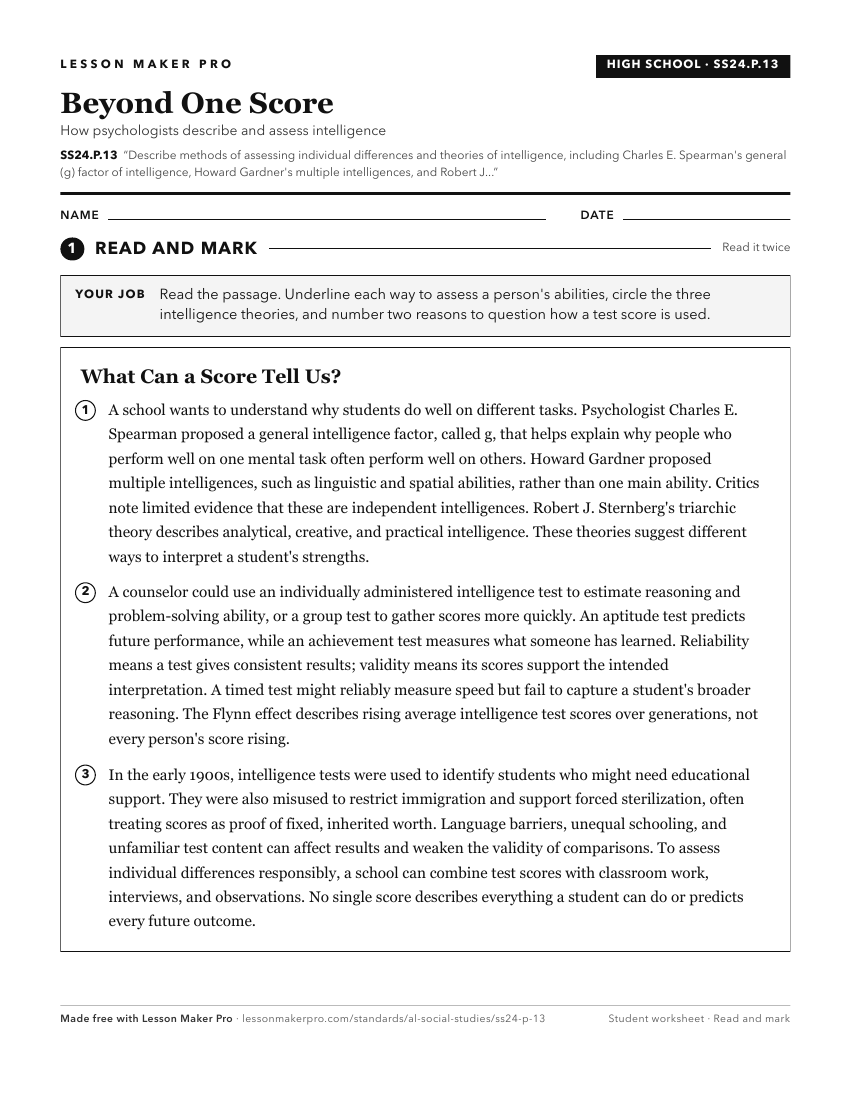
A ready-to-print activity worksheet aligned to SS24.P.13, with an answer key for the teacher on its own page. No account needed.
PDF, US Letter, prints cleanly in black and white.
Download the worksheetKeep exploring
Related Standards
- SS24.P.14a
Describe different measures of personality, including the Neuroticism-Extroversion-Openness Personality Inventory (NEO-PI), the Minnesota Multiphasic Personalit...
- SS24.P.1c
Describe how modern psychologists utilize multiple perspectives to understand behavior and mental processes, citing examples.*
Turn this cluster into a lesson
Grade, subject, topic, and the complete cluster are prefilled. Create one free, no account needed.
Also for this cluster:Make a WorksheetMake a QuizMake a Sub Lesson