Alabama Social Studies SS24.P.11a
The Standard
- SS24.P.11
- Describe ways in which organisms learn, including the processes of classical conditioning, operant conditioning, and observational learning.*
Identify and describe unconditioned stimuli, conditioned stimuli, unconditioned responses, and conditioned responses.
2024 Alabama Course of Study: Social Studies · Cognitive Psychology
Teacher's field guide
What This Standard Means
What Students Need to Do
- Students tell what triggers a response before learning and what triggers it after repeated pairings. They identify the natural trigger, the learned signal, and the response to each.
What Mastery Looks Like
- Given a dog that salivates at food and later at a whistle, a student labels food as the unconditioned stimulus and the whistle as the conditioned stimulus. They label salivation to food as the unconditioned response and salivation to the whistle as the conditioned response.
Common Misconceptions
- Students may call the whistle an unconditioned stimulus because it sounds before the food appears. They may also label salivation as an unconditioned response every time, even when the whistle alone triggers it.
How to Assess It
- Exit ticket: A dog salivates at a biscuit. After repeated whistle and biscuit pairings, it salivates at the whistle alone. Label both stimuli and both salivation responses.
Lesson moves
Ways to Teach It
Give pairs biscuit, whistle, and two salivation cards to arrange into a before and after diagram, then label each stimulus and response.
Ask, “Why is salivation to a biscuit unconditioned, but salivation to a whistle conditioned?” Have students write two sentences naming the trigger each time.
Underline biscuit, whistle, or salivation in four dog training sentences; students hold up US, UR, CS, or CR cards for each.
Draw a lunch bell and pizza smell on the board; students label all four roles after repeated pairings.
Free download
Printable SS24.P.11a Worksheet
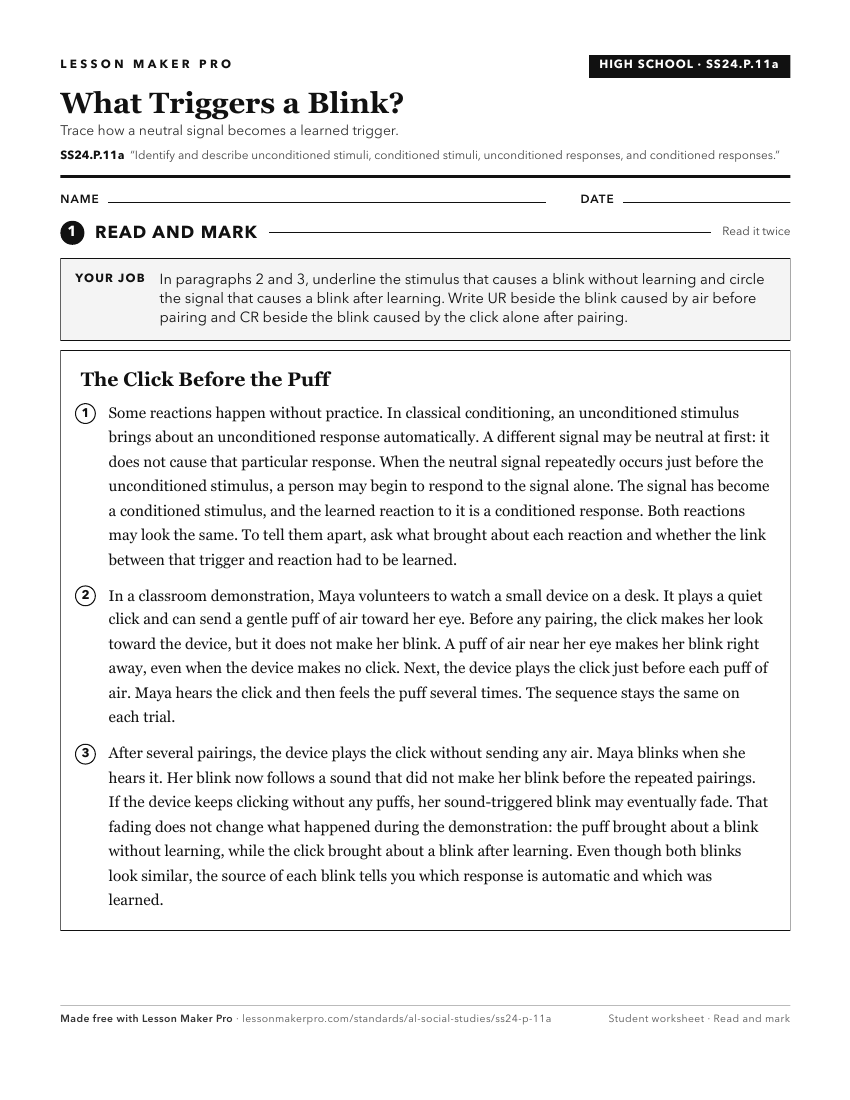
A ready-to-print activity worksheet aligned to SS24.P.11a, with an answer key for the teacher on its own page. No account needed.
PDF, US Letter, prints cleanly in black and white.
Download the worksheetKeep exploring
Related Standards
- SS24.P.11c
Describe original experiments conducted by Albert Bandura, B. F. Skinner, Ivan Pavlov, John B. Watson, Kenneth and Mamie Clark, and Rosalie Rayner.
- SS24.P.11b
Explain the law of effect, and differentiate between reinforcement and punishment, positive and negative reinforcement, and various schedules of reinforcement.
- SS24.P.11
Describe ways in which organisms learn, including the processes of classical conditioning, operant conditioning, and observational learning.*
- SS24.S.5b
Differentiate among primary, secondary, and adult socialization and identify the key influences of socialization for each stage.
Turn this exact standard into a lesson
Grade, subject, topic, and the complete standard are prefilled. Create one free, no account needed.
Also for this standard:Make a WorksheetMake a QuizMake a Sub Lesson