Alabama Social Studies SS24.HOS.18
Standard Cluster
Critique the responses considered by the Roosevelt administration and the United States military to the suffering of European Jews in the Holocaust.* 18a Evaluate American and Allied officials’ knowledge of and response to the Final Solution. 18b Explain the role of the United States military in liberating concentration camps. 18c Identify the locations of concentration camps liberated by American, British, and Red Army soldiers.
2024 Alabama Course of Study: Social Studies
Cluster contents
Standards in This Cluster
SS24.HOS.18 is a cluster heading. These are the individual standards under it.
- SS24.HOS.18a
Evaluate American and Allied officials’ knowledge of and response to the Final Solution.
- SS24.HOS.18b
Explain the role of the United States military in liberating concentration camps.
- SS24.HOS.18c
Identify the locations of concentration camps liberated by American, British, and Red Army soldiers.
Teacher's field guide
What This Cluster Means
What Students Need to Do
- Students examine what U.S. and Allied officials knew about the murder of European Jews and how they responded. They explain what U.S. troops did when they reached camps. They locate camps liberated by U.S., British, and Soviet forces.
What Mastery Looks Like
- Students can use the 1942 Allied declaration and the 1944 War Refugee Board to explain what officials knew and did, while pointing out limits on rescue. They can describe U.S. troops helping survivors and documenting what they found. They can match Dachau, Bergen-Belsen, and Auschwitz with their locations and liberating armies.
Common Misconceptions
- Students may think Allied leaders first learned about mass murder when soldiers reached the camps. They may think U.S. troops liberated Auschwitz or that all camps served the same purpose.
How to Assess It
- On an exit ticket, ask students to match Dachau, Bergen-Belsen, and Auschwitz with their liberating armies. Then ask them to name one U.S. rescue effort and one decision that limited help.
Lesson moves
Ways to Teach It
Give pairs a blank Europe map and cards for Dachau, Bergen-Belsen, and Auschwitz; have them place each camp and match its liberating army.
Ask students: What could officials have done after the 1942 Allied declaration? Have them support an answer with one policy choice.
Run a timeline sort using the 1942 Allied declaration, the 1944 War Refugee Board, and 1945 camp liberations.
Using a current UNHCR refugee appeal, have students identify actions governments can take, then compare those options with U.S. choices in 1944.
Free download
Printable SS24.HOS.18 Worksheet
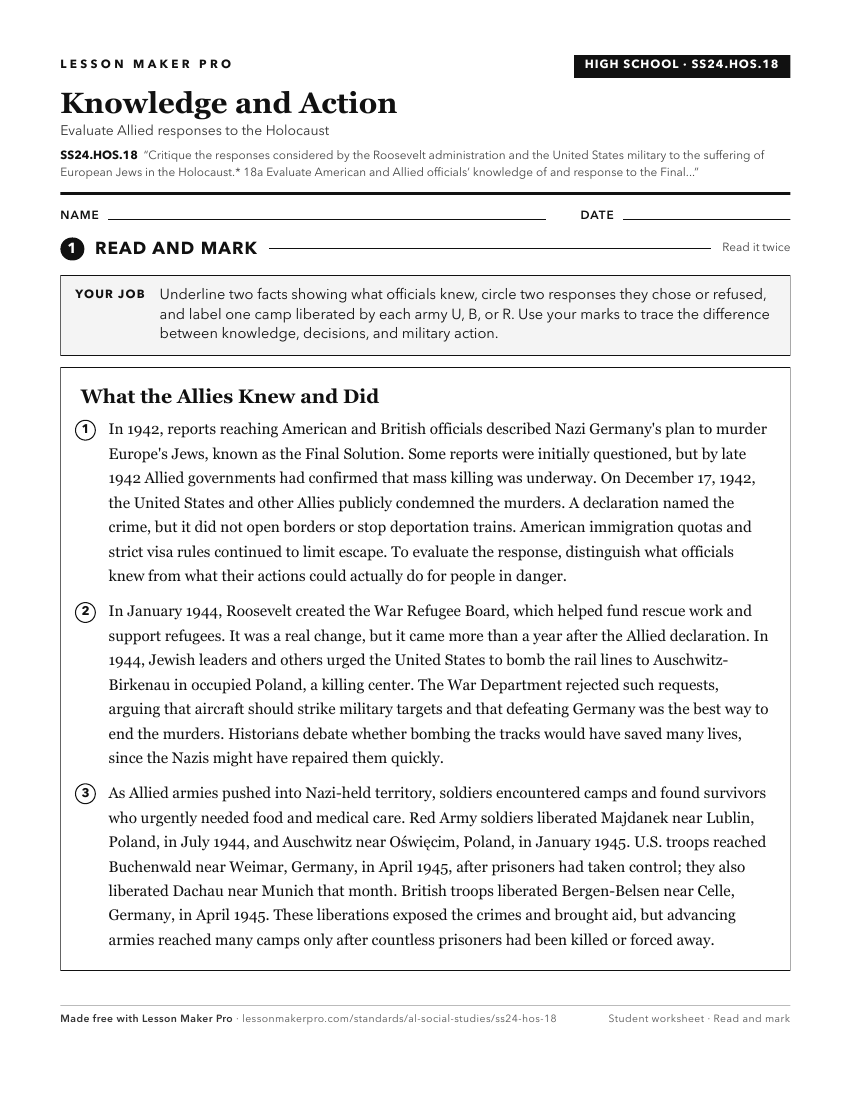
A ready-to-print activity worksheet aligned to SS24.HOS.18, with an answer key for the teacher on its own page. No account needed.
PDF, US Letter, prints cleanly in black and white.
Download the worksheetKeep exploring
Related Standards
- SS24.US2.6b
Critique the evolving United States policy and public attitudes toward Nazi Germany and the growing refugee crisis as the Holocaust began.
- SS24.HOS.8b
Critique American and world responses to the November pogrom (Kristallnacht) and the persecution of Jews in Germany and Nazi-controlled territories.
- SS24.HOS.16
Critique the role that bystanders, collaborators, and perpetrators played in the implementation of Nazi policies against Jewish people and other targeted groups...
Turn this cluster into a lesson
Grade, subject, topic, and the complete cluster are prefilled. Create one free, no account needed.
Also for this cluster:Make a WorksheetMake a QuizMake a Sub Lesson