Alabama Social Studies SS24.HG.4
Standard Cluster
Identify the characteristics, diffusion, distribution, and complexity of Earth's cultural mosaics. 4a Identify and describe essential aspects of culture, including architecture, art, belief systems, customs, food, languages, religion, technology, and traditions. 4b Differentiate between material and nonmaterial culture within a society, including folk customs. 4c Explain how music, dance, fashion, and art provide avenues for understanding the cultures from which they originate, both past and present.
2024 Alabama Course of Study: Social Studies
Cluster contents
Standards in This Cluster
SS24.HG.4 is a cluster heading. These are the individual standards under it.
- SS24.HG.4a
Identify and describe essential aspects of culture, including architecture, art, belief systems, customs, food, languages, religion, technology, and traditions.
- SS24.HG.4b
Differentiate between material and nonmaterial culture within a society, including folk customs.
- SS24.HG.4c
Explain how music, dance, fashion, and art provide avenues for understanding the cultures from which they originate, both past and present.
Teacher's field guide
What This Cluster Means
What Students Need to Do
- Students identify cultural features such as food, language, religion, art, and architecture. They distinguish physical objects from beliefs and customs, including folk customs, and map where practices overlap and spread. They use music, dance, fashion, and art as evidence about cultures past and present.
What Mastery Looks Like
- Given a festival photo and caption, a student can label the clothing as material culture and the custom it represents as nonmaterial culture. On a map, they can show how a tradition crosses borders and coexists with others. They support a claim about a song or artwork with specific details, without assuming everyone in a place shares the same practices.
Common Misconceptions
- Students may treat a festival costume and the belief behind it as the same type of culture. They may assume one language or religion fills an entire country, or that a tradition stays where it began. They may take one song or outfit as proof that everyone in a culture thinks alike.
How to Assess It
- Give students a photo captioned “Families light lamps for Diwali” and a map marking celebrations in India, London, and Toronto. Ask them to name one material object, one custom, and one sign of spread.
Lesson moves
Ways to Teach It
Give pairs photo and caption cards of a festival; have them sort clothing and instruments from beliefs and customs.
Play two dated music clips from one community with brief context cards; ask, “What changed, and what evidence supports your claim?”
Play map-card match: teams place language-use cards on a world map, then draw arrows for migration routes listed on the cards.
Read a grocery flyer and a short source on chili peppers, then map their spread from the Americas into cuisines elsewhere.
Free download
Printable SS24.HG.4 Worksheet
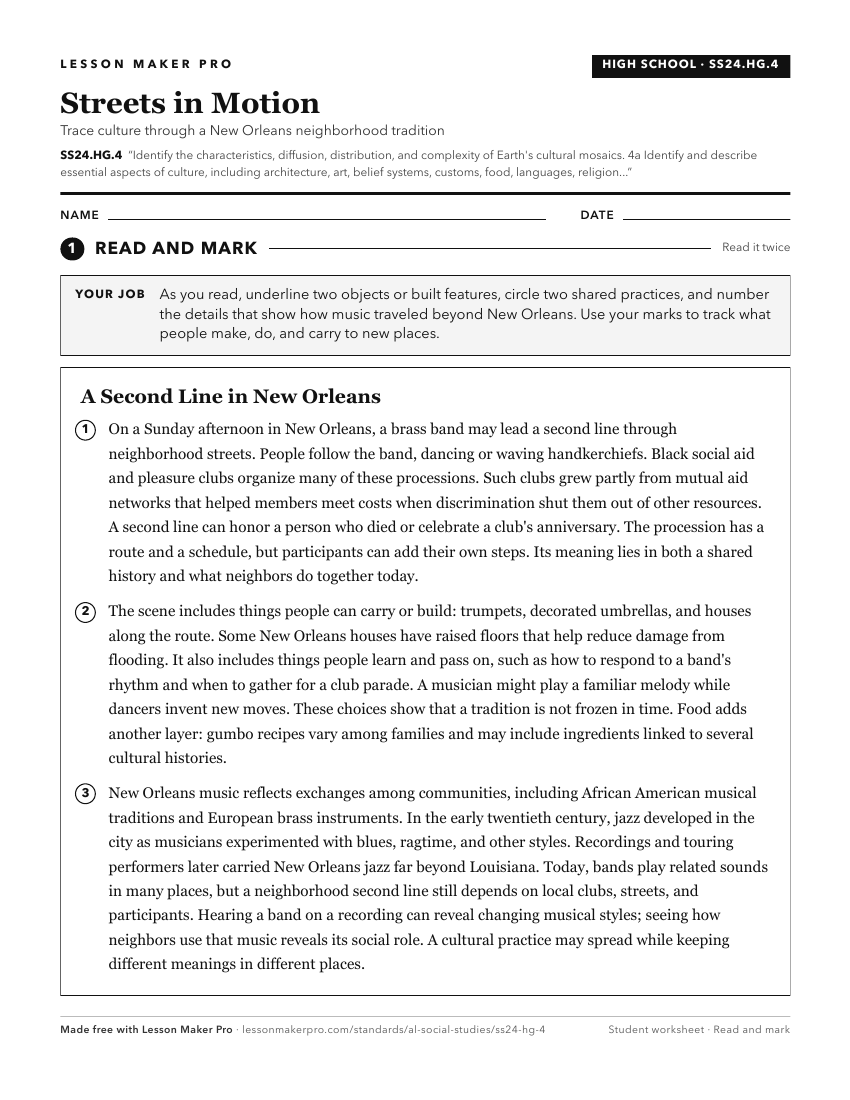
A ready-to-print activity worksheet aligned to SS24.HG.4, with an answer key for the teacher on its own page. No account needed.
PDF, US Letter, prints cleanly in black and white.
Download the worksheetKeep exploring
Related Standards
Turn this cluster into a lesson
Grade, subject, topic, and the complete cluster are prefilled. Create one free, no account needed.
Also for this cluster:Make a WorksheetMake a QuizMake a Sub Lesson