Alabama Social Studies SS24.HG.4b
The Standard
- SS24.HG.4
- Identify the characteristics, diffusion, distribution, and complexity of Earth's cultural mosaics.
Differentiate between material and nonmaterial culture within a society, including folk customs.
2024 Alabama Course of Study: Social Studies · Culture and Geography
Teacher's field guide
What This Standard Means
What Students Need to Do
- Students tell physical objects apart from shared beliefs and practices in a community. They explain how an object can be part of a folk custom without being the custom itself.
What Mastery Looks Like
- Given an annual town quilt display, a student identifies the quilts as material culture and the repeated display as nonmaterial culture. They explain why the display is a folk custom.
Common Misconceptions
- Students may call a photo of a custom the custom itself, rather than a record of it. They may think folk customs must be old or rural, or that an object and its related practice must fit the same category.
How to Assess It
- Exit ticket: A neighborhood holds a lantern parade each fall. Name one material item and one nonmaterial folk custom, then explain the difference.
Lesson moves
Ways to Teach It
Bring a clay pot and a card reading 'Neighbors pass down pottery skills each spring'; partners sort the pot and practice into two columns.
Ask: When a town hangs handmade quilts at its annual fair, which part is an object and which part is a folk custom?
Play a card sort with pottery, festival songs, woven baskets, and greeting rituals; students explain each choice to a partner.
Show a flyer for an annual town quilt display; students identify the quilts as objects and the recurring display as a folk custom.
Free download
Printable SS24.HG.4b Worksheet
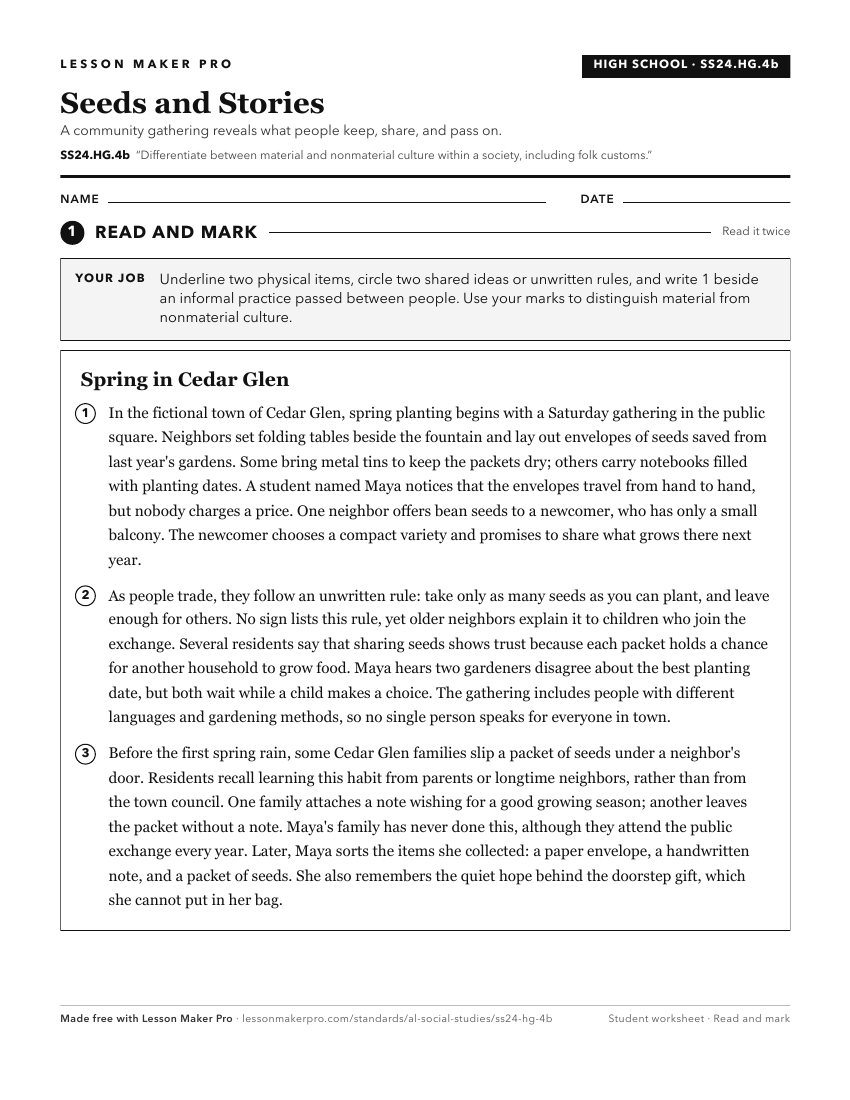
A ready-to-print activity worksheet aligned to SS24.HG.4b, with an answer key for the teacher on its own page. No account needed.
PDF, US Letter, prints cleanly in black and white.
Download the worksheetKeep exploring
Related Standards
- SS24.S.4a
Describe ways in which cultures differ, change, and resist change, including countercultures, subcultures, and ethnocentric beliefs.
- SS24.HG.7b
Compare and contrast ceremonies based on religious traditions in a variety of cultures, including marriages, funerals, and coming-of-age rituals.
- SS24.HG.4a
Identify and describe essential aspects of culture, including architecture, art, belief systems, customs, food, languages, religion, technology, and traditions.
- SS24.HG.7
Describe ways religion influences cultures, citing examples from around the globe.
Turn this exact standard into a lesson
Grade, subject, topic, and the complete standard are prefilled. Create one free, no account needed.
Also for this standard:Make a WorksheetMake a QuizMake a Sub Lesson