Alabama Social Studies SS24.E.11
Standard Cluster
Explain why individuals, businesses, and nations engage in trading goods and services in the global economy. 11a Contrast absolute advantage to comparative advantage, and explain how they are used to measure gains from trade. 11b Locate and utilize current economic data to demonstrate how changes in exchange rates impact the purchasing power of individuals and businesses. 11c Analyze why countries sometimes impose trade barriers and sometimes engage in free trade. 11d Construct and explain examples of specialization and exchange.
2024 Alabama Course of Study: Social Studies
Cluster contents
Standards in This Cluster
SS24.E.11 is a cluster heading. These are the individual standards under it.
- SS24.E.11a
Contrast absolute advantage to comparative advantage, and explain how they are used to measure gains from trade.
- SS24.E.11b
Locate and utilize current economic data to demonstrate how changes in exchange rates impact the purchasing power of individuals and businesses.
- SS24.E.11c
Analyze why countries sometimes impose trade barriers and sometimes engage in free trade.
- SS24.E.11d
Construct and explain examples of specialization and exchange.
Teacher's field guide
What This Cluster Means
What Students Need to Do
- Students compare who can produce more with who gives up less to produce a good. They explain why shoppers, businesses, and countries trade, and why a country might limit imports. They use recent exchange rates to compare the dollar cost of foreign goods.
What Mastery Looks Like
- Students identify absolute and comparative advantage from a production table and calculate opportunity costs. They set a trade price that benefits both sides. They calculate how a currency change affects an import price and explain who gains and who pays when a tariff is added.
Common Misconceptions
- Students may think that producing more of everything means having a comparative advantage in everything. They may think a stronger dollar makes imports priced in foreign currency more expensive, or that tariffs help local producers without raising buyers' costs.
How to Assess It
- Exit ticket: Country A can make 10 shirts or 5 phones, while Country B can make 6 shirts or 6 phones. Ask students to calculate the cost of one shirt in phones for each country, choose who should make shirts, and propose a trade price that benefits both.
Lesson moves
Ways to Teach It
Give pairs cards marked '10 shirts or 5 phones' and '6 shirts or 6 phones'; have them exchange four paper shirts for three paper phones.
Ask: 'Would a tariff on imported steel help mill workers but hurt carmakers? Who gains under free trade?'
Play exchange-rate bingo: call €100 at $1.05 or $1.20 per euro; students cover $105 or $120 on prepared cards.
Use the latest and month-earlier Federal Reserve H.10 rates to price a €10,000 parts order for a U.S. shop.
Free download
Printable SS24.E.11 Worksheet
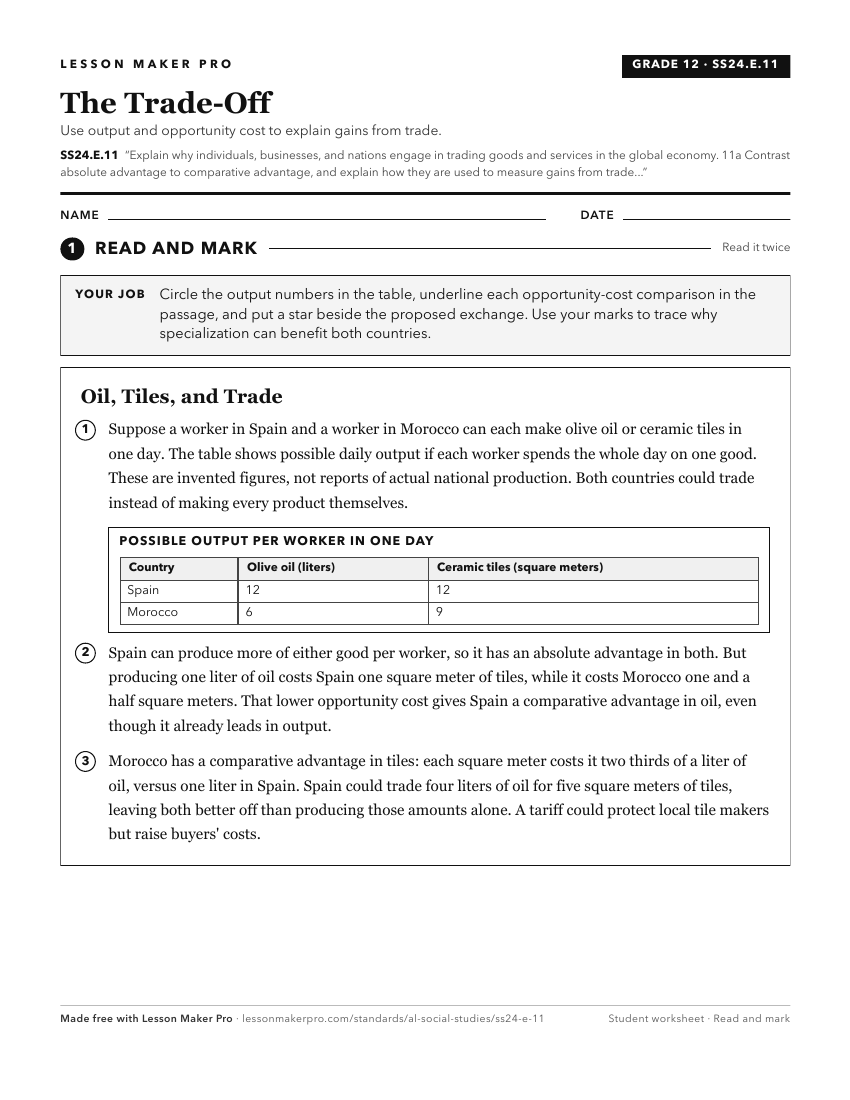
A ready-to-print activity worksheet aligned to SS24.E.11, with an answer key for the teacher on its own page. No account needed.
PDF, US Letter, prints cleanly in black and white.
Download the worksheetKeep exploring
Related Standards
Turn this cluster into a lesson
Grade, subject, topic, and the complete cluster are prefilled. Create one free, no account needed.
Also for this cluster:Make a WorksheetMake a QuizMake a Sub Lesson