Alabama Social Studies SS24.CWI.6
Standard Cluster
Evaluate the extent to which nations have successfully collaborated to achieve broad international goals, citing specific instances. 6a Describe the functions of modern-day alliance systems, regional organizations, and multinational corporations and cartels.
2024 Alabama Course of Study: Social Studies
Cluster contents
Standards in This Cluster
SS24.CWI.6 is a cluster heading. These are the individual standards under it.
Teacher's field guide
What This Cluster Means
What Students Need to Do
- Students compare times when countries worked together, such as the Montreal Protocol and the Paris Agreement. They use results to judge what worked and what fell short. They explain what alliances, regional groups, multinational companies, and cartels do.
What Mastery Looks Like
- A student cites the drop in ozone-depleting chemicals as evidence that the Montreal Protocol worked. They use emissions data to discuss the Paris Agreement's limits. They can explain NATO's defense role, the African Union's regional work, Toyota's cross-border business, and OPEC's oil output decisions.
Common Misconceptions
- Students may treat a treaty, an alliance, and a company as the same kind of group. They may assume that signing an agreement means countries have met its goals. They may mistake OPEC for an oil company rather than governments coordinating production.
How to Assess It
- Give students a graph of global CFC use after the Montreal Protocol and a short note on OPEC's oil output decisions. Ask them to cite one result of cooperation and explain what OPEC does.
Lesson moves
Ways to Teach It
Tape a success-to-limits line on desks; pairs place Montreal Protocol and Paris Agreement evidence cards and explain each placement.
Ask students to write: What helped the Montreal Protocol work, and what limits the Paris Agreement? Cite one fact for each.
Play four corners with NATO, African Union, Toyota, and OPEC cards; students choose alliance, regional group, corporation, or cartel and explain why.
Print a local gas price chart and an OPEC output announcement; students explain how coordinated production might affect prices at the pump.
Free download
Printable SS24.CWI.6 Worksheet
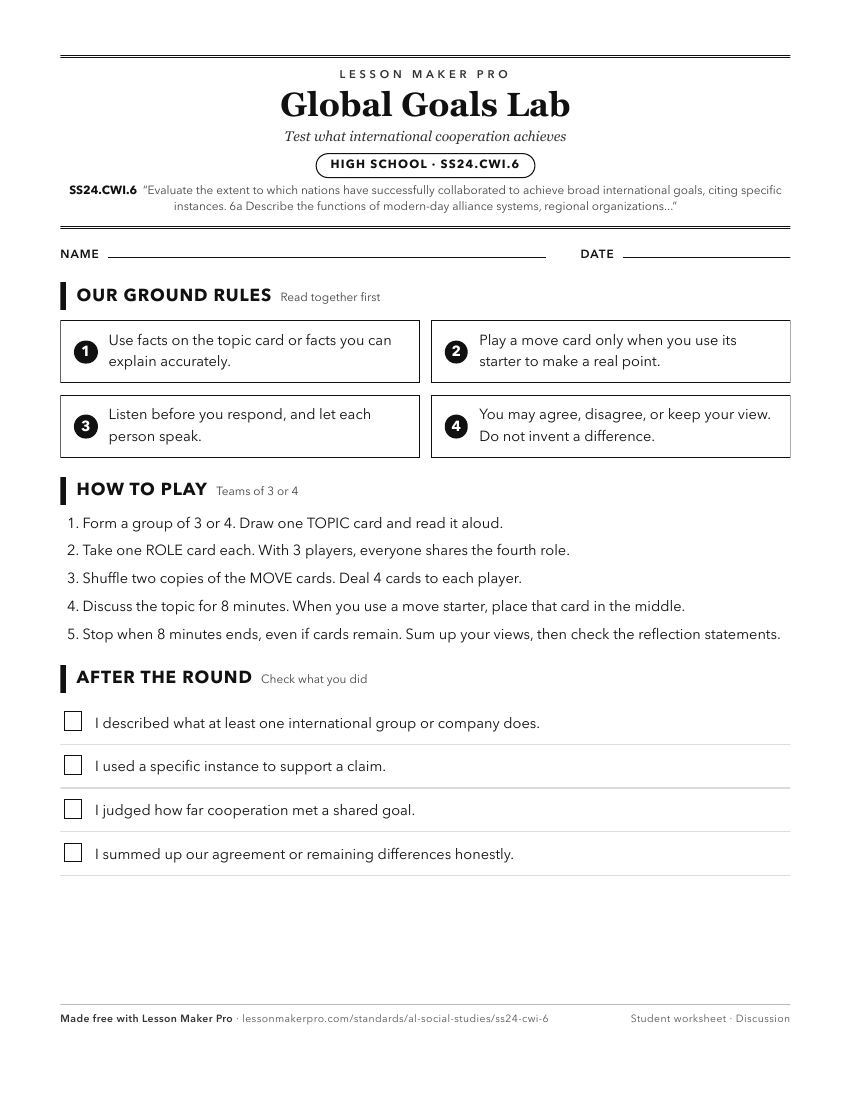
A ready-to-print activity worksheet aligned to SS24.CWI.6, with an answer key for the teacher on its own page. No account needed.
PDF, US Letter, prints cleanly in black and white.
Download the worksheetKeep exploring
Related Standards
- SS24.CWI.7a
Investigate and explain how individuals and non-governmental groups may cause or perpetuate conflict, citing specific cases.
- SS24.WH.16a
Critique the response of the world community to mass atrocities and violations of human rights and civil liberties in various nations and regions.
- SS24.CWI.4
Compare and contrast the functions and powers of United States government entities which shape official responses to international issues and events.
- SS24.CWI.8c
Critique how countries and international organizations respond to human rights violations, giving examples from recent history.
Turn this cluster into a lesson
Grade, subject, topic, and the complete cluster are prefilled. Create one free, no account needed.
Also for this cluster:Make a WorksheetMake a QuizMake a Sub Lesson