Alabama Social Studies SS24.AS.20
Standard Cluster
Compare and contrast the roles of statewide elected officials, including the governor, lieutenant governor, secretary of state, and attorney general. 20a Describe the state court system in Alabama, and explain how the election of judges in Alabama differs from the appointment of judges at the federal level. 20b Differentiate among the types of state bureaucratic bodies in Alabama, including commissions, boards, and agencies. 20c Research and report on significant political figures in Alabama history who have shaped the state and nation through their actions and initiatives.
2024 Alabama Course of Study: Social Studies
Cluster contents
Standards in This Cluster
SS24.AS.20 is a cluster heading. These are the individual standards under it.
- SS24.AS.20a
Describe the state court system in Alabama, and explain how the election of judges in Alabama differs from the appointment of judges at the federal level.
- SS24.AS.20b
Differentiate among the types of state bureaucratic bodies in Alabama, including commissions, boards, and agencies.
- SS24.AS.20c
Research and report on significant political figures in Alabama history who have shaped the state and nation through their actions and initiatives.
Teacher's field guide
What This Cluster Means
What Students Need to Do
- Students compare the jobs of the governor, lieutenant governor, secretary of state, and attorney general. They map Alabama's courts, compare how state and federal judges get their jobs, and sort commissions, boards, and agencies by what they do. They use sources to explain how an Alabama political figure affected the state and the nation.
What Mastery Looks Like
- Students match each official to a duty and trace a criminal appeal from circuit court to the Court of Criminal Appeals. They explain that Alabama voters elect judges, while the president nominates federal judges and the Senate confirms them. They sort real state bodies by type and cite evidence for a political figure's impact.
Common Misconceptions
- Students may confuse Alabama's secretary of state with the U.S. foreign affairs official, or think the attorney general is a judge. They may assume Alabama judges are appointed like federal judges or that federal courts hear every state appeal. They may lump boards, commissions, and agencies together or name a famous Alabamian without explaining what that person changed.
How to Assess It
- Give a 10-minute exit ticket: match the four officials to their jobs, name the court that hears a criminal appeal from circuit court, and label the Public Service Commission, State Board of Education, and Department of Revenue by type. Ask how Alabama and federal judges are chosen, then provide a short source on John Lewis and ask for one effect of his work in Alabama and one nationwide.
Lesson moves
Ways to Teach It
Give pairs four official cards and four task cards: sign a bill, preside over the Senate, oversee elections, represent Alabama in court.
Ask students: How might elections for Alabama judges and appointments for federal judges create different pressures on each?
Run a sorting race with Public Service Commission, State Board of Education, and Department of Revenue cards; students label each body and explain its job.
Show an archive photo of John Lewis at Selma; students write two captions explaining his work's effects in Alabama and nationwide.
Free download
Printable SS24.AS.20 Worksheet
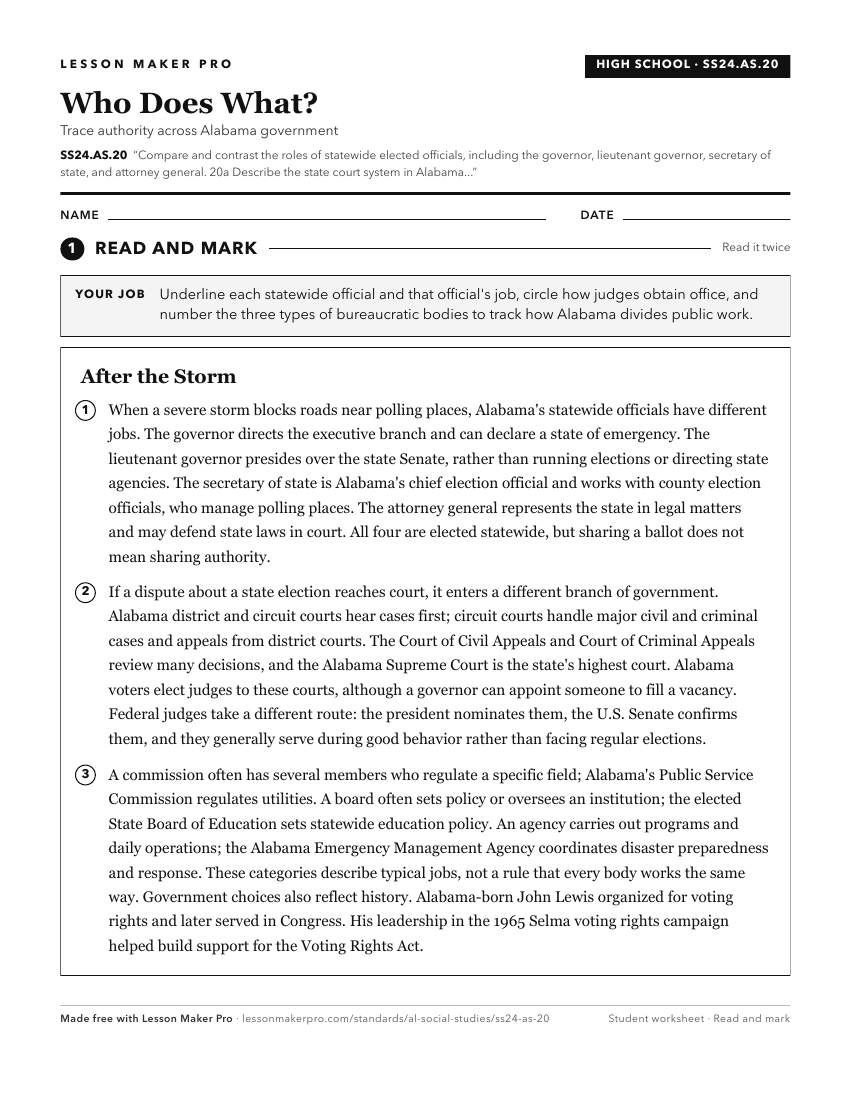
A ready-to-print activity worksheet aligned to SS24.AS.20, with an answer key for the teacher on its own page. No account needed.
PDF, US Letter, prints cleanly in black and white.
Download the worksheetKeep exploring
Related Standards
- SS24.2.2a
Compare the state and national governments in respect to their powers, roles, and leaders.
- SS24.1.2
Identify public offices in the community and state and the duties associated with them.
- SS24.6.10a
Compare and contrast the division of power among levels of government in unitary, federal, and confederate styles of governance.
- SS24.USG.13a
Compare specific functions, organizations, and purposes of local and state governments.
Turn this cluster into a lesson
Grade, subject, topic, and the complete cluster are prefilled. Create one free, no account needed.
Also for this cluster:Make a WorksheetMake a QuizMake a Sub Lesson