Alabama Social Studies SS24.8.15a
The Standard
- SS24.8.15
- Analyze the development of parliamentary and constitutional government in England.
Compare and contrast the political philosophies of Thomas Hobbes and John Locke.
2024 Alabama Course of Study: Social Studies
Teacher's field guide
What This Standard Means
What Students Need to Do
- Students explain why Hobbes favored strong government to keep peace and why Locke wanted government to protect natural rights. They explain that both described a social contract, but disagreed about limits on government power.
What Mastery Looks Like
- Given a ruler who restricts protests to prevent unrest, students can predict how each thinker might respond and give a reason. They can explain that both saw protection as a reason to form a government.
Common Misconceptions
- Students may think Hobbes believed people had no rights at all, but he held that people could defend their own lives. Others think Locke opposed government, when he argued for government with limited powers and public consent.
How to Assess It
- Exit ticket: A ruler bans public protests to prevent unrest. Write one sentence explaining how Hobbes might judge the ban and one explaining how Locke might judge it.
Lesson moves
Ways to Teach It
Give pairs six statement cards about safety, consent, and rights; have them sort the cards under Hobbes, Locke, or both and defend one choice.
Ask students to write: When, if ever, should people be able to replace a ruler? Explain how Hobbes and Locke would answer.
Read four short government policies aloud; teams hold up Hobbes or Locke cards and give one reason for each choice.
Compare a school rule set without student input to one students voted on; ask which arrangement each thinker would trust and why.
Free download
Printable SS24.8.15a Worksheet
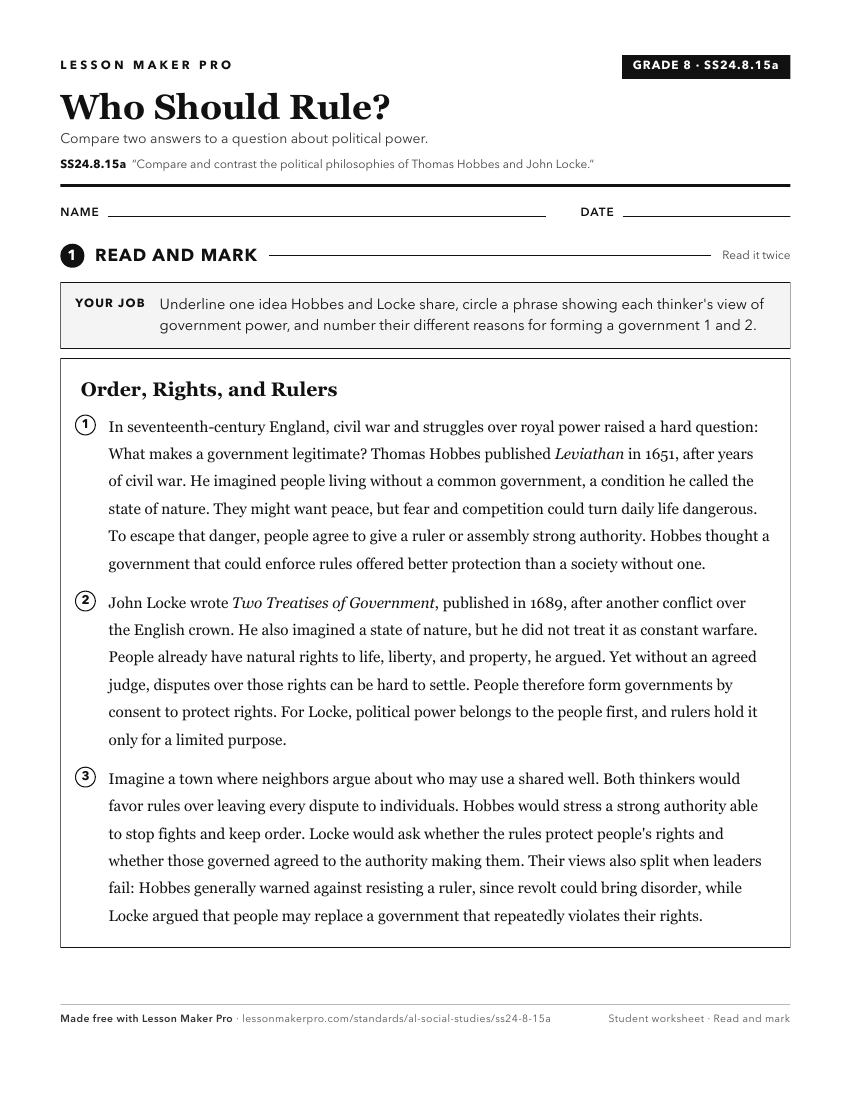
A ready-to-print activity worksheet aligned to SS24.8.15a, with an answer key for the teacher on its own page. No account needed.
PDF, US Letter, prints cleanly in black and white.
Download the worksheetKeep exploring
Related Standards
- SS24.6.12b
Compare and contrast how Enlightenment thinkers interpreted the purpose of government and the relationship between government and citizens.
- SS24.USG.1
Explain how Enlightenment principles informed the structure and principles of the United States government, its founding documents, its institutions, and the di...
- SS24.WH.1a
Compare and contrast the emerging ideas of Adam Smith, Jean-Jacques Rousseau, John Locke, Mary Wollstonecraft, Montesquieu, and Voltaire.
- SS24.US1.9c
Compare and contrast political and sectional views on economic policies, and explain how these views led to political conflict during the early to mid-nineteent...
Turn this exact standard into a lesson
Grade, subject, topic, and the complete standard are prefilled. Create one free, no account needed.
Also for this standard:Make a WorksheetMake a QuizMake a Sub Lesson