Alabama Social Studies SS24.USG.1
The Standard
Explain how Enlightenment principles informed the structure and principles of the United States government, its founding documents, its institutions, and the division of powers, as set forth in Leviathan (Thomas Hobbes, 1651), Two Treatises of Government (John Locke, 1689), The Spirit of the Laws (Montesquieu, 1748), The Social Contract (Jean-Jacques Rousseau, 1762), and Treatise on Tolerance (Voltaire, 1763)
2024 Alabama Course of Study: Social Studies
Teacher's field guide
What This Standard Means
What Students Need to Do
- Students connect five writers’ ideas about rights, consent, tolerance, authority, and divided power to the Declaration, Constitution, and Bill of Rights. They explain how those ideas appear in government institutions and limits on power.
What Mastery Looks Like
- Students link Locke’s rights and consent to the Declaration, Montesquieu’s divided power to three branches, and Voltaire’s tolerance to religious liberty. They connect Rousseau’s popular sovereignty to “We the People” and contrast Hobbes’s strong sovereign with constitutional limits. They distinguish powers divided among branches from powers divided between federal and state governments.
Common Misconceptions
- Students may think every writer favored democracy, though Hobbes defended a powerful sovereign. They may confuse the three branches with federal and state governments, or assume the founders copied each writer’s ideas exactly.
How to Assess It
- Exit ticket: Show the Constitution’s three branch headings and the First Amendment’s religion clauses. Ask students to name a writer connected to each and explain how each limits government power.
Lesson moves
Ways to Teach It
Give groups five thinker quote cards and excerpts from the Declaration, Constitution, and Bill of Rights; have them match ideas and flag Hobbes’s tension.
Ask whether “We the People” fits Hobbes or Rousseau better; students write two sentences citing a short passage from each writer.
Play power sort: teams place “declare war,” “veto a bill,” and “run public schools” under Congress, president, or states.
Write “Federal judge blocks presidential order” on the board; students name both branches and explain why one can limit the other.
Free download
Printable SS24.USG.1 Worksheet
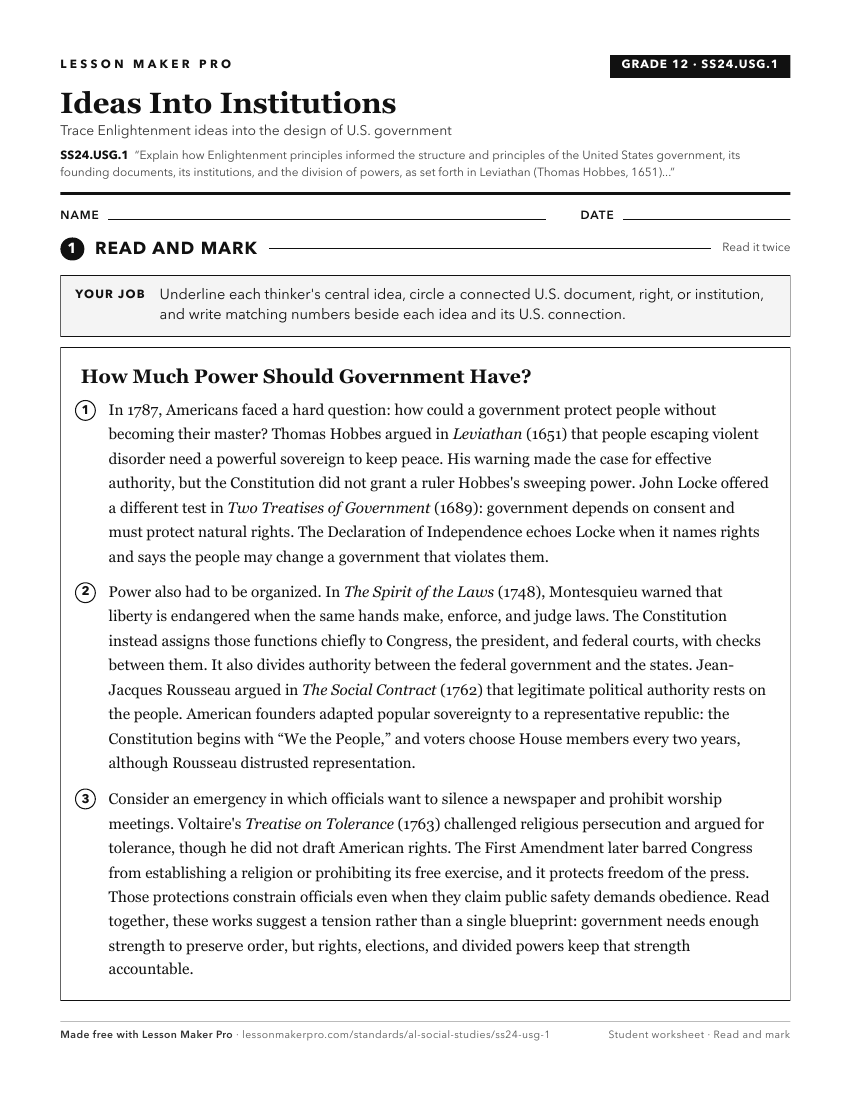
A ready-to-print activity worksheet aligned to SS24.USG.1, with an answer key for the teacher on its own page. No account needed.
PDF, US Letter, prints cleanly in black and white.
Download the worksheetKeep exploring
Related Standards
- SS24.6.12b
Compare and contrast how Enlightenment thinkers interpreted the purpose of government and the relationship between government and citizens.
- SS24.WH.1a
Compare and contrast the emerging ideas of Adam Smith, Jean-Jacques Rousseau, John Locke, Mary Wollstonecraft, Montesquieu, and Voltaire.
- SS24.WH.1b
Summarize the influence of the Enlightenment on the American Revolution.
- SS24.6.12
Explain how forms of governments established prior to the founding of the United States influenced the formation of the new nation’s system of government.
Turn this exact standard into a lesson
Grade, subject, topic, and the complete standard are prefilled. Create one free, no account needed.
Also for this standard:Make a WorksheetMake a QuizMake a Sub Lesson