Alabama Social Studies SS24.8.14
Standard Cluster
Summarize the rise of absolutism and explain how absolute monarchy differed from governing practices in Europe before the seventeenth century. 14a Explain how the Thirty Years’ War and the Peace of Westphalia led to the rise of absolutism. 14b Analyze the rise of absolutism in France under Louis XIV, including the divine right of kings. 14c Describe how the development of absolutism affected governments in Russia and Prussia under the reigns of Peter the Great, Frederick the Great, and Catherine the Great. 14d Summarize the influence of the Ottoman Empire on the political landscape of European monarchies.
2024 Alabama Course of Study: Social Studies
Cluster contents
Standards in This Cluster
SS24.8.14 is a cluster heading. These are the individual standards under it.
- SS24.8.14a
Explain how the Thirty Years’ War and the Peace of Westphalia led to the rise of absolutism.
- SS24.8.14b
Analyze the rise of absolutism in France under Louis XIV, including the divine right of kings.
- SS24.8.14c
Describe how the development of absolutism affected governments in Russia and Prussia under the reigns of Peter the Great, Frederick the Great, and Catherine th...
- SS24.8.14d
Summarize the influence of the Ottoman Empire on the political landscape of European monarchies.
Teacher's field guide
What This Cluster Means
What Students Need to Do
- Students explain how the Thirty Years’ War and the Peace of Westphalia shifted power toward territorial rulers. They compare that power with earlier limits from nobles, assemblies, and churches. They examine Louis XIV, Peter the Great, Catherine the Great, and Frederick the Great, then explain how Ottoman power shaped European alliances.
What Mastery Looks Like
- A student can explain why war and control over territory helped some monarchs gain power without claiming that every ruler became absolute. They can use Louis XIV’s divine right, Peter’s reforms, Catherine’s support for nobles, and Frederick’s army as examples. They can explain why Ottoman expansion led European rulers to seek allies.
Common Misconceptions
- Students may think Westphalia made every European king absolute, though many rulers still faced limits. They may think divine right meant the pope appointed kings, or that Catherine took power away from nobles. Some overlook the role of Ottoman wars in European alliances.
How to Assess It
- Exit ticket: Name one limit on kings before 1600 and explain one way war or Westphalia helped rulers gain power. Give an example from one monarch studied and name one effect of Ottoman pressure on European alliances.
Lesson moves
Ways to Teach It
Give pairs king, noble, assembly, and church cards; have them allocate tax and army tokens for a medieval kingdom and Louis XIV’s France.
Ask students to write: Did the Peace of Westphalia make rulers absolute? Support your answer with one fact from the Thirty Years’ War.
Play a ruler sorting game: match Louis XIV, Peter, Catherine, and Frederick to Versailles, westernizing reforms, noble privileges, and a strong army.
Use a modern map to locate Vienna and Istanbul, then trace the 1683 Ottoman campaign and explain why European rulers formed alliances.
Free download
Printable SS24.8.14 Worksheet
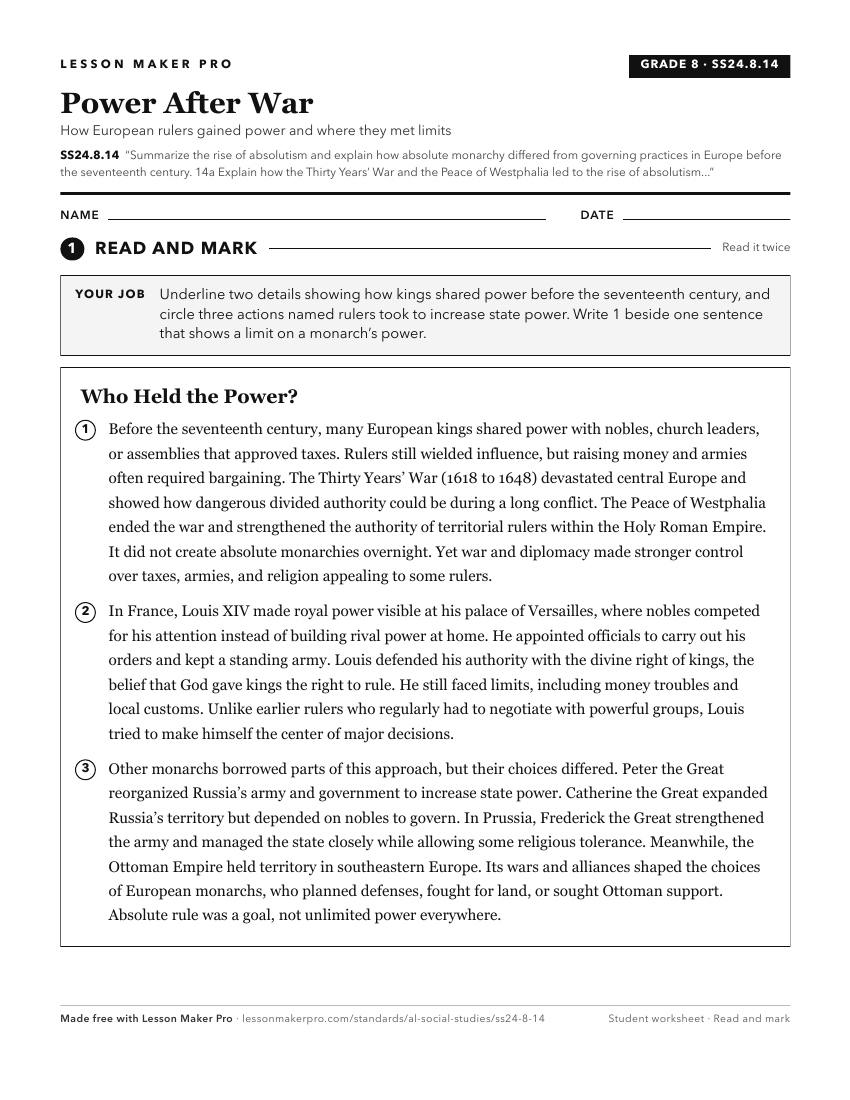
A ready-to-print activity worksheet aligned to SS24.8.14, with an answer key for the teacher on its own page. No account needed.
PDF, US Letter, prints cleanly in black and white.
Download the worksheetKeep exploring
Related Standards
Turn this cluster into a lesson
Grade, subject, topic, and the complete cluster are prefilled. Create one free, no account needed.
Also for this cluster:Make a WorksheetMake a QuizMake a Sub Lesson