Alabama Social Studies SS24.7.8
Standard Cluster
Explain the geographic and cultural development of ancient Israel. 8a Identify the central tenets of Judaism, and compare Judaism to the polytheistic religions of other Mediterranean ancient civilizations. 8b Describe the establishment of a unified Israel under Kings Saul, David, and Solomon. 8c Outline the multiple exiles of the Jewish people and their return to Israel, from the establishment of the nation through the Roman destruction of Jerusalem in 70 AD/CE.
2024 Alabama Course of Study: Social Studies
Cluster contents
Standards in This Cluster
SS24.7.8 is a cluster heading. These are the individual standards under it.
- SS24.7.8a
Identify the central tenets of Judaism, and compare Judaism to the polytheistic religions of other Mediterranean ancient civilizations.
- SS24.7.8b
Describe the establishment of a unified Israel under Kings Saul, David, and Solomon.
- SS24.7.8c
Outline the multiple exiles of the Jewish people and their return to Israel, from the establishment of the nation through the Roman destruction of Jerusalem in ...
Teacher's field guide
What This Cluster Means
What Students Need to Do
- Students locate ancient Israel on a map and connect its location to trade, travel, and invasion. They compare Jewish belief in one God, covenant, and Torah with Egyptian worship of many gods. They put the kings, exiles, return, and destruction of Jerusalem in order.
What Mastery Looks Like
- A student can point to Jerusalem and the Jordan River and explain how nearby routes brought trade and invading armies. They can name Saul, David, and Solomon in order and explain how Jewish beliefs differed from Egyptian polytheism. They can distinguish Assyria's conquest of Israel from Babylon's exile of people from Judah, then place the Persian return and Rome's destruction of Jerusalem in 70 CE.
Common Misconceptions
- Students sometimes put Solomon before David or confuse Israel with Judah after the kingdom split. They may treat the Assyrian and Babylonian conquests as one event. They may think every Jew left after 70 CE or that Judaism had many gods like neighboring religions.
How to Assess It
- Give students a half-sheet with a blank map and seven timeline boxes. Ask them to mark Jerusalem and the Jordan River, order Saul, David, Solomon, the Assyrian conquest, Babylonian exile, Persian return, and 70 CE, then name one difference between Jewish and Egyptian beliefs about gods.
Lesson moves
Ways to Teach It
Give pairs a blank eastern Mediterranean map and yarn; have them mark Jerusalem, the Jordan River, and routes toward Egypt and Mesopotamia.
Read Exodus 20:3 beside a card naming Ra, Isis, and Osiris; ask students how the two traditions differ.
Hand groups event cards for Saul, David, Solomon, the kingdom split, Assyrian conquest, Babylonian exile, Persian return, and 70 CE; check their order.
Use a current road map to trace a route from Jerusalem to the Mediterranean coast, then compare it with an ancient terrain map.
Free download
Printable SS24.7.8 Worksheet
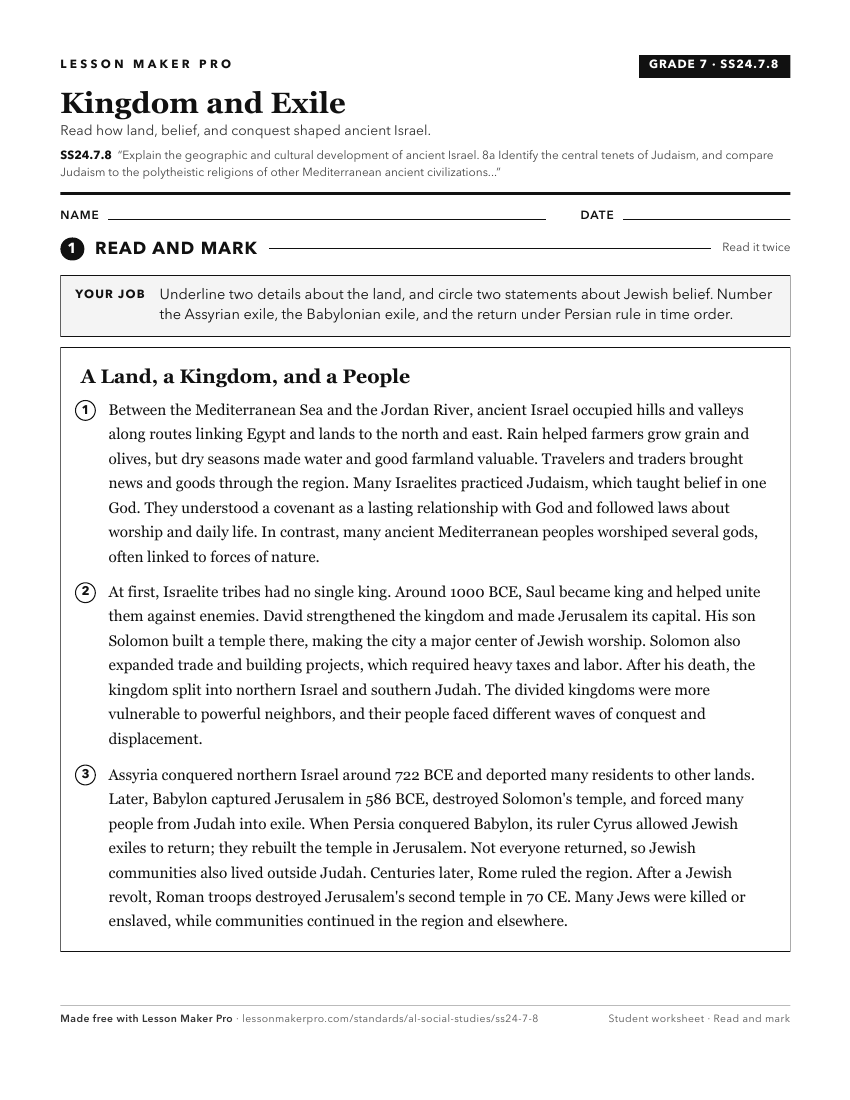
A ready-to-print activity worksheet aligned to SS24.7.8, with an answer key for the teacher on its own page. No account needed.
PDF, US Letter, prints cleanly in black and white.
Download the worksheetKeep exploring
Related Standards
- SS24.7.11
Trace the development and growth of societies in Southwest Asia, including the Assyrians, Phoenicians, and Persian Empire.
- SS24.7.14a
Explain the development of the polis and analyze how geography affected the process, including Athens and Sparta.
- SS24.8.6a
Analyze how geographic and environmental factors led to the location and growth of Indigenous societies.
Turn this cluster into a lesson
Grade, subject, topic, and the complete cluster are prefilled. Create one free, no account needed.
Also for this cluster:Make a WorksheetMake a QuizMake a Sub Lesson