Alabama Social Studies SS24.5.1
Standard Cluster
Explain how industry and agriculture expanded during the early twentieth century. 1a Summarize how important entrepreneurs and inventors shaped American society, and identify Alabamians who contributed to these innovations. 1b Describe the emergence of new forms of economic activity in Alabama at the turn of the twentieth century, including the iron, steel, textile, and timber industries. 1c Outline reasons for the growth of urban areas at the turn of the twentieth century, including Birmingham.
2024 Alabama Course of Study: Social Studies
Cluster contents
Standards in This Cluster
SS24.5.1 is a cluster heading. These are the individual standards under it.
- SS24.5.1a
Summarize how important entrepreneurs and inventors shaped American society, and identify Alabamians who contributed to these innovations.
- SS24.5.1b
Describe the emergence of new forms of economic activity in Alabama at the turn of the twentieth century, including the iron, steel, textile, and timber industr...
- SS24.5.1c
Outline reasons for the growth of urban areas at the turn of the twentieth century, including Birmingham.
Teacher's field guide
What This Cluster Means
What Students Need to Do
- Students explain how farms and factories produced more goods in the early 1900s. They identify Mary Anderson’s windshield wiper and George Washington Carver’s farming research. They describe Alabama’s iron, steel, textile, and timber industries and explain why Birmingham grew.
What Mastery Looks Like
- Students match cotton with cloth, trees with lumber, and iron ore, coal, and limestone with Birmingham’s iron and steel plants. They explain how Henry Ford made cars cheaper, Anderson made driving safer, and Carver helped farmers improve their crops. They name jobs and rail access as reasons people moved to Birmingham.
Common Misconceptions
- Students may say Carver invented peanut butter, rather than describing his crop research at Tuskegee. They may think Birmingham grew because of cotton alone and miss the role of coal, iron ore, limestone, railroads, and plant jobs.
How to Assess It
- Exit ticket: Explain how cotton supported textile mills, name one farming practice Carver taught, and give two reasons Birmingham grew.
Lesson moves
Ways to Teach It
Give groups a blank Birmingham map and cards labeled coal, iron ore, limestone, railroads, and steel plants; have them arrange the cards.
Have students write two sentences comparing the problems Mary Anderson’s windshield wiper and George Washington Carver’s crop research helped solve.
Play a matching race with material and product cards: cotton and cloth, trees and lumber, iron ore and steel.
Show a photo of Birmingham’s Sloss Furnaces and a current city map; students locate the site and name two reasons it operated there.
Free download
Printable SS24.5.1 Worksheet
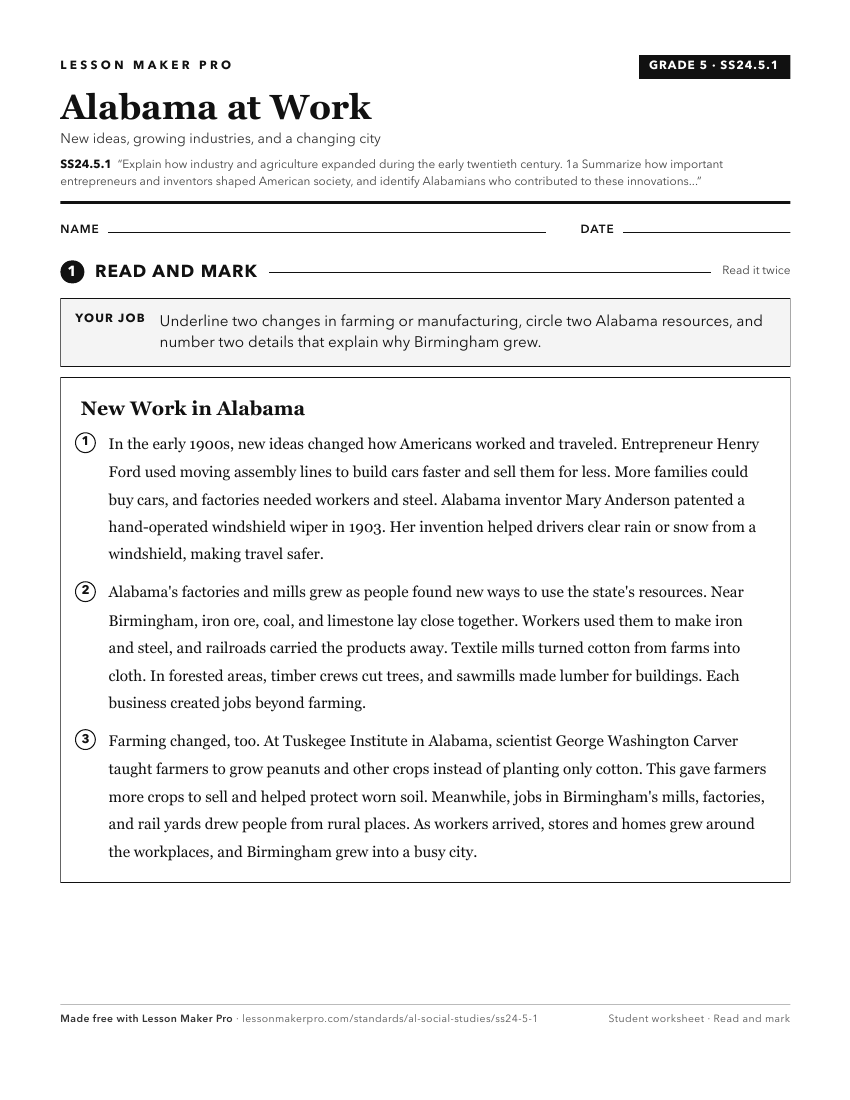
A ready-to-print activity worksheet aligned to SS24.5.1, with an answer key for the teacher on its own page. No account needed.
PDF, US Letter, prints cleanly in black and white.
Download the worksheetKeep exploring
Related Standards
- SS24.4.16a
Describe how industry, trade, farming, and the rise of Populism changed Alabama after the Civil War and shaped its economy and communities in the late 1800s.
- SS24.HG.13a
Describe how cultural diffusion and changes in technology have advanced agricultural methods over time.
- SS24.US2.3a
Describe how the automobile, cinema, print media, and radio contributed to the rise in mass culture, economic growth, and expansion of the middle class during t...
Turn this cluster into a lesson
Grade, subject, topic, and the complete cluster are prefilled. Create one free, no account needed.
Also for this cluster:Make a WorksheetMake a QuizMake a Sub Lesson