Alabama Social Studies SS24.4.12
Standard Cluster
Explain how the growth of the United States from 1812 to 1860 changed economic and social life in Alabama. 12a Identify different trades and occupations of Alabamians in the period from 1812 to 1860. 12b Describe the living and working conditions and the cultural practices of enslaved persons engaged in skilled trades, domestic roles, and agricultural production, including effects of the domestic slave trade on their lives. 12c Explain how the Indian Removal Act (1830), Second Creek War (1836) and economic policies affected the lives, rights, and territories of the Muscogee Creek, Cherokee, Choctaw, Chickasaw, and Seminole tribes. 12d Describe the development of educational institutions in Alabama from statehood through 1860.
2024 Alabama Course of Study: Social Studies
Cluster contents
Standards in This Cluster
SS24.4.12 is a cluster heading. These are the individual standards under it.
- SS24.4.12a
Identify different trades and occupations of Alabamians in the period from 1812 to 1860.
- SS24.4.12b
Describe the living and working conditions and the cultural practices of enslaved persons engaged in skilled trades, domestic roles, and agricultural production...
- SS24.4.12c
Explain how the Indian Removal Act (1830), Second Creek War (1836) and economic policies affected the lives, rights, and territories of the Muscogee Creek, Cher...
- SS24.4.12d
Describe the development of educational institutions in Alabama from statehood through 1860.
Teacher's field guide
What This Cluster Means
What Students Need to Do
- Students use maps and short accounts to explain who gained farmland and jobs as Alabama grew, and who lost land or freedom. They compare enslaved people's field, household, and skilled work, including family traditions and the harm caused by forced sales. They connect removal, the 1836 Creek conflict, and land sales to changes for Native nations, then look at who could attend new schools.
What Mastery Looks Like
- Students can show on a Southeast map that the Muscogee, Cherokee, Choctaw, Chickasaw, and Seminole had different homelands and faced removal. They compare an enslaved cook, blacksmith, and field worker, and explain how forced sales separated families despite efforts to keep traditions alive. They identify academies and early public schools and explain why access was unequal.
Common Misconceptions
- Some students think the five Native nations shared one Alabama homeland or moved away by choice. Others think all enslaved workers picked cotton or that skilled work meant freedom. They may assume new schools admitted every child.
How to Assess It
- Exit ticket: Name one job in 1850s Alabama. Explain how cotton farming affected an enslaved family and a Native nation, then name one type of school available at the time.
Lesson moves
Ways to Teach It
Overlay a Southeast Native homelands map and an 1860 Alabama farm map; mark where cotton farms spread after forced removal.
Read a short account of an enslaved blacksmith, then ask, "Could a skilled job protect his family from forced sale? Why?"
Play two card-sort rounds: match job cards to workplaces, then match 1850s child profiles to an academy, public school, or no school.
Locate the Tallapoosa River on current and Muscogee homeland maps, then discuss how removal changed control of nearby land.
Free download
Printable SS24.4.12 Worksheet
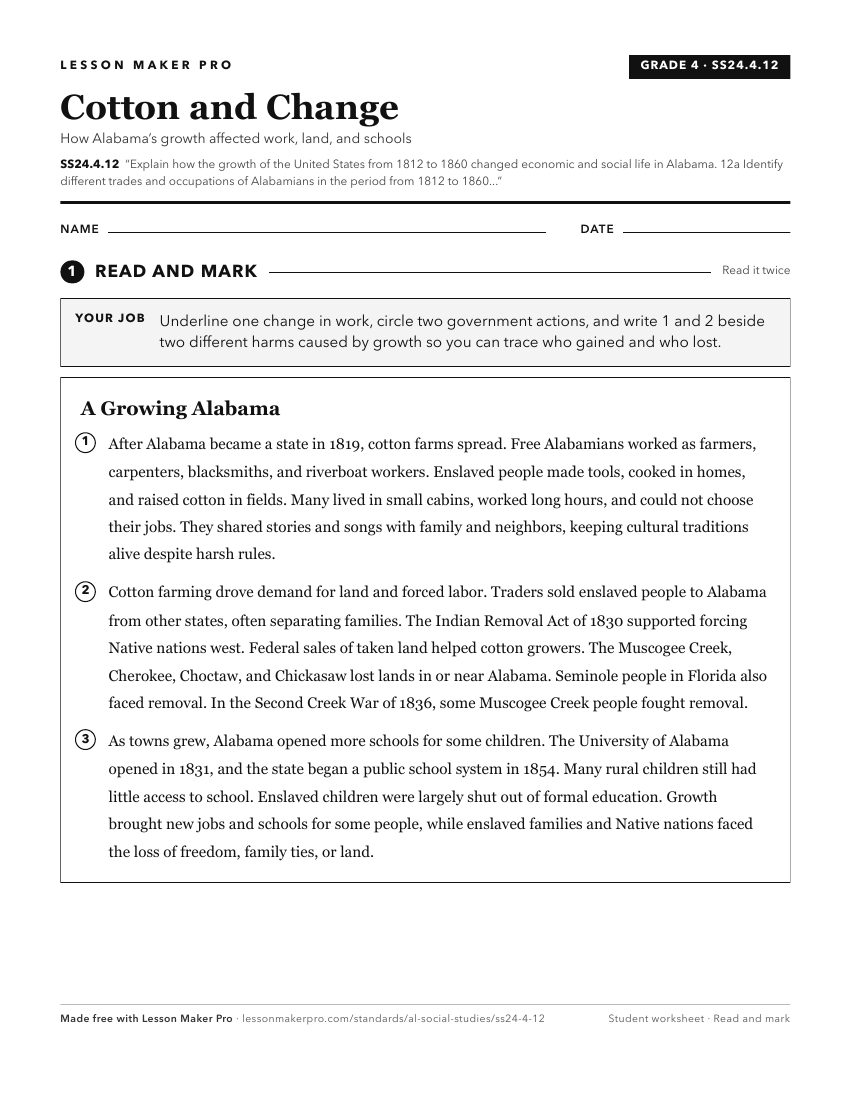
A ready-to-print activity worksheet aligned to SS24.4.12, with an answer key for the teacher on its own page. No account needed.
PDF, US Letter, prints cleanly in black and white.
Download the worksheetKeep exploring
Related Standards
- SS24.4.16a
Describe how industry, trade, farming, and the rise of Populism changed Alabama after the Civil War and shaped its economy and communities in the late 1800s.
- SS24.5.1b
Describe the emergence of new forms of economic activity in Alabama at the turn of the twentieth century, including the iron, steel, textile, and timber industr...
- SS24.5.4
Analyze the reasons for increased immigration to, and migration within, the United States and Alabama in the early twentieth century.
- SS24.4.10
Explain how “Alabama fever” influenced Alabama's settlement, economic growth, and political development, leading to statehood and the 1819 constitution.
Turn this cluster into a lesson
Grade, subject, topic, and the complete cluster are prefilled. Create one free, no account needed.
Also for this cluster:Make a WorksheetMake a QuizMake a Sub Lesson