Alabama Science PS.2.b
The Standard
- PS.2
- Obtain, evaluate, and communicate information to compare and contrast the properties of mechanical and electromagnetic waves as they relate to real-world applications.
Develop models to illustrate reflection, refraction, interference, and diffraction.
2023 Alabama Course of Study: Science · Waves and Their Applications in Technologies for Information Transfer
Teacher's field guide
What This Standard Means
What Students Need to Do
- Students draw models of waves bouncing off a surface, bending at a boundary, spreading through a gap, and overlapping. They show the wave direction before and after each event.
What Mastery Looks Like
- A student draws a reflected ray with equal incoming and outgoing angles and shows light bending toward the normal as it enters water. Their wavefront sketches show spreading at a narrow gap and places where overlapping waves add or cancel.
Common Misconceptions
- Students may draw refraction as a bounce instead of a bend. They may think waves stop at a narrow gap or disappear when they cancel.
How to Assess It
- Exit ticket: Sketch wavefronts at a mirror, a water boundary, a narrow gap, and two wave sources. Label where waves bounce, bend, spread, and add or cancel.
Lesson moves
Ways to Teach It
In a shallow water tray, use a ruler wall, a submerged plastic sheet, a gap between rulers, and two fingertips to make and sketch wave patterns.
Show sketches of waves meeting a wall, shallow water, and a narrow gap; ask students to write what changes in each sketch.
Give groups wavefront cards and event cards; have them match each pair and explain the wave pattern.
Sketch how sound spreads through an open classroom door and light reflects off a hallway window; label the gap and reflecting surface.
Free download
Printable PS.2.b Worksheet
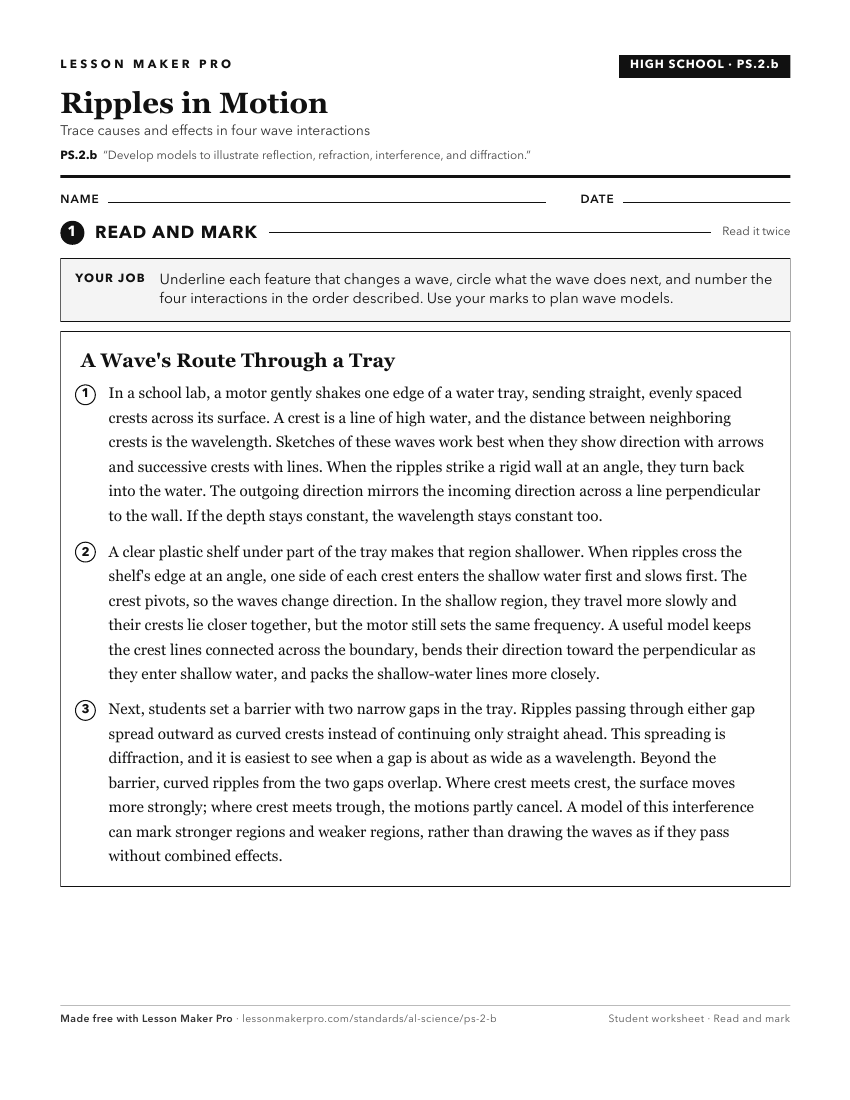
A ready-to-print activity worksheet aligned to PS.2.b, with an answer key for the teacher on its own page. No account needed.
PDF, US Letter, prints cleanly in black and white.
Download the worksheetKeep exploring
Related Standards
- 8.17.a
Use models to compare and contrast light and sound wave behaviors, including reflection, refraction, diffraction, and speed, as waves propagate and interact wit...
- 4.5
Develop and use models to describe amplitude and wavelength patterns and how waves can cause objects to move.
- PS.2.d
Use models to illustrate the Doppler effect and explain the changes in sound perception associated with it.
Turn this exact standard into a lesson
Grade, subject, topic, and the complete standard are prefilled. Create one free, no account needed.
Also for this standard:Make a WorksheetMake a QuizMake a Sub Lesson