Alabama Science BIO.3.b
The Standard
- BIO.3
- Develop and use models to explain how events during the cell cycle lead to the formation of new cells and repair of multicellular organisms, including cell growth, DNA replication, separation of chromosomes, and separation of cell contents.
Using observations of cell growth, construct an explanation of how the cell cycle leads to differentiation in tissue development.
2023 Alabama Course of Study: Science
Teacher's field guide
What This Standard Means
What Students Need to Do
- Students compare images of growing tissue. They look for cells that are dividing and cells that have taken on different shapes. They explain how division adds cells and how some cells become specialized as tissue develops.
What Mastery Looks Like
- A student can point out dividing cells near a root tip and root hair cells farther back. They can explain that division makes more cells, while signals help cells develop different jobs.
Common Misconceptions
- Students may think mitosis directly turns a cell into a different cell type. Some assume every new cell keeps dividing, or that specialized cells have different DNA.
How to Assess It
- Show two labeled root images, one with dividing cells and one with root hair cells. Ask: What do you observe, and how do division and specialization help the root grow?
Lesson moves
Ways to Teach It
Give pairs printed root images; have them mark dividing cells near the tip and circle root hair cells farther back.
Ask: If root cells share DNA, why do cells near the tip look different from root hair cells farther back?
Give teams cards for growth, DNA copying, division, and cell signals; have them arrange the cards to explain root hair formation.
Show photos of a healing scrape across several days; ask how cell division and specialization rebuild the outer skin layer.
Free download
Printable BIO.3.b Worksheet
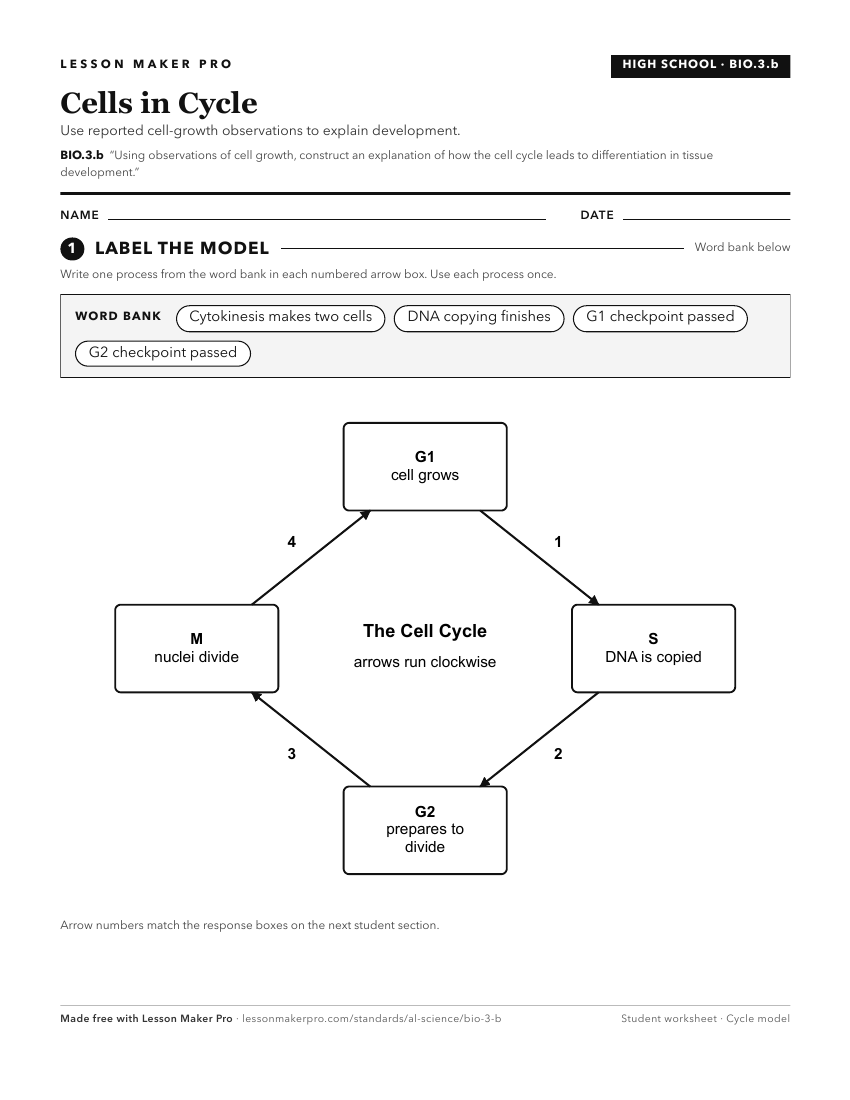
A ready-to-print activity worksheet aligned to BIO.3.b, with an answer key for the teacher on its own page. No account needed.
PDF, US Letter, prints cleanly in black and white.
Download the worksheetKeep exploring
Related Standards
- BIO.3
Develop and use models to explain how events during the cell cycle lead to the formation of new cells and repair of multicellular organisms, including cell grow...
- HAP.1
Obtain, evaluate, and communicate information to explain how differences in cellular structure (mitochondria, cytoskeletal structure, endoplasmic reticulum, cel...
- 7.3
Construct an explanation of how the process of mitosis maintains complex organisms and ensures new cells with identical genetic information.
- BIO.1
Engage in evidence-based argument to relate a cell’s function to the structure, function, and diversity of its components.
Turn this exact standard into a lesson
Grade, subject, topic, and the complete standard are prefilled. Create one free, no account needed.
Also for this standard:Make a WorksheetMake a QuizMake a Sub Lesson