Alabama Science BIO.2.a
The Standard
- BIO.2
- Obtain and evaluate information to explain the role of DNA and RNA in transcription and translation leading to protein synthesis and cellular function.
Use a model to describe the structure and sequence of DNA, including nucleotide structure, base pairing, and the structure of the helix.
2023 Alabama Course of Study: Science
Teacher's field guide
What This Standard Means
What Students Need to Do
- Students use a DNA model to show that each nucleotide has a sugar, phosphate, and base. They show how A pairs with T and C pairs with G, and how two strands twist into a helix. They use one strand's base order to find the matching strand.
What Mastery Looks Like
- Students place sugar and phosphate along the outside of a twisted ladder, with paired bases across the middle. Given ACGT, they write TGCA and identify one complete nucleotide in their model.
Common Misconceptions
- Students may pair A with C or put sugar and phosphate on the ladder's rungs. Some label a base alone as a nucleotide or draw the helix as one strand.
How to Assess It
- Exit ticket: Draw a twisted DNA ladder for ACGT, add the matching strand, and circle one nucleotide. Label its sugar, phosphate, and base.
Lesson moves
Ways to Teach It
Give pairs colored paper sugars, phosphates, and bases; have them assemble matching strands, then twist the paper ladder into a helix.
Show two DNA sketches, one with base pairs as rungs and one with phosphates as rungs; ask which is accurate and why.
Hand out four-base sequence cards and letter tiles; students build each matching strand, then check the pairs with a partner.
Give students a mock forensic DNA strand, ACGT, and suspect strands TGCA, TCCA, and AGCA; ask which strand pairs with the sample.
Free download
Printable BIO.2.a Worksheet
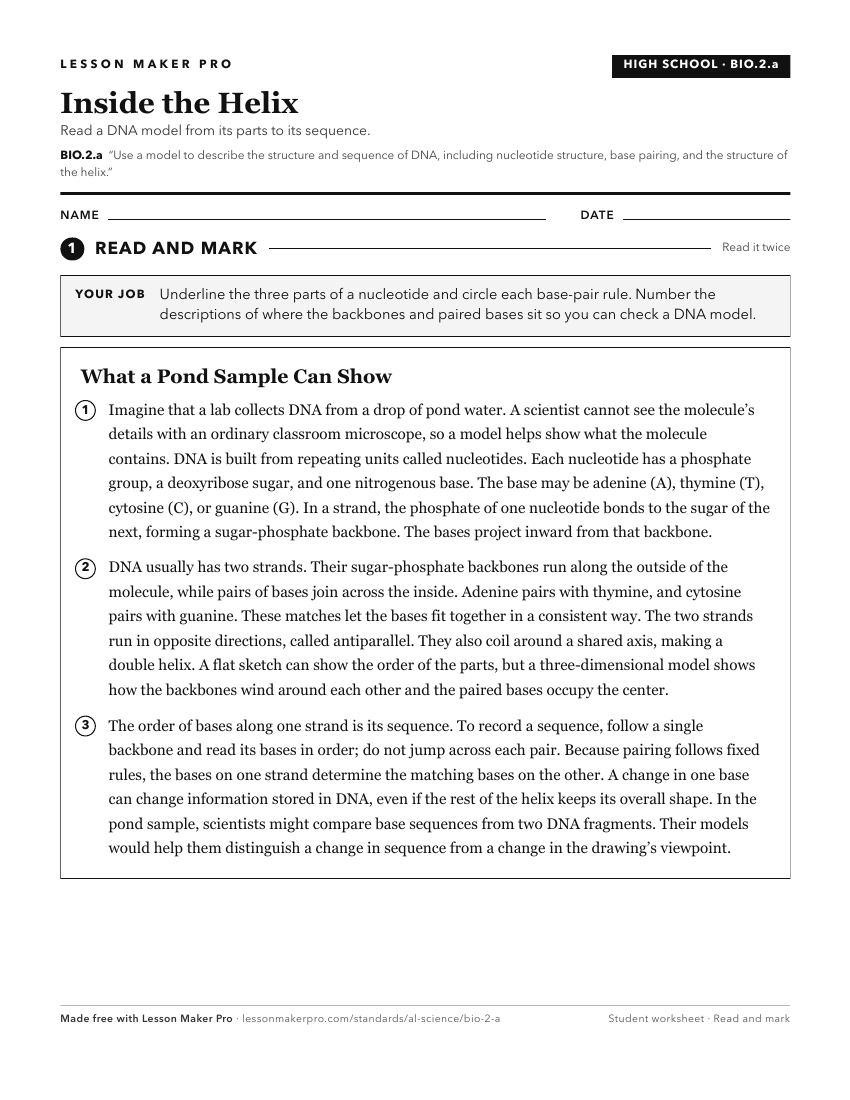
A ready-to-print activity worksheet aligned to BIO.2.a, with an answer key for the teacher on its own page. No account needed.
PDF, US Letter, prints cleanly in black and white.
Download the worksheetKeep exploring
Related Standards
- 7.12
Develop and use models to explain how genes are expressed through the flow of genetic information from DNA to RNA to a functional protein.
- BIO.2
Obtain and evaluate information to explain the role of DNA and RNA in transcription and translation leading to protein synthesis and cellular function.
- BIO.4.a
Use models to illustrate how the structural characteristics of lipids and proteins in the cell membrane regulate cellular processes.
- 7.1
Develop and use a model to explain the functions of specific cell structures necessary for maintaining a stable environment, including the cell membrane, cell w...
Turn this exact standard into a lesson
Grade, subject, topic, and the complete standard are prefilled. Create one free, no account needed.
Also for this standard:Make a WorksheetMake a QuizMake a Sub Lesson