Alabama Science BIO.2
Standard Cluster
Obtain and evaluate information to explain the role of DNA and RNA in transcription and translation leading to protein synthesis and cellular function. a. Use a model to describe the structure and sequence of DNA, including nucleotide structure, base pairing, and the structure of the helix. b. Obtain and evaluate information to explore additional functions and regulatory roles of RNA, DNA, and protein, including their roles in gene expression and cellular differentiation. c. Obtain, evaluate, and communicate information regarding how DNA and genetic technology apply to daily life.
2023 Alabama Course of Study: Science · From Molecules to Organisms: Structures and Processes
Cluster contents
Standards in This Cluster
BIO.2 is a cluster heading. These are the individual standards under it.
- BIO.2.a
Use a model to describe the structure and sequence of DNA, including nucleotide structure, base pairing, and the structure of the helix.
- BIO.2.b
Obtain and evaluate information to explore additional functions and regulatory roles of RNA, DNA, and protein, including their roles in gene expression and cell...
- BIO.2.c
Obtain, evaluate, and communicate information regarding how DNA and genetic technology apply to daily life.
Teacher's field guide
What This Cluster Means
What Students Need to Do
- Students model paired DNA nucleotides in a double helix and trace a gene through RNA to protein. They explain how RNA and proteins help control which genes a cell uses. They check evidence about uses of DNA technology, such as genetic testing.
What Mastery Looks Like
- Given a DNA template strand, a student writes the matching mRNA and uses a codon chart to find the amino acids. They label the sugar, phosphate, and bases in a DNA model. They explain why two cells with the same DNA can make different proteins.
Common Misconceptions
- Students may put thymine in RNA or pair adenine with cytosine. Some think DNA directly becomes protein or that skin and muscle cells have different DNA. Others treat a genetic test result as a certain prediction of disease.
How to Assess It
- Exit ticket: Give students the DNA template strand TAC GGA and a codon chart. Ask for the matching mRNA, the amino acids, and one reason another cell might make less of that protein.
Lesson moves
Ways to Teach It
Use paper nucleotide cutouts to build paired DNA strands, twist them into a helix, and label each sugar, phosphate, and base.
Show a diagram of microRNA blocking protein production, then ask: How could this make two cells with the same DNA act differently?
Give teams a template strand and codon chart; have them transcribe, translate, and check another team's answer.
Compare a genetic testing company's disease-risk claim with a public health fact sheet; underline what each says the test can and cannot predict.
Free download
Printable BIO.2 Worksheet
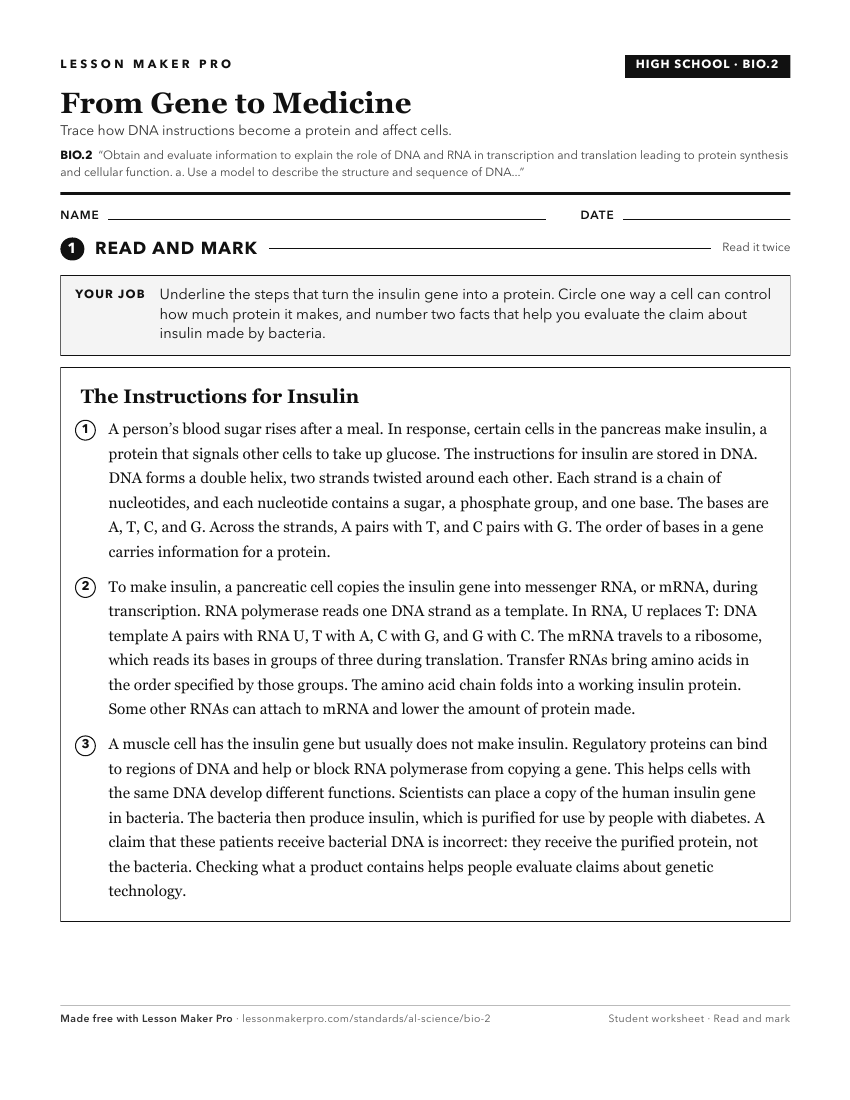
A ready-to-print activity worksheet aligned to BIO.2, with an answer key for the teacher on its own page. No account needed.
PDF, US Letter, prints cleanly in black and white.
Download the worksheetKeep exploring
Related Standards
Turn this cluster into a lesson
Grade, subject, topic, and the complete cluster are prefilled. Create one free, no account needed.
Also for this cluster:Make a WorksheetMake a QuizMake a Sub Lesson