Alabama Science 6.6
Standard Cluster
Construct an evidence-based explanation of how tectonic plate movement impacts Earth’s surface over geological time. a. Construct an evidence-based explanation of how Earth's internal energy flows between its surface and its interior. b. Construct a scientific explanation of how the movement of lithospheric plates can cause major geologic events and form Earth’s surface features, including convergent, divergent, and transform boundaries; earthquakes; and volcanoes. c. Provide evidence of past plate movements, using data regarding the distribution of fossils, rocks, continental shapes, and seafloor structures.
2023 Alabama Course of Study: Science · Earth’s Systems: Materials and Processes
Cluster contents
Standards in This Cluster
6.6 is a cluster heading. These are the individual standards under it.
- 6.6.a
Construct an evidence-based explanation of how Earth's internal energy flows between its surface and its interior.
- 6.6.b
Construct a scientific explanation of how the movement of lithospheric plates can cause major geologic events and form Earth’s surface features, including conve...
- 6.6.c
Provide evidence of past plate movements, using data regarding the distribution of fossils, rocks, continental shapes, and seafloor structures.
Teacher's field guide
What This Cluster Means
What Students Need to Do
- Students use fossils, rocks, continental shapes, and seafloor patterns to show how plates moved over millions of years. They explain how heat moves from Earth’s interior toward the surface. They connect plate collisions, separation, and sideways motion to landforms, earthquakes, and volcanoes.
What Mastery Looks Like
- Given a plate map, a student identifies where plates collide, pull apart, or slide past each other. They predict likely features and hazards at each boundary. They use map evidence to explain where plates were in the past.
Common Misconceptions
- Students may think plates move fast enough to see or that every boundary makes volcanoes. Some think the mantle is entirely liquid or that sunlight drives plate movement. Others treat matching coastlines as proof without checking fossils, rocks, or seafloor patterns.
How to Assess It
- Draw two plates pulling apart, with matching fossils on opposite coasts and striped seafloor rock. Ask students to name the boundary, describe how heat from below helps form new crust, and cite two clues that the plates moved.
Lesson moves
Ways to Teach It
Move two foam sheets together, apart, and past each other; use clay to mark mountains and new crust, and pencil lines to mark faults.
Give pairs a map of matching fossils and rocks on separated coasts; ask them to write a two-sentence explanation of past plate movement.
Give pairs boundary cards with arrows; have them sort the cards by motion, then match each one with a landform or hazard card.
Open a USGS earthquake map of the Pacific coast; have students mark quake clusters and compare them with plate boundaries on an atlas map.
Free download
Printable 6.6 Worksheet
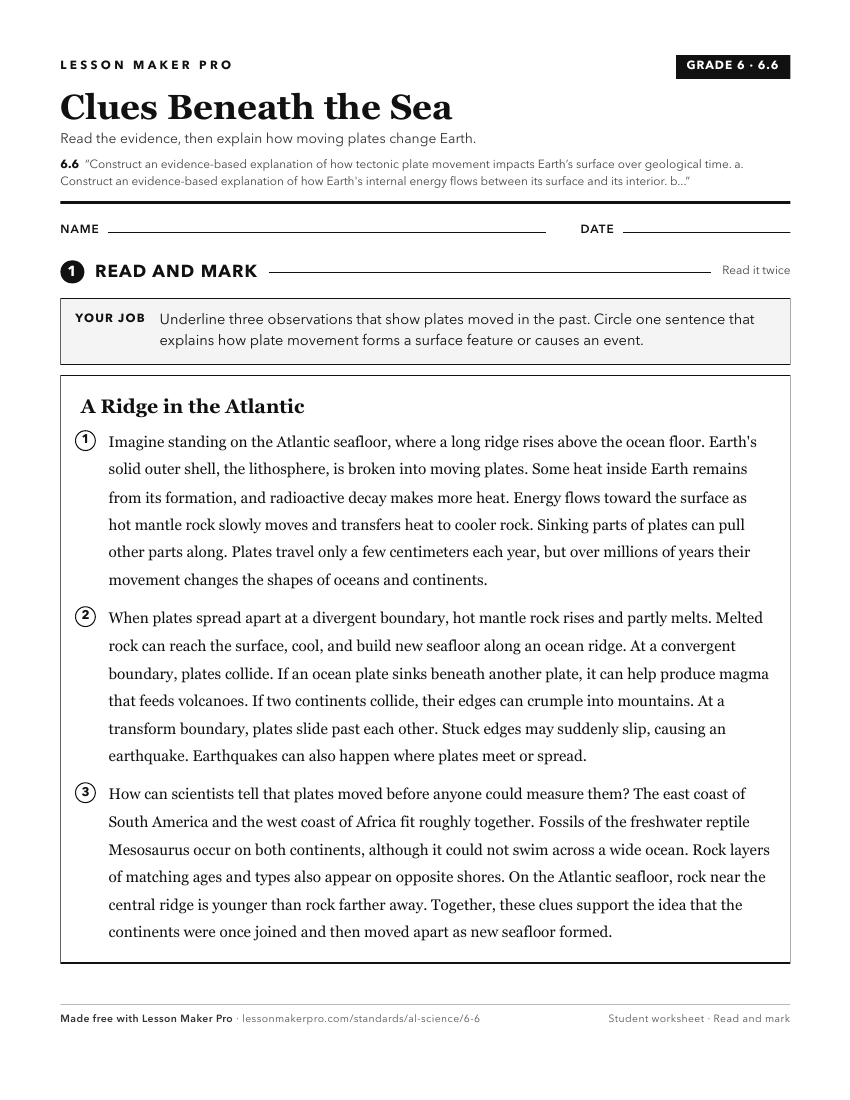
A ready-to-print activity worksheet aligned to 6.6, with an answer key for the teacher on its own page. No account needed.
PDF, US Letter, prints cleanly in black and white.
Download the worksheetKeep exploring
Related Standards
Turn this cluster into a lesson
Grade, subject, topic, and the complete cluster are prefilled. Create one free, no account needed.
Also for this cluster:Make a WorksheetMake a QuizMake a Sub Lesson