Alabama Math MM.D3D.A
Standard Cluster
Two- and three-dimensional representations, coordinates systems, geometric transformations, and scale models are useful tools in planning, designing, and constructing solutions to real-world problems.
2019 Alabama Course of Study: Mathematics · Mathematical Modeling
Cluster contents
Standards in This Cluster
MM.D3D.A is a cluster heading. These are the individual standards under it.
- MM.D3D.A.9
Use the Mathematical Modeling Cycle to solve real-world problems involving the design of three-dimensional objects.
- MM.D3D.A.10
Construct a two-dimensional visual representation of a three-dimensional object or structure.
- MM.D3D.A.10.a
Determine the level of precision and the appropriate tools for taking the measurements in constructing a two-dimensional visual representation of a three-dimens...
- MM.D3D.A.10.b
Create an elevation drawing to represent a given solid structure, using technology where appropriate.
- MM.D3D.A.10.c
Determine which measurements cannot be taken directly and must be calculated based on other measurements when constructing a two-dimensional visual representati...
- MM.D3D.A.10.d
Determine an appropriate means to visually represent an object or structure, such as drawings on paper or graphics on computer screens.
- MM.D3D.A.11
Plot coordinates on a three-dimensional Cartesian coordinate system and use relationships between coordinates to solve design problems.
- MM.D3D.A.11.a
Describe the features of a three-dimensional Cartesian coordinate system and use them to graph points.
- MM.D3D.A.11.b
Graph a point in space as the vertex of a right prism drawn in the appropriate octant with edges along the x, y, and z axes.
- MM.D3D.A.11.c
Find the distance between two objects in space given the coordinates of each.
- MM.D3D.A.11.d
Find the midpoint between two objects in space given the coordinates of each.
- MM.D3D.A.12
Use technology and other tools to explore the results of simple transformations using three-dimensional coordinates, including translations in the x, y, and/or ...
- MM.D3D.A.13
Create a scale model of a complex three-dimensional structure based on observed measurements and indirect measurements, using translations, reflections, rotatio...
Teacher's field guide
What This Cluster Means
What Students Need to Do
- Students draw a scaled floor plan and build a matching 3D model. They use coordinates to place objects, rotate them to test layouts, and convert model measurements to real lengths.
What Mastery Looks Like
- A student can place a desk at given coordinates on a scaled room plan, rotate it, and show its new footprint. Their 3D model matches the plan, including the desk’s height.
Common Misconceptions
- Students may forget what one grid square represents and draw objects at the wrong size. They may swap x and y, mistake a rotation for a reflection, or show height as floor space.
How to Assess It
- Exit ticket: Draw a 12-by-10-foot room at one square per two feet. Place the center of a 4-by-2-foot table at (4, 4), rotate it 90 degrees, and sketch its new position with a 3-foot height.
Lesson moves
Ways to Teach It
Cut paper furniture footprints for a 12-by-10-foot room at one square per two feet, then fold matching card models.
Ask: How could turning a 4-by-2-foot desk make room beside a door, and which coordinates would change?
Give pairs desk coordinate cards; each partner plots and rotates a desk 90 degrees, then checks the other's new footprint.
Measure the classroom door, then use a scale drawing to test whether a 3-by-2-foot shelf can pass through when turned.
Free download
Printable MM.D3D.A Worksheet
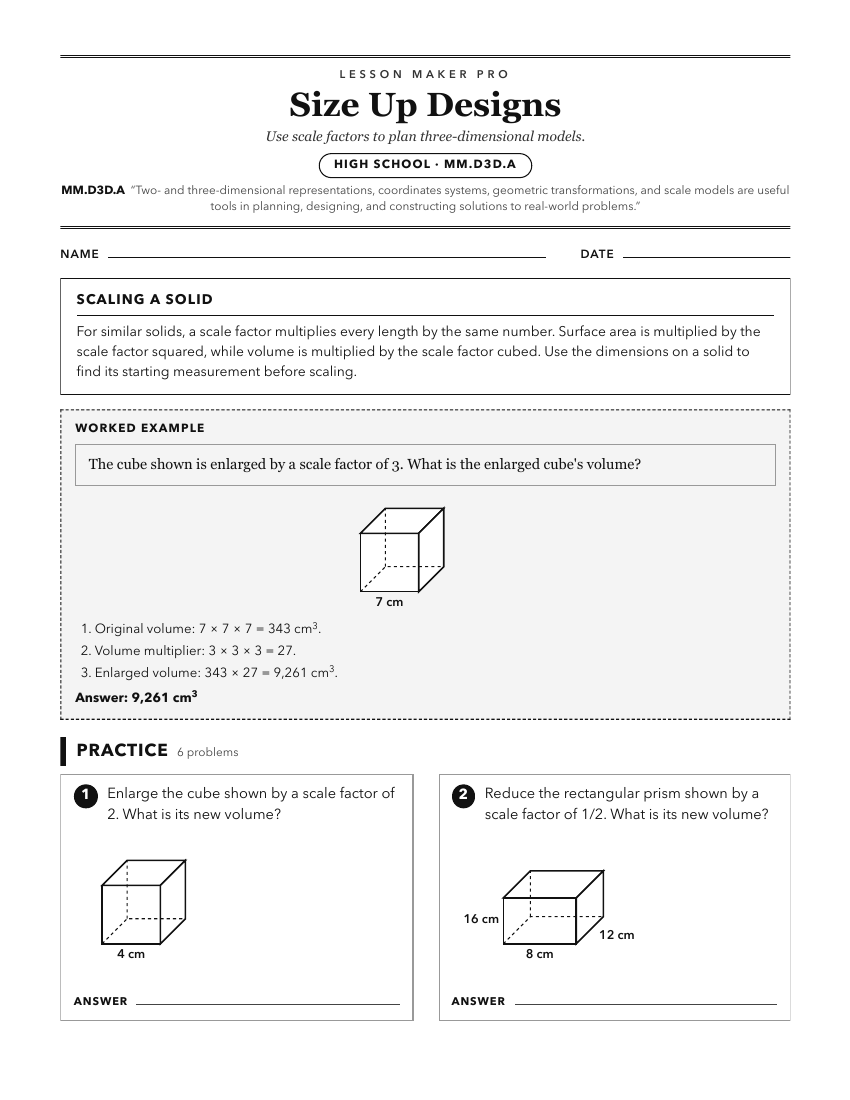
A ready-to-print activity worksheet aligned to MM.D3D.A, with an answer key for the teacher on its own page. No account needed.
PDF, US Letter, prints cleanly in black and white.
Download the worksheetKeep exploring
Related Standards
Turn this cluster into a lesson
Grade, subject, topic, and the complete cluster are prefilled. Create one free, no account needed.
Also for this cluster:Make a WorksheetMake a QuizMake a Sub Lesson