Alabama Math MM.D3D.A.10
Standard Cluster
- MM.D3D.A
- Two- and three-dimensional representations, coordinates systems, geometric transformations, and scale models are useful tools in planning, designing, and constructing solutions to real-world problems.
Construct a two-dimensional visual representation of a three-dimensional object or structure. a. Determine the level of precision and the appropriate tools for taking the measurements in constructing a two-dimensional visual representation of a three-dimensional object or structure. b. Create an elevation drawing to represent a given solid structure, using technology where appropriate. c. Determine which measurements cannot be taken directly and must be calculated based on other measurements when constructing a two-dimensional visual representation of a three-dimensional object or structure. d. Determine an appropriate means to visually represent an object or structure, such as drawings on paper or graphics on computer screens.
2019 Alabama Course of Study: Mathematics
Cluster contents
Standards in This Cluster
MM.D3D.A.10 is a cluster heading. These are the individual standards under it.
- MM.D3D.A.10.a
Determine the level of precision and the appropriate tools for taking the measurements in constructing a two-dimensional visual representation of a three-dimens...
- MM.D3D.A.10.b
Create an elevation drawing to represent a given solid structure, using technology where appropriate.
- MM.D3D.A.10.c
Determine which measurements cannot be taken directly and must be calculated based on other measurements when constructing a two-dimensional visual representati...
- MM.D3D.A.10.d
Determine an appropriate means to visually represent an object or structure, such as drawings on paper or graphics on computer screens.
Teacher's field guide
What This Cluster Means
What Students Need to Do
- Students measure a solid object and decide how precise the measurements need to be. They draw a labeled, flat view of one side, calculate lengths they cannot measure directly, and choose paper or a drawing app for the job.
What Mastery Looks Like
- A student chooses a ruler for a small model or a tape measure for furniture. Their front elevation has accurate labels and proportions. They can find an inside width by subtracting both side-panel thicknesses from the outside width.
Common Misconceptions
- Students may draw a 3D sketch instead of a flat elevation, or mix front and side measurements. They often subtract only one side panel when finding an inside width. Some report millimeter precision from rough centimeter measurements.
How to Assess It
- Show a photo of an 80 cm wide cabinet with two 2 cm side panels. Ask students to draw and label its front elevation, find the inside width, and name a tool and precision for checking the outside width.
Lesson moves
Ways to Teach It
Stack three cardboard boxes, measure the front with a ruler, and draw a labeled front elevation on grid paper.
Show a bookshelf photo and ask, “Which view best shows shelf heights, and which lengths would you calculate rather than measure?”
Give pairs three front-view sketches of a box stack; have them correct mislabeled widths on grid paper or in a drawing app.
Measure a classroom bookshelf to the nearest centimeter, subtract both side-panel thicknesses, and draw a front view for planning new shelves.
Free download
Printable MM.D3D.A.10 Worksheet
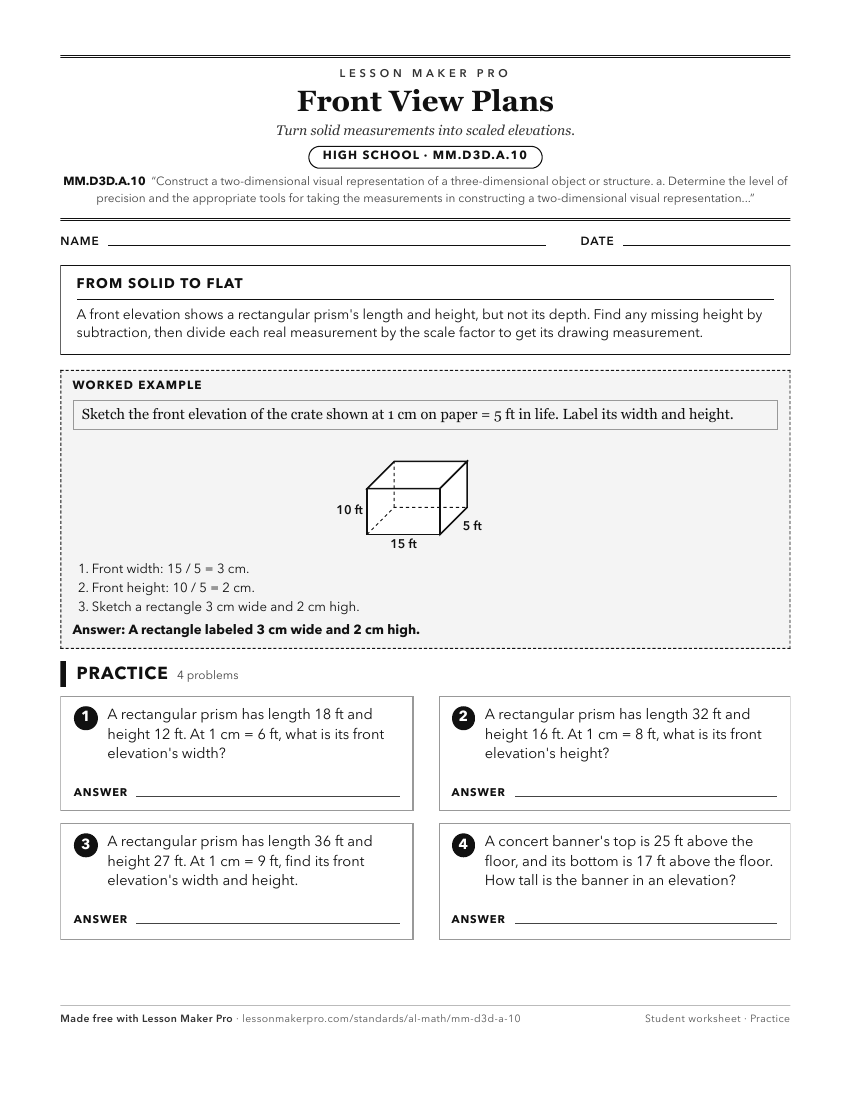
A ready-to-print activity worksheet aligned to MM.D3D.A.10, with an answer key for the teacher on its own page. No account needed.
PDF, US Letter, prints cleanly in black and white.
Download the worksheetTurn this cluster into a lesson
Grade, subject, topic, and the complete cluster are prefilled. Create one free, no account needed.
Also for this cluster:Make a WorksheetMake a QuizMake a Sub Lesson