Alabama Math MM.D3D.A.11
Standard Cluster
- MM.D3D.A
- Two- and three-dimensional representations, coordinates systems, geometric transformations, and scale models are useful tools in planning, designing, and constructing solutions to real-world problems.
Plot coordinates on a three-dimensional Cartesian coordinate system and use relationships between coordinates to solve design problems. a. Describe the features of a three-dimensional Cartesian coordinate system and use them to graph points. b. Graph a point in space as the vertex of a right prism drawn in the appropriate octant with edges along the x, y, and z axes. c. Find the distance between two objects in space given the coordinates of each. d. Find the midpoint between two objects in space given the coordinates of each.
2019 Alabama Course of Study: Mathematics
Cluster contents
Standards in This Cluster
MM.D3D.A.11 is a cluster heading. These are the individual standards under it.
- MM.D3D.A.11.a
Describe the features of a three-dimensional Cartesian coordinate system and use them to graph points.
- MM.D3D.A.11.b
Graph a point in space as the vertex of a right prism drawn in the appropriate octant with edges along the x, y, and z axes.
- MM.D3D.A.11.c
Find the distance between two objects in space given the coordinates of each.
- MM.D3D.A.11.d
Find the midpoint between two objects in space given the coordinates of each.
Teacher's field guide
What This Cluster Means
What Students Need to Do
- Students locate points using signed x, y, and z values. They sketch a prism from the origin to a point, then calculate the straight-line distance and midpoint between two locations.
What Mastery Looks Like
- Students plot signed coordinates in the correct octant and draw prism edges parallel to the axes. For (1,2,3) and (4,6,15), they find a distance of 13 and a midpoint of (2.5,4,9).
Common Misconceptions
- Students may treat the third coordinate as another sideways move or place a negative coordinate on the positive side of an axis. Some use only x and y to find distance, or average distances instead of coordinates to find the midpoint.
How to Assess It
- Exit ticket: Plot (-2,3,1), draw a prism from the origin to that point, then find its distance and midpoint from (2,6,13).
Lesson moves
Ways to Teach It
On paper axes, stack unit cubes into a 2-by-3-by-1 prism toward negative x, positive y, and positive z; label its far vertex.
Ask students why (1,2,3) and (1,2,8) lie on the same vertical line but are five units apart.
Play coordinate bingo: call signed triples while students plot each point on a three-axis sketch and cover the matching entry on their cards.
Map two drones at (1,2,3) and (4,6,15) meters; calculate their separation and midpoint for placing a relay drone.
Free download
Printable MM.D3D.A.11 Worksheet
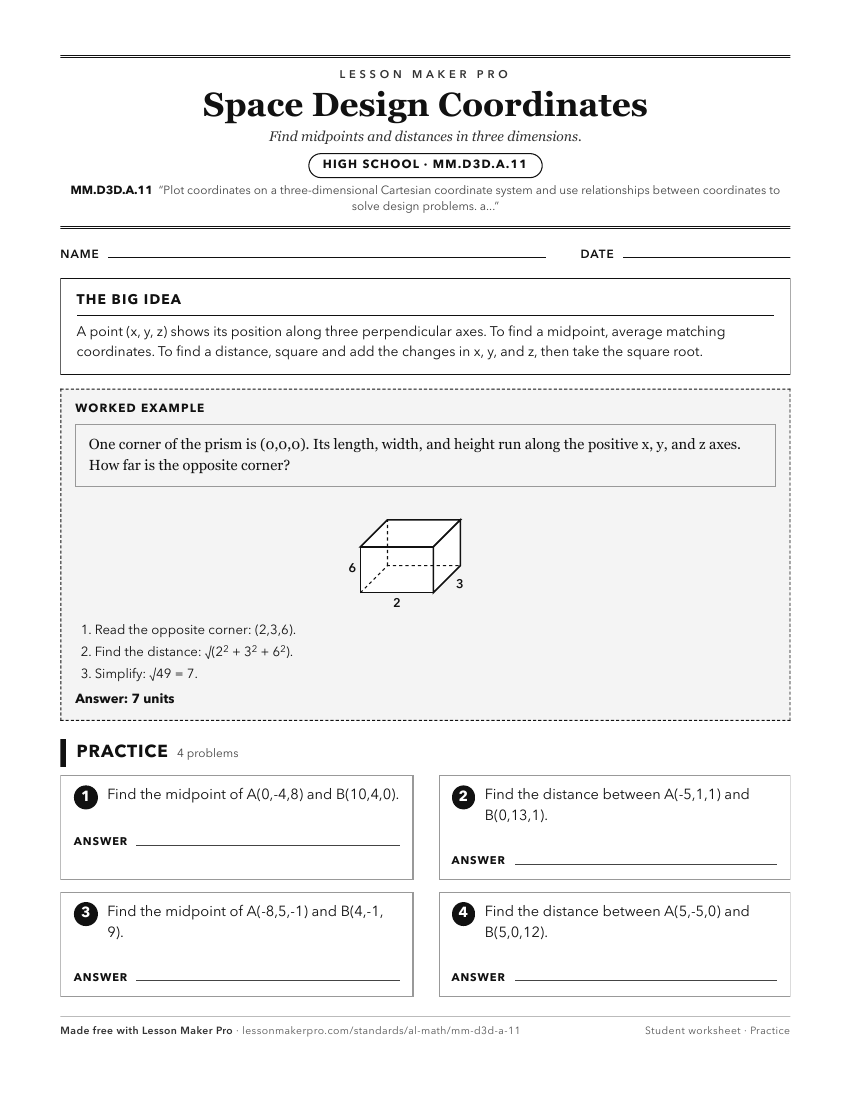
A ready-to-print activity worksheet aligned to MM.D3D.A.11, with an answer key for the teacher on its own page. No account needed.
PDF, US Letter, prints cleanly in black and white.
Download the worksheetKeep exploring
Related Standards
- MM.D3D.A
Two- and three-dimensional representations, coordinates systems, geometric transformations, and scale models are useful tools in planning, designing, and constr...
- 6.GM.A
Graph polygons in the coordinate plane to solve real-world and mathematical problems.
- 6.NS.C.11.d
Solve real-world and mathematical problems by graphing points in all four quadrants of the coordinate plane, including finding distances between points with the...
Turn this cluster into a lesson
Grade, subject, topic, and the complete cluster are prefilled. Create one free, no account needed.
Also for this cluster:Make a WorksheetMake a QuizMake a Sub Lesson