Alabama Math K.DA.A.15
Standard Cluster
- K.DA.A
- Collect and analyze data and interpret results.
Classify objects into given categories of 10 or fewer; count the number of objects in each category and sort the categories by count. a. Categorize data on Venn diagrams, pictographs, and "yes-no" charts using real objects, symbolic representations, or pictorial representations.
2019 Alabama Course of Study: Mathematics · Collect and analyze data and interpret results.
Cluster contents
Standards in This Cluster
K.DA.A.15 is a cluster heading. These are the individual standards under it.
Teacher's field guide
What This Cluster Means
What Students Need to Do
- Students sort up to ten objects into given groups using a Venn diagram, picture graph, or yes-no chart. They count each group and order the groups from fewest to most.
What Mastery Looks Like
- A student puts an object that fits both Venn labels in the overlap and uses one picture for each object on a graph. They count each group, compare the totals, and spot ties.
Common Misconceptions
- Students may put an object that fits both Venn labels in just one circle. They may leave items off the no side of a yes-no chart or count one object twice on a picture graph.
How to Assess It
- Give students picture cards showing three apples, two bananas, and three pears. Ask them to make a picture graph, count each fruit, and list the fruits from fewest to most.
Lesson moves
Ways to Teach It
Give pairs eight paper shapes and a Venn mat labeled red and round; have them place the shapes and count each region.
Show four toy cars under yes and two toy bears under no on a has-wheels chart; ask, 'Which side has more?'
Give pairs three cat, two dog, and two bird cards; have them build a picture graph and order the groups by count.
At snack time, sort eight snack pictures into fruit, cracker, and other; count each group and name the largest.
Free download
Printable K.DA.A.15 Worksheet
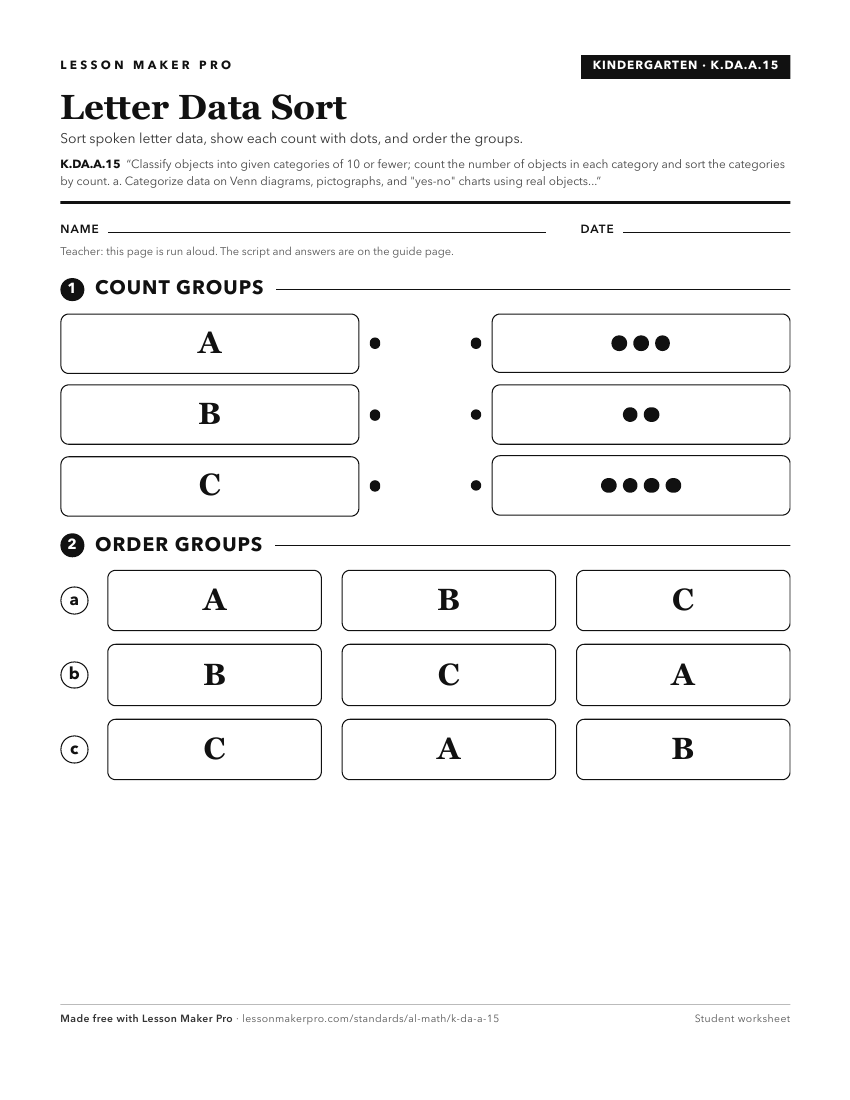
A ready-to-print activity worksheet aligned to K.DA.A.15, with an answer key for the teacher on its own page. No account needed.
PDF, US Letter, prints cleanly in black and white.
Download the worksheetKeep exploring
Related Standards
- 1.DA.A.16.c
Determine "how many" in each category using up to three categories of data.
- K.FC.C.6
Orally identify whether the number of objects in one group is greater/more than, less/fewer than, or equal/the same as the number of objects in another group, i...
- 1.DA.A.16.d
Determine "how many more" or "how many less" are in one category than in another using data organized into two or three categories.
- K.FC.B.5.b
Count using no more than 10 concrete objects in a scattered configuration.
Turn this cluster into a lesson
Grade, subject, topic, and the complete cluster are prefilled. Create one free, no account needed.
Also for this cluster:Make a WorksheetMake a QuizMake a Sub Lesson