Alabama Math GDA.GM.H.31
Standard Cluster
- GDA.GM.H
- Proof is the means by which we demonstrate whether a statement is true or false mathematically, and proofs can be communicated in a variety of ways (e.g., two-column, paragraph).
Justify whether conjectures are true or false in order to prove theorems and then apply those theorems in solving problems, communicating proofs in a variety of ways, including flow chart, two-column, and paragraph formats. a. Investigate, prove, and apply theorems about lines and angles, including but not limited to: vertical angles are congruent; when a transversal crosses parallel lines, alternate interior angles are congruent and corresponding angles are congruent; the points on the perpendicular bisector of a line segment are those equidistant from the segment's endpoints. b. Investigate, prove, and apply theorems about triangles, including but not limited to: the sum of the measures of the interior angles of a triangle is 180˚; the base angles of isosceles triangles are congruent; the segment joining the midpoints of two sides of a triangle is parallel to the third side and half the length; a line parallel to one side of a triangle divides the other two proportionally, and conversely; the Pythagorean Theorem using triangle similarity. c. Investigate, prove, and apply theorems about parallelograms and other quadrilaterals, including but not limited to both necessary and sufficient conditions for parallelograms and other quadrilaterals, as well as relationships among kinds of quadrilaterals.
2019 Alabama Course of Study: Mathematics
Cluster contents
Standards in This Cluster
GDA.GM.H.31 is a cluster heading. These are the individual standards under it.
- GDA.GM.H.31.a
Investigate, prove, and apply theorems about lines and angles, including but not limited to: vertical angles are congruent; when a transversal crosses parallel ...
- GDA.GM.H.31.b
Investigate, prove, and apply theorems about triangles, including but not limited to: the sum of the measures of the interior angles of a triangle is 180˚; the ...
- GDA.GM.H.31.c
Investigate, prove, and apply theorems about parallelograms and other quadrilaterals, including but not limited to both necessary and sufficient conditions for ...
Teacher's field guide
What This Cluster Means
What Students Need to Do
- Students test geometry claims with diagrams, measurements, proofs, and counterexamples. They prove and use facts about angles, triangles, and quadrilaterals. They explain their reasoning in flow charts, two-column proofs, or paragraphs.
What Mastery Looks Like
- A student can prove why vertical angles are equal, then use that fact to find an unknown angle. They can use triangle and quadrilateral properties to solve problems and tell when a claim needs a counterexample instead of a proof.
Common Misconceptions
- Students may treat a diagram that looks right as proof. They may assume a theorem works in reverse, such as claiming one pair of equal opposite sides makes a parallelogram. They may also use a triangle midpoint result without checking that both points are midpoints.
How to Assess It
- Exit ticket: Draw two intersecting lines and prove that one pair of vertical angles is congruent. Use two linear pairs and write a two-column proof.
Lesson moves
Ways to Teach It
Fold a paper segment so its endpoints meet, mark three points on the crease, and measure each point's distance from both endpoints.
Ask: If one pair of opposite sides is equal, must a quadrilateral be a parallelogram? Draw a counterexample and explain it.
Give pairs diagram cards with missing angles in triangles, parallel lines, and quadrilaterals; award a point only when they name the theorem used.
Draw a triangular roof truss with a beam joining two side midpoints, then calculate the beam length from the base span.
Free download
Printable GDA.GM.H.31 Worksheet
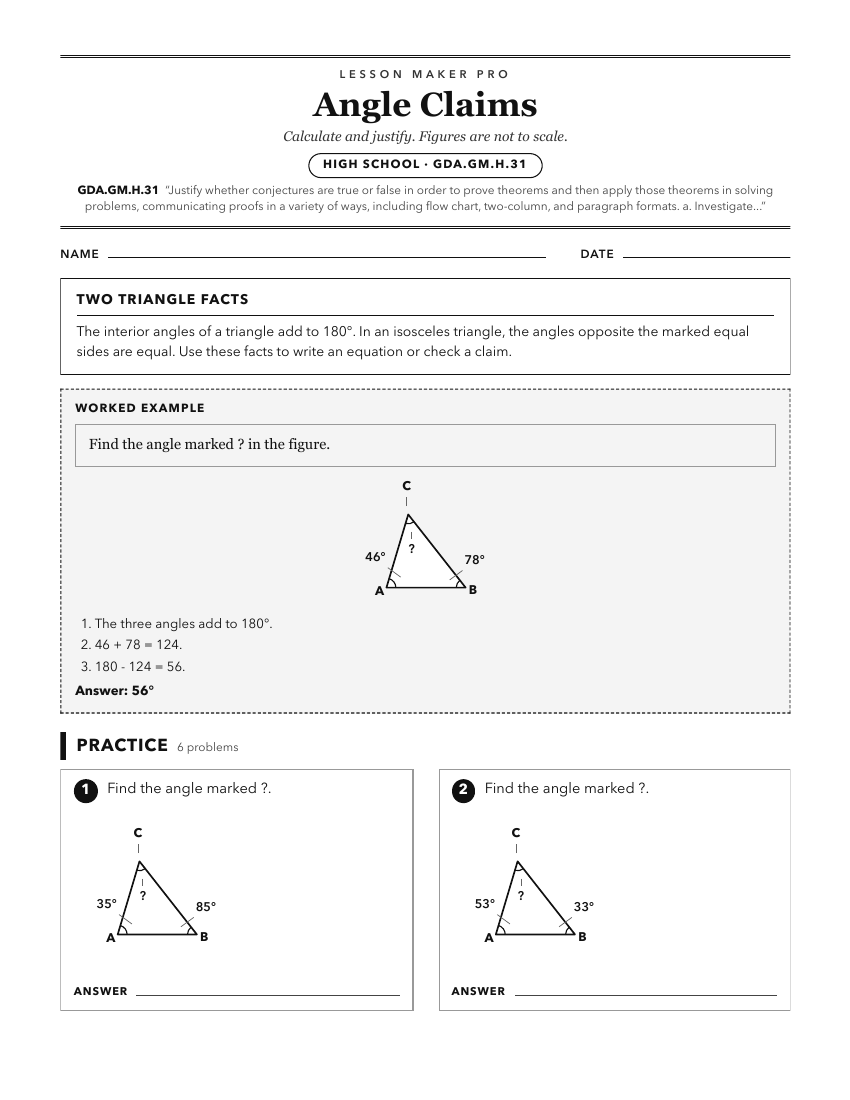
A ready-to-print activity worksheet aligned to GDA.GM.H.31, with an answer key for the teacher on its own page. No account needed.
PDF, US Letter, prints cleanly in black and white.
Download the worksheetKeep exploring
Related Standards
- GDA.GM.H
Proof is the means by which we demonstrate whether a statement is true or false mathematically, and proofs can be communicated in a variety of ways (e.g., two-c...
- GDA.GM.I
Proofs of theorems can sometimes be made with transformations, coordinates, or algebra; all approaches can be useful, and in some cases one may provide a more a...
- GDA.GM.G.29.a
Construct figures, using technology and other tools, in order to make and test conjectures about their properties.
- FM.LR.A.1
Represent logic statements in words, with symbols, and in truth tables, including conditional, biconditional, converse, inverse, contrapositive, and quantified ...
Turn this cluster into a lesson
Grade, subject, topic, and the complete cluster are prefilled. Create one free, no account needed.
Also for this cluster:Make a WorksheetMake a QuizMake a Sub Lesson