Alabama Math GDA.GM.H.31.c
The Standard
- GDA.GM.H
- Proof is the means by which we demonstrate whether a statement is true or false mathematically, and proofs can be communicated in a variety of ways (e.g., two-column, paragraph).
- GDA.GM.H.31
- Justify whether conjectures are true or false in order to prove theorems and then apply those theorems in solving problems, communicating proofs in a variety of ways, including flow chart, two-column, and paragraph formats.
Investigate, prove, and apply theorems about parallelograms and other quadrilaterals, including but not limited to both necessary and sufficient conditions for parallelograms and other quadrilaterals, as well as relationships among kinds of quadrilaterals.
2019 Alabama Course of Study: Mathematics · Proof is the means by which we demonstrate whether a statement is true or false mathematically, and proofs can be communicated in a variety of ways (e.g., two-column, paragraph).
Teacher's field guide
What This Standard Means
What Students Need to Do
- Students test which facts about sides, angles, and diagonals prove a quadrilateral is a parallelogram, rectangle, rhombus, or square. They prove claims, check whether the reverse claims hold, and use the results to find missing measures.
What Mastery Looks Like
- A student can prove a quadrilateral is a parallelogram when its diagonals bisect each other, then use that fact to find a missing length. They can explain why every square is both a rectangle and a rhombus, but not every rectangle is a square.
Common Misconceptions
- Students may think one pair of parallel sides is enough to prove a parallelogram. They may think congruent diagonals alone prove a rectangle, or that a square cannot be a rhombus.
How to Assess It
- Exit ticket: A(0,0), B(4,0), C(5,3), and D(1,3). Find both diagonal midpoints and explain why they prove ABCD is a parallelogram.
Lesson moves
Ways to Teach It
Cut out a rectangle, rhombus, and kite from grid paper; mark diagonal midpoints and sort by which diagonals bisect each other.
Ask: If a quadrilateral has congruent diagonals, must it be a rectangle? Draw a counterexample and explain what else is needed.
Give pairs of students property cards and quadrilateral cards; have them match each claim to a theorem or draw a counterexample.
Give students a labeled window-frame sketch with parallel opposite sides and equal diagonals; ask them to prove the frame is rectangular.
Free download
Printable GDA.GM.H.31.c Worksheet
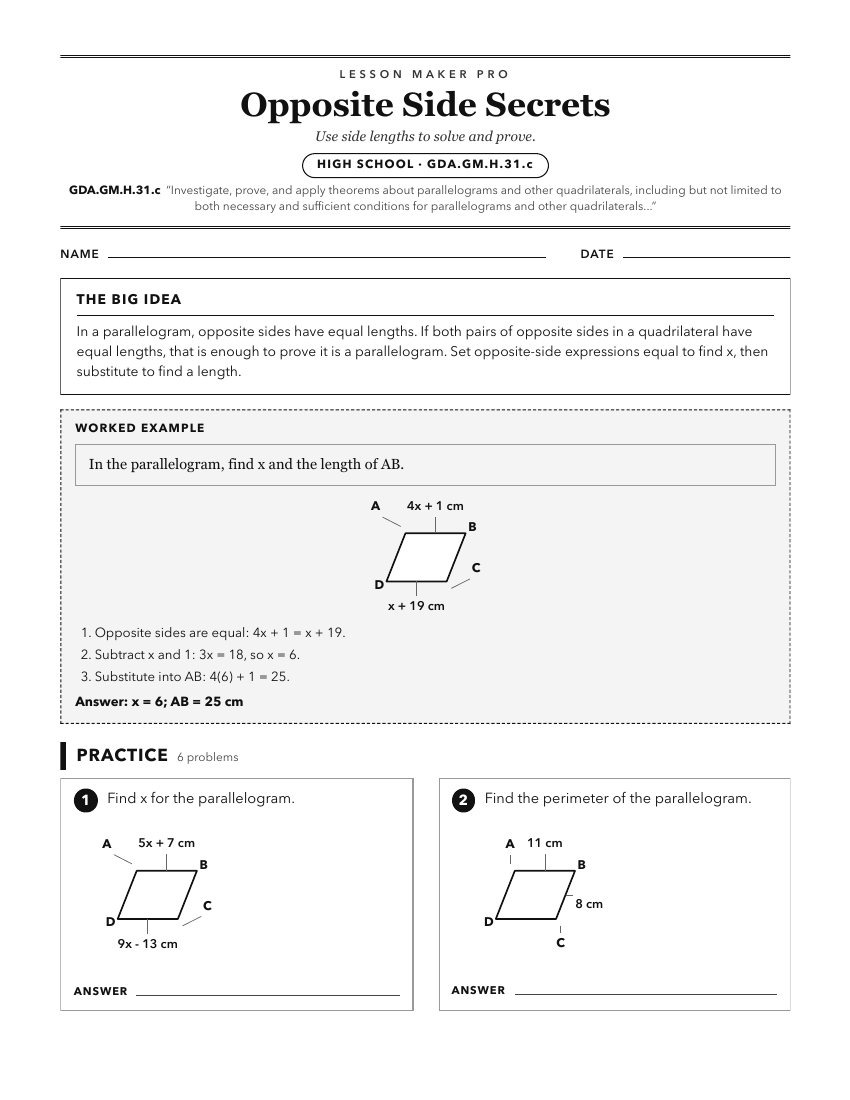
A ready-to-print activity worksheet aligned to GDA.GM.H.31.c, with an answer key for the teacher on its own page. No account needed.
PDF, US Letter, prints cleanly in black and white.
Download the worksheetKeep exploring
Related Standards
- GDA.GM.H.31.b
Investigate, prove, and apply theorems about triangles, including but not limited to: the sum of the measures of the interior angles of a triangle is 180˚; the ...
- GDA.GM.H.31.a
Investigate, prove, and apply theorems about lines and angles, including but not limited to: vertical angles are congruent; when a transversal crosses parallel ...
- 3.G.A.26.a
Draw examples of quadrilaterals that are and are not rhombuses, rectangles, and squares.
- 3.G.A.26
Recognize and describe polygons (up to 8 sides), triangles, and quadrilaterals (rhombuses, rectangles, and squares) based on the number of sides and the presenc...
Turn this exact standard into a lesson
Grade, subject, topic, and the complete standard are prefilled. Create one free, no account needed.
Also for this standard:Make a WorksheetMake a QuizMake a Sub Lesson